Azure PostgreSQL from commit to cloud: what platform teams should standardize now
Azure PostgreSQL from commit to cloud: what platform teams should standardize now


Stop giving every team its own PostgreSQL platform.
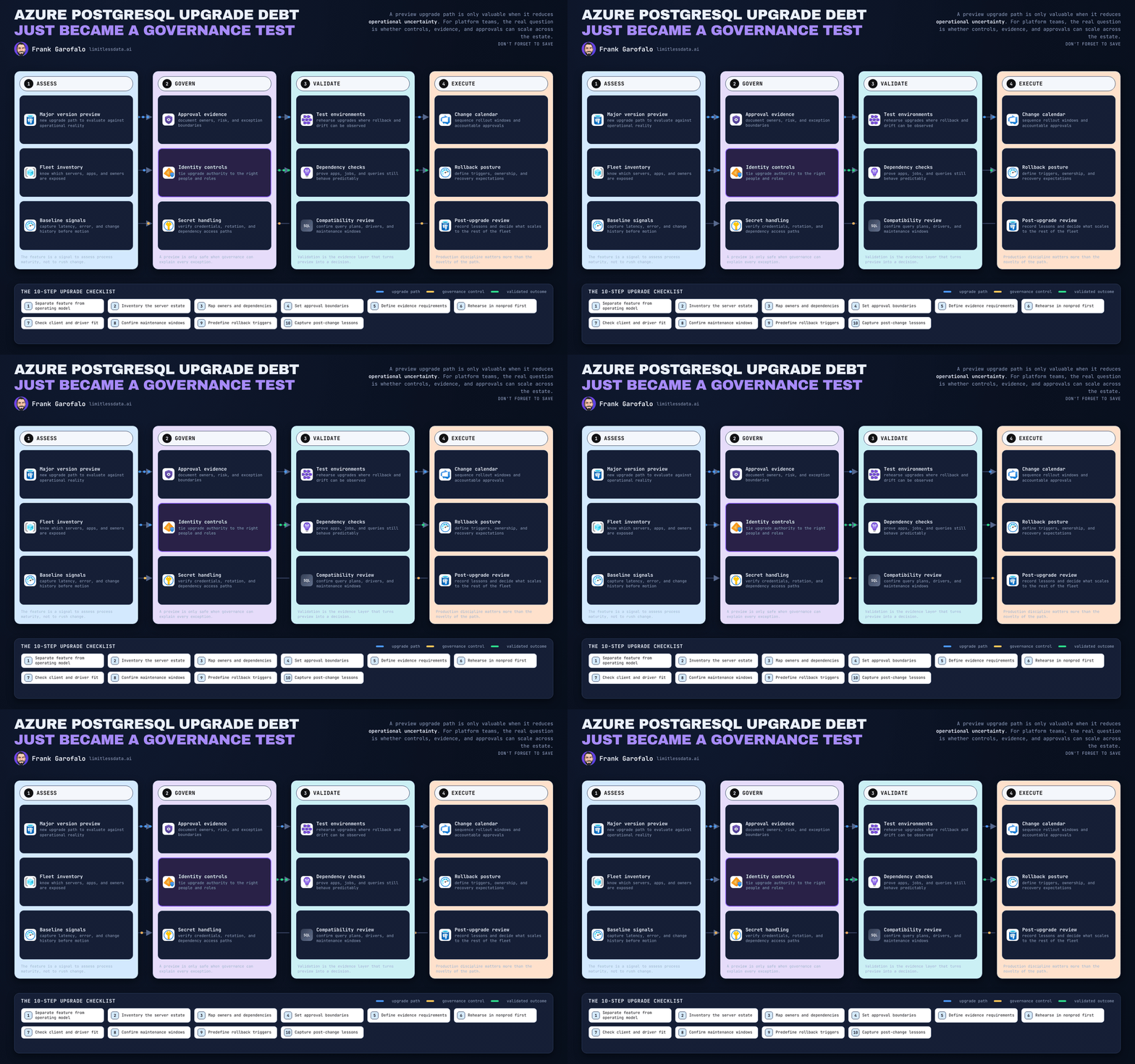
The Azure PostgreSQL decision most platform teams still avoid is not which feature to enable, but which choices to remove. In 2026, the teams that win will standardize the operating model around Azure Database for PostgreSQL now, before AI-era data gravity, governance pressure, and migration sprawl harden into expensive exceptions.
Here is the opinion plainly: platform teams should treat Azure Database for PostgreSQL as a platform product, not a menu of one-off deployments. If you let every app team choose its own topology, backup posture, network model, alerting stack, and exception process, you are not offering a platform. You are distributing database toil.
Microsoft’s own direction supports this. The Cloud Adoption Framework exists to help organizations establish governance and landing zone patterns before scale, not after the estate is already fragmented. Microsoft’s platform engineering guidance makes the same point from a developer-experience angle: reusable platform building blocks beat bespoke environments when you want secure, optimized delivery at scale.
There are legitimate exceptions. Some workloads really do need unusual extensions, sovereign constraints, portability mandates, or deeper engine control than a managed service comfortably provides. But those should be explicit exception classes with clear ownership, not the default posture for the whole estate.
The conventional wisdom is wrong: flexibility first is not maturity
A lot of teams still approach Azure Database for PostgreSQL as if the main task is feature comparison:
- Flexible Server versus self-managed
- public versus private access
- HA on or off
- backup retention per team
- monitoring choices per product line
- network topology negotiated case by case
That feels responsible. It usually is not. It pushes architecture and operational decisions down to application teams that do not want to own them and will not own them consistently.
The real risk is not choosing Azure Database for PostgreSQL. The real risk is allowing 40 teams to create 40 different interpretations of what “production-ready PostgreSQL on Azure” means.
In Q1 this year, I reviewed a 27-database estate where three teams had production PostgreSQL running with three different backup retention periods, two different connectivity models, and no shared failover test evidence for audit. Every one of those deployments had been called “standard.”
Managed PostgreSQL in Azure is valuable because it removes undifferentiated work: host maintenance, core service management, and much of the plumbing around availability and backups. If your platform model reintroduces that complexity through endless customization, you have paid for a managed service and rebuilt a bespoke one on top of it.
Standardize the landing zone before you standardize the database
If teams are still debating basic network topology per workload, they are not ready for self-service.
Start with 2-3 approved landing zone patterns for Azure Database for PostgreSQL and treat all other patterns as exceptions unless formally approved. That is not bureaucracy. That is the minimum viable platform.
At a minimum, each landing zone pattern should define:
- subscription placement
- resource group naming and ownership conventions
- private connectivity expectations
- DNS integration model
- identity and admin boundaries
- tagging requirements
- policy inheritance and enforcement points
- separation between shared platform services and app-owned database instances
A practical pattern I recommend is:
- Shared app pattern for lower-risk internal workloads with approved size bands and inherited monitoring.
- Dedicated business-critical pattern for production systems with explicit HA/DR commitments.
- Regulated pattern with stricter tagging, retention, and access controls.
That is enough for many enterprises. Not 19 patterns. Not “it depends” as the default answer.

A concise workflow is usually more useful than another architecture diagram:
- Developer commits code or IaC
- CI validates tags, SKU choices, backup, and network rules
- Platform automation provisions an approved PostgreSQL pattern
- Private DNS, diagnostics, and monitoring are attached by default
- Governance jobs review fleet compliance and report drift
The important move is not provisioning by itself. It is making policy checks, DNS integration, monitoring, and governance part of the same path instead of optional follow-up tasks.
Publish a small service catalog
The strongest platform teams publish a database service catalog, not a wiki full of options.
For Azure Database for PostgreSQL, I would standardize around a small set of approved patterns such as:
- Default transactional app database
- Business-critical HA database
- Operational store adjacent to analytics
- Regulated workload database
For each one, define:
- approved compute sizing bands
- storage expectations
- maintenance window defaults
- backup retention
- private networking model
- observability pack
- escalation path
- expected RPO/RTO tier
Do not expose every SKU and engine-adjacent choice just because the portal allows it. That is not flexibility; that is architecture work being pushed onto teams that should be shipping product.
This is where many organizations get seduced by self-managed PostgreSQL on VMs or Kubernetes. Yes, that path gives you more control. It also gives you more patching strategy, more failover design, more backup validation, more extension compatibility testing, and more runbooks. That can be justified for edge cases. It is a poor default for a mainstream enterprise portfolio.
Security baseline: private by default, policy enforced
Security guidance in a wiki is not a control. Policy is a control.
Your Azure PostgreSQL baseline should be clear and not open to ad hoc per-team negotiation:
- private network access by default
- least-privilege administrative model
- centralized secret handling
- encryption expectations aligned to enterprise policy
- mandatory tags for ownership, environment, cost center, and data classification
- continuous drift detection for network exposure, backup posture, and service tier
This aligns cleanly with Microsoft Defender for Cloud. Database posture cannot depend on annual review meetings and spreadsheet attestations; it needs continuous visibility and continuous governance.
Here is the kind of governance logic I want teams to codify. This is pseudocode, intentionally simplified for readability:
# Pseudocode: evaluate PostgreSQL flexible servers against a baseline.
for server in fleet:
    issues = []

    if server.public_network_access != "Disabled":
        issues.append("PublicNetworkNotDisabled")

    if server.backup_retention_days < 14:
        issues.append("BackupRetentionBelow14Days")

    if server.service_tier not in approved_tiers:
        issues.append("UnapprovedServiceTier")

    if missing_required_tags(server):
        issues.append("MissingMandatoryTags")

    report(server.name, issues)
What matters is the operating model: detect violations mechanically, route them into remediation, and make exceptions visible.

HA and DR should be defined by recovery objectives, not team preference
Every workload needs an explicit recovery contract. Not every workload needs the most expensive one.
Platform teams should publish a small service-tier matrix based on:
- RPO
- RTO
- zone resilience expectations
- backup and restore posture
- cross-region strategy
- failover testing cadence
- ownership of application-level recovery validation
The anti-pattern is letting every team invent its own availability story. One team chooses HA because “it feels safer.” Another skips it because “the app is stateless.” A third assumes backups equal DR. None of those are service definitions.
A better approach is to define named tiers, for example:
- Tier 1: zone-resilient production, explicit restore testing, tighter RTO
- Tier 2: standard production with documented restore expectations
- Tier 3: non-production with lower-cost defaults and lifecycle controls
Then encode environment-specific defaults so the provisioning path reflects policy, not personal preference.
Observability and cost control are part of the product
A managed database without standardized observability is just outsourced ambiguity.
Every PostgreSQL deployment should inherit a default telemetry package that covers:
- health and availability signals
- storage growth
- connection saturation
- query performance indicators
- backup status
- failover events
- logs and metrics routed to the right workspace
- standard dashboards and alert thresholds
- clear ownership for action
One of the most common anti-patterns I see is “logs enabled” with no agreed thresholds, no routing model, and no service owner who knows what to do when the alert fires.
The same goes for cost. Managed PostgreSQL cost discipline is mostly a governance problem, not a pricing problem.
Standardize:
- approved size classes
- environment-specific defaults
- chargeback tags
- auto-review thresholds
- non-production expiration or review rules
- guidance for when to scale up versus tune queries versus retire idle instances
Finance will eventually standardize this for you if you do not do it first, and their version will be slower and less context-aware.
The right self-service path is boring, fast, and opinionated
Developer self-service does not mean unrestricted parameter exposure. It means a path that is fast enough that nobody wants to bypass it.
A good Azure PostgreSQL self-service experience should let teams:
- request or provision from templates
- choose from approved service tiers
- inherit networking, tags, monitoring, and backup settings
- integrate with CI/CD automatically
- follow a documented exception path when the standard does not fit
It should not require manual ticket chains for routine provisioning. But it also should not let teams improvise production-grade databases with arbitrary settings.
Here is a simple provisioning pattern expressed as pseudocode rather than executable commands:
# Pseudocode: provision an approved PostgreSQL flexible server pattern.
param(
  [ValidateSet("dev","test","prod")] [string]$Environment,
  [ValidateSet("standard","businessCritical","regulated")] [string]$Pattern
)

$defaults = Get-PlatformPostgresDefaults -Environment $Environment -Pattern $Pattern

New-ApprovedPostgresFlexibleServer `
  -Name $defaults.ServerName `
  -Region $defaults.Region `
  -Sku $defaults.Sku `
  -Storage $defaults.Storage `
  -BackupRetentionDays $defaults.BackupRetentionDays `
  -PrivateAccessEnabled $true `
  -DiagnosticsEnabled $true `
  -Tags $defaults.Tags
What to observe: standard tags, approved sizing, private access, and diagnostics are part of the provisioning action, not a cleanup exercise.

This is the platform engineering mindset Microsoft is pushing: secure, optimized developer experiences built from reusable platform products rather than handcrafted environments.
Where self-managed PostgreSQL still makes sense, and what to do in the next 90 days
There are real exceptions. Self-managed PostgreSQL on VMs or Kubernetes can be justified when you need deep engine customization, niche extensions, unusual replication topologies, sovereign constraints, or portability mandates that materially outweigh managed-service benefits.
But treat those as exception classes with explicit cost and operational ownership. Do not let them become the default architecture because a few senior engineers prefer more knobs.
If I were running a platform team today, my next 90 days would be focused:
- Publish 2-3 approved landing zone patterns.
- Publish a small PostgreSQL service catalog with named tiers.
- Enforce private-by-default networking and mandatory tags with policy.
- Define HA/DR tiers using named RPO/RTO targets and test expectations.
- Roll out a default observability pack with standard dashboards and alerts.
- Add cost guardrails and non-production lifecycle controls.
- Launch self-service through templates and pipelines, with a documented exception path.
That is the work. Not another quarter of debating whether every team should get its own bespoke PostgreSQL architecture.
Standardization is not bureaucracy here. It is the scalable way to make Azure Database for PostgreSQL a platform capability instead of a collection of snowflakes.

Which of these would you standardize first: landing zones, HA/DR tiers, or private-by-default enforcement? And what was the first control you standardized in your environment—and what resistance did you face?
#AzurePostgreSQL #PlatformEngineering #CloudGovernance
Sources & References
- Cloud Adoption Framework for Microsoft
- Platform engineering guide
- What is Azure DevOps?
- Microsoft Defender for Cloud Overview
Try it yourself
Run this tutorial as a Jupyter notebook: Download runbook.ipynb (27 cells, 24 KB).