Azure AI Security Governance for Keys TLS and Logs
If your AI platform can’t prove its keys, logs, and TLS path, it isn’t enterprise-ready

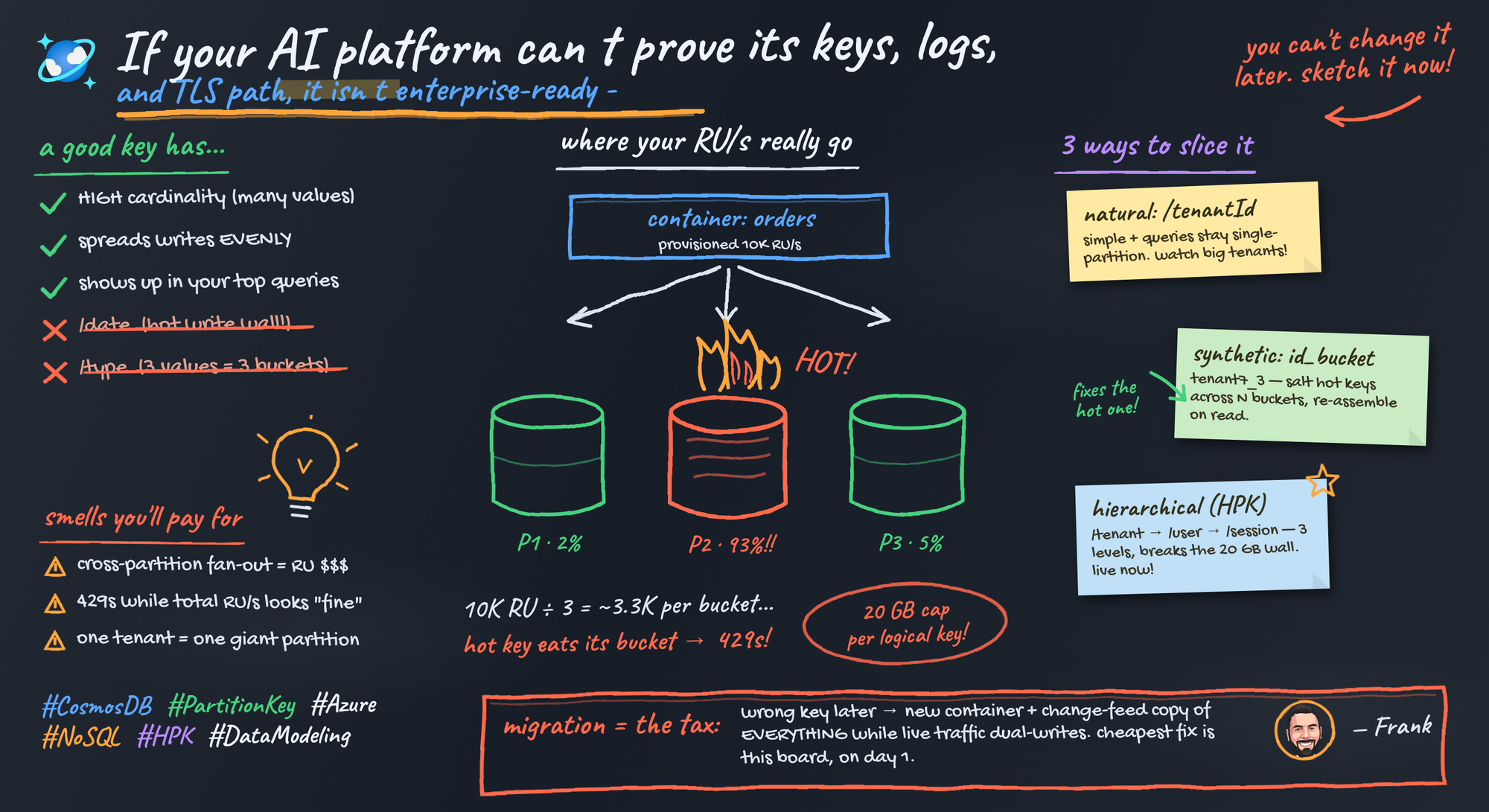
Keys, logs, and TLS beat a slick copilot demo every single time.
On this page
- The demo is not the control plane
- Why keys, TLS, and logs are one architecture decision
- Start with the path, not the promise
- Prove the TLS path with your own hands
- Prove key custody without leaking the key
- Logs are the evidence, not the leftovers
- Set an evidence standard for every AI platform
- The failures weak governance cannot explain
- Make proof the scale gate
- Sources & References
If your AI platform cannot prove who controls secrets, where encryption terminates, and which audit trail survives a hard review, it is not enterprise-ready. It is a workshop artifact with branding.
The demo is not the control plane
A useful agent, a polished dashboard, and a vendor security PDF make people feel comfortable fast. That comfort is dangerous.
Enterprise readiness is a proof problem. I want evidence for three things:
- who can use, rotate, recover, or authorize the keys
- where TLS starts and where it terminates
- what logs let me reconstruct a consequential AI action end to end
Everything else is secondary.
I’ve sat in too many steering committees where the governance conversation stops at model inventory, owner assignment, and a green checkbox next to “compliance reviewed.” That is governance theater. If nobody can draw the real request path from user to gateway to agent to tool to backend to model endpoint, and then show the key custody and audit evidence for that path, you have a gap.
Azure gives you useful building blocks. Azure API Management’s AI gateway is explicitly positioned to secure, scale, monitor, and govern AI models, agents, and tools for intelligent applications per the Azure API Management documentation. Good. Use it. But don’t confuse available features with proven control in your environment.
Why keys, TLS, and logs are one architecture decision
Teams love to split this into separate workstreams.
Security owns keys. Network owns TLS. Ops owns logs.
That org chart is exactly how you end up with an AI platform nobody can defend under scrutiny.
Key custody decides who can actually exercise power. The real questions are:
- which identities can retrieve the secret
- which services can use it without retrieval
- who can rotate it
- who can recover it
- who can override policy when production is on fire at 2:13 AM
TLS is the transport boundary. I want a precise answer to:
- where the encrypted session terminates
- which intermediary can inspect traffic
- what policy engine governs the onward call
- whether the next hop is re-encrypted
- which certificate chain and peer identity were observed
Logs are the evidence layer. They connect the principal, the policy decision, the backend call, the tool invocation, the result, and the operator action. Without that chain, incident response turns into archaeology.
Put those together and you get the only question that matters: can you reconstruct and defend a single AI transaction?
That is why I keep pushing platform teams toward the same discipline I wrote about in Microsoft Foundry Routines for Enterprise Agent Control: control points have to be operational, not aspirational.
Start with the path, not the promise
Before you argue about policy, draw the path.
This is the minimum architecture sketch I expect from any team asking for production approval:
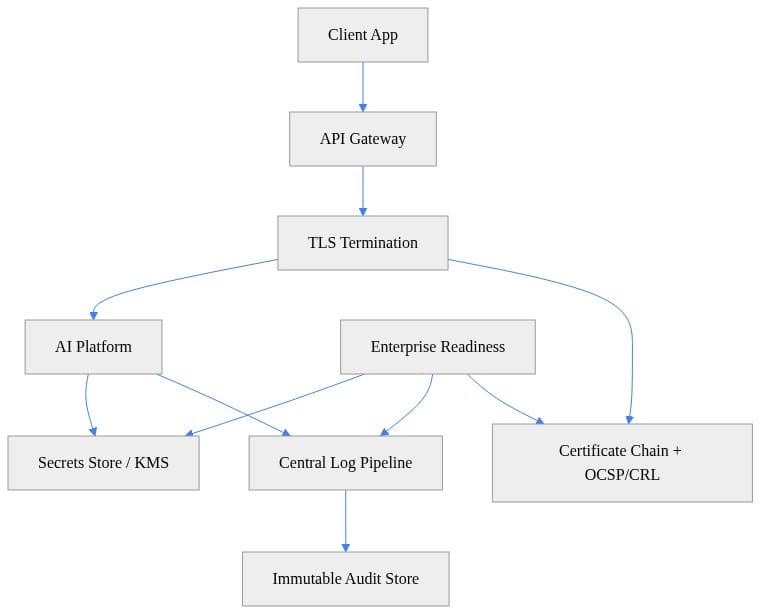
What you should observe: enterprise readiness hangs off three supporting systems in that diagram, not off the model box. Secrets or KMS, certificate validation, and immutable audit storage are the control plane. If your diagram only shows app → model → response, you are not done.
A fintech architecture review I ran in Q1 had 14 people in the room, a beautiful agent demo on the screen, and nobody could answer whether TLS terminated at the edge appliance, the API gateway, or the vendor endpoint after a managed connector hop.
That is not a minor documentation issue. That is a blind spot with legal, audit, and incident-response consequences.
Microsoft Entra Agent ID is useful here because it is designed to apply enterprise-grade access management, protection, and governance to AI agents using Zero Trust principles at scale per the Entra Agent ID docs. Again: useful building block. Still not proof. You have to wire the identities, approvals, reviews, and logs into your own operating model.
The same goes for Copilot Studio. Its governance surface covers data residency, DLP, standards certifications, compliance, environment routing, and regional considerations per the Copilot Studio security and governance docs. Those are real controls. They still do not absolve you from proving your actual path for keys, transport, and evidence.
Prove the TLS path with your own hands
I’m blunt on this one: if your team has never inspected the certificate chain and peer identity itself, you are operating on trust, not verification.
Here’s a simple Python example that checks the remote certificate details during a TLS handshake:
# Verify the server certificate chain and capture the TLS peer identity
import socket
import ssl
from pprint import pprint

host = "api.openai.com"
port = 443

ctx = ssl.create_default_context()
with socket.create_connection((host, port), timeout=5) as sock:
    with ctx.wrap_socket(sock, server_hostname=host) as tls:
        cert = tls.getpeercert()
        print("TLS version:", tls.version())
        print("Cipher:", tls.cipher())
        print("Peer subject:")
        pprint(cert.get("subject"))
        print("Issuer:")
        pprint(cert.get("issuer"))
        print("SANs:")
        pprint(cert.get("subjectAltName"))
What you should observe: TLS version, cipher suite, peer subject, issuer, and SANs. Save that output as part of your control evidence packet. Don’t log it once and forget it; run it as part of environment validation and after any network-path change.
If your team lives in PowerShell, same idea:
# Inspect the remote TLS certificate and print thumbprint, subject, and issuer
$hostName = "api.openai.com"
$port = 443

$tcp = [System.Net.Sockets.TcpClient]::new($hostName, $port)
try {
    $ssl = [System.Net.Security.SslStream]::new($tcp.GetStream(), $false, ({ $true }))
    $ssl.AuthenticateAsClient($hostName)
    $cert = [System.Security.Cryptography.X509Certificates.X509Certificate2]::new($ssl.RemoteCertificate)
    [pscustomobject]@{
        Subject    = $cert.Subject
        Issuer     = $cert.Issuer
        Thumbprint = $cert.Thumbprint
        NotAfter   = $cert.NotAfter
    } | Format-List
}
finally {
    $tcp.Dispose()
}
What you should observe: subject, issuer, thumbprint, and expiration. Now you can answer a basic but critical question: what certificate did we actually see from this endpoint at validation time?
This does not magically prove every intermediary in a complex enterprise route. It does force the team to stop hand-waving. If there is a proxy, gateway, WAF, service mesh, private endpoint, or connector in the middle, document each hop and validate each termination point. Draw the chain. Test the chain. Store the evidence.
I covered a related pattern in Azure azd Standard for Agent Delivery Platform Teams because deployment standardization is the only way this stays repeatable across environments.
Prove key custody without leaking the key
The fastest way to fail an audit conversation is to say, “the app has the key somewhere.” That sentence should embarrass everybody in the room.
You need to prove presence and control without exposing secret material. A safe pattern is to emit a short fingerprint derived from the key and log only that fingerprint.
Here is a small Python example:
# Load an API key from environment and prove only a safe fingerprint in logs
import hashlib
import logging
import os

logging.basicConfig(level=logging.INFO, format="%(message)s")

api_key = os.environ.get("OPENAI_API_KEY", "")
if not api_key:
    raise SystemExit("OPENAI_API_KEY is not set")

fingerprint = hashlib.sha256(api_key.encode()).hexdigest()[:12]
logging.info("api_key_present=true api_key_fingerprint=%s", fingerprint)
logging.info("api_key_length=%d source=environment", len(api_key))
What you should observe: the application confirms the key is present and emits a short fingerprint, not the secret itself. That gives you a way to correlate which credential version was in use during a request window without dumping sensitive material into logs.
If your operational world is PowerShell and SecretManagement, same pattern:
# Read a secret from SecretManagement and emit a non-sensitive fingerprint for audit
$secretName = "OpenAI-ApiKey"
$plain = Get-Secret -Name $secretName -AsPlainText

if ([string]::IsNullOrWhiteSpace($plain)) {
    throw "Secret '$secretName' was not found."
}

$bytes = [System.Text.Encoding]::UTF8.GetBytes($plain)
$hash = [System.Security.Cryptography.SHA256]::HashData($bytes)
$fingerprint = ([BitConverter]::ToString($hash)).Replace("-", "").Substring(0, 12)

[pscustomobject]@{
    SecretName  = $secretName
    Present     = $true
    Fingerprint = $fingerprint
    Source      = "SecretManagement"
} | ConvertTo-Json
What you should observe: secret name, source, and a non-sensitive fingerprint. Use this in validation runbooks and break-glass procedures. The goal is simple: prove which secret path was exercised and by which runtime identity.
This is where weak governance usually collapses. Teams can tell me where the key was created. They cannot tell me all identities that could use it, whether a human operator could retrieve it directly, or whether an old automation account still had access after a project handoff.
That is why I care so much about nonhuman identity governance. Microsoft 365 Copilot APIs are documented as enabling secure access to Copilot capabilities in applications and custom engine agents while aligning with Microsoft 365 compliance standards per the Microsoft 365 Copilot APIs overview. Great. But if your service principals, managed identities, agent identities, and connector credentials are not reviewed with the same rigor as privileged human access, you are building future incidents.
Logs are the evidence, not the leftovers
A lot of AI logging is still junk.
Teams log prompts, token counts, and latency. Fine. Useful for tuning. Not enough for governance.
I want structured audit events that let me tie together:
- the calling principal
- the correlation ID
- the key fingerprint or credential reference
- the TLS peer or gateway identity
- the policy decision
- the target tool or backend
- the outcome and timestamp
Here is a minimal example of the shape:
# Emit structured audit logs with correlation IDs and redaction-safe fields
import json
import logging
import uuid
from datetime import datetime, timezone

logging.basicConfig(level=logging.INFO, format="%(message)s")

event = {
    "ts": datetime.now(timezone.utc).isoformat(),
    "event": "ai_request_authorized",
    "correlation_id": str(uuid.uuid4()),
    "principal": "svc-ai-gateway",
    "key_fingerprint": "a1b2c3d4e5f6",
    "tls_peer": "CN=api.openai.com",
    "prompt_sha256": "redacted-or-hashed-only",
}
logging.info(json.dumps(event, separators=(",", ":")))
What you should observe: no raw secret, no raw prompt, but enough metadata to reconstruct the event safely. This is the kind of log that helps during a regulator review, a customer security questionnaire, or a 3 AM Sev A.
For tamper evidence, hash the serialized payload and store the record hash with the event:
# Write a tamper-evident audit record by hashing the serialized event payload
$event = [ordered]@{
    ts             = [DateTimeOffset]::UtcNow.ToString("o")
    event          = "tls_verified"
    correlation_id = [guid]::NewGuid().ToString()
    principal      = "svc-ai-gateway"
    tls_version    = "TLS1.2+"
    cert_thumbprint= "ABCD1234EF567890"
}

$json = $event | ConvertTo-Json -Compress
$bytes = [System.Text.Encoding]::UTF8.GetBytes($json)
$hash = [System.Security.Cryptography.SHA256]::HashData($bytes)
$event["record_hash"] = ([BitConverter]::ToString($hash)).Replace("-", "")

$event | ConvertTo-Json -Compress
What you should observe: a deterministic record hash attached to the event. That does not replace a proper immutable logging pipeline, but it is a clean way to make event integrity visible and testable.
If your gateway logs, identity logs, agent logs, and backend access logs cannot be correlated, you do not have an audit trail. You have four partial stories and a meeting invite.
This matters even more as teams adopt MCP patterns. Microsoft’s MCP Server for Enterprise is documented as a programmatic interface that lets AI agents query enterprise data in a Microsoft Entra tenant using natural language and Model Context Protocol per the MCP Server for Enterprise overview. Useful capability. Also an expansion of your evidence problem. More tools and data paths mean more identities, more transport boundaries, and more events that must be correlated.
Set an evidence standard for every AI platform
Here is the standard I push with leadership teams.
For every production AI pattern, require a control-evidence packet that includes:
- Key ownership
Who owns the secret or key, who can use it, who can rotate it, who can recover it, and what the break-glass path looks like.
- Authorized access paths
Which identities call which services, using what auth method, through which gateway or connector.
- Transport map
Where TLS terminates, where traffic can be inspected, where it is re-encrypted, and which certificates are expected at each boundary.
- Logging sources
Which systems emit the authoritative events for identity, policy, gateway, tool use, backend access, and operator intervention.
- Retention and integrity
How long logs are retained, where immutable copies live, and how tampering is detected.
- Named operators
Which team owns runtime operations, incident response, and exception approval.
That packet should be a scale gate. No broad rollout without it.
This is especially important in Power Platform and Copilot-heavy estates, where speed of assembly can outrun speed of governance. Microsoft’s Power Platform documentation rightly positions governance alongside building and managing agents, apps, automations, analytics, and websites in the broader Power Platform docs. Good. Then use that governance muscle where it counts: prove the path, not just the configuration screen.
The failures weak governance cannot explain
When the controls are weak, the failure modes get ugly fast:
- Security cannot identify the TLS termination point for an AI request after a connector or proxy change.
- The platform team cannot produce a defensible list of identities that could use a sensitive credential.
- Agent, gateway, identity, and data-access logs cannot be connected into a coherent sequence.
- A board, regulator, customer, or internal audit asks for evidence and gets a vendor whitepaper instead.
That last one is where the room gets quiet.
Vendor assurances are useful context. They are not your evidence.
Make proof the scale gate
My position is simple: no serious AI rollout should proceed until the organization can produce control evidence on demand for keys, transport, and auditability.
If the platform touches sensitive enterprise data, triggers actions in line-of-business systems, or operates with nonhuman identities at scale, evidence quality matters more than feature velocity. Every single time.
A polished copilot demo can win a workshop. It cannot survive an incident review.
Rate your team from 1 to 5 on this specific test: could you prove key custody, TLS termination, and end-to-end auditability for one production AI transaction by tomorrow morning?
#EnterpriseAI #AzureAI #DataArchitecture
Sources & References
- Official Microsoft Power Platform documentation - Power Platform
- AI gateway capabilities in Azure API Management
- Security and governance - Microsoft Copilot Studio
- Microsoft 365 Copilot APIs Overview
- Microsoft Entra Agent ID documentation
- Overview of Microsoft MCP Server for Enterprise - Microsoft Graph
Try it yourself
Run this tutorial as a Jupyter notebook: Download runbook.ipynb (21 cells, 16 KB).