Microsoft Fabric November 2026 Strategy for Data Leaders
Fabric November 2026 Feature Summary: The Capabilities Data Leaders Should Actually Care About

“Should I care about the latest Fabric updates, or just wait for the next Copilot demo?”
On this page
- The real signal is governance, not feature volume
- Fund the data-context control plane first
- Interoperability is the platform test
- Operational readiness matters more than another AI demo
- Agents are a governed access channel, not a governance substitute
- Where I’d put money first
- Sources & References
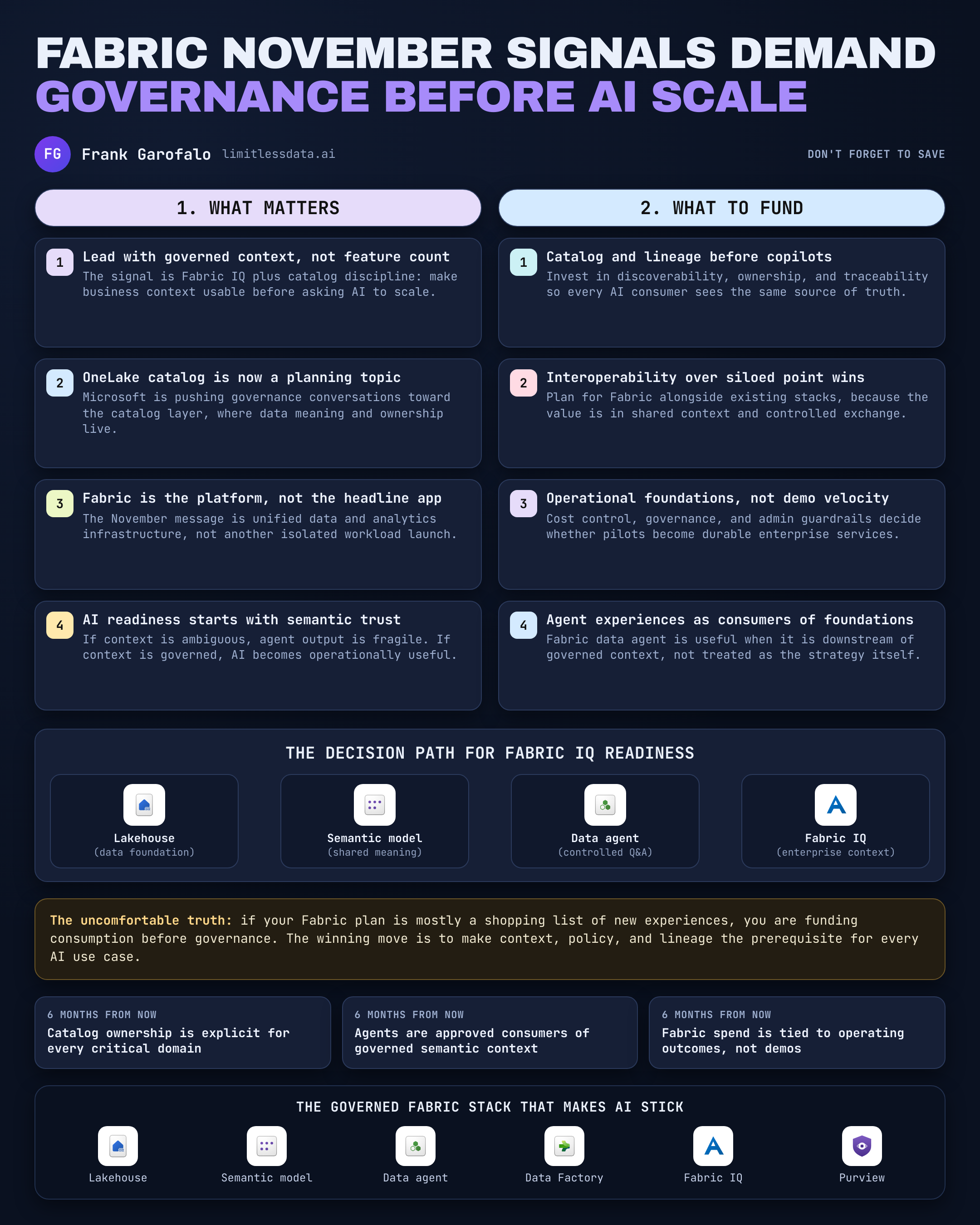
Care about them for one reason: the strongest signal is not flashy AI. It’s that governed business context is still the gate in front of enterprise AI.
The real signal is governance, not feature volume
A lot of leaders read Fabric news like a shopping catalog. Wrong lens.
The more useful read is this: Microsoft continues to position Fabric as a unified analytics platform, while adjacent documentation around Fabric IQ, runtime defaults, and agent experiences reinforces the same operational truth—ownership, discoverability, context, and control matter before broad AI rollout.
Fabric itself is still the broad unified analytics play Microsoft describes as a platform for an organization’s data and analytics needs per the Fabric overview. Fine. Unified surfaces help.
But a unified surface does not create shared definitions. It does not assign owners. It does not settle policy. It does not magically make “gross margin” mean the same thing in finance, sales, and operations.
In one client workshop I participated in, a retail analytics team watched an executive demo agent answer the same KPI question three different ways because the semantic path still included two trusted datasets and one analyst sandbox nobody had retired. The model did exactly what the platform allowed. Governance failed first.
So my read is simple:
- fund the foundations now
- prove interoperability on purpose
- treat AI access as a controlled rollout behind those foundations
That is the strategy. The feature list is just the packaging.
Fund the data-context control plane first
If you are a CDO, CIO, or head of data, your first budget question should be boring on purpose:
Who owns the business context your AI is allowed to use?
That is why I’d treat catalog, ownership, certification, discoverability, stewardship, and semantic approval as control-plane investments, not admin details.
This also lines up with how Microsoft describes Fabric IQ. Microsoft’s documentation presents Fabric IQ as part of Microsoft Fabric and describes it as bringing AI-powered experiences to data and analytics workflows per the Fabric IQ overview. That is a useful direction of travel, but it does not remove the need for disciplined business context underneath it.
Here’s the blunt version: if your semantic layer is sloppy, your AI layer is ungovernable.
I’ve written before about Microsoft Fabric Governance Strategy for Enterprise Scale because this is where most teams still get cute. They want ten AI use cases before they have five approved business definitions. That is upside-down.
What to do this quarter
Pick 3 to 5 high-value domains. Not 30.
For each one, require:
- a named business owner
- a named technical owner
- a short approved glossary
- a narrow set of trusted semantic assets
- access rules that survive audit
- acceptance criteria before any agent can use the domain
If you want a lightweight way to force discipline, start with a tiny KPI registry.
# Lightweight KPI registry to keep agent answers bounded to approved definitions
approved_kpis = {
    "net_revenue": {
        "definition": "Gross sales minus returns and discounts.",
        "owner": "Finance",
        "certified_source": "SalesLakehouse"
    },
    "active_customer": {
        "definition": "Customer with at least one completed order in the last 90 days.",
        "owner": "Growth",
        "certified_source": "CustomerMart"
    }
}

for kpi, meta in approved_kpis.items():
    print(f"{kpi}: {meta['definition']} [{meta['certified_source']}]")
The point is not the Python. The point is the operating model. Every KPI has a definition, owner, and certified source.
And once that foundation exists, the next question becomes obvious: can your broader platform patterns preserve that discipline across systems?
Interoperability is the platform test
The second thing data leaders should care about is whether Fabric behaves like a real enterprise platform instead of a closed destination.
That is why I pay attention when Microsoft documentation across Fabric and adjacent Azure services keeps pointing toward cross-service analytics patterns. Even without over-reading any single page, the direction is clear: the enterprise estate is not one engine, one store, one team, or one pattern. It is operational systems plus analytical platforms plus governed copies plus semantic control.
This is where weak platform programs fall apart. They celebrate the integration and skip the operating questions:
- Who owns the source truth?
- What are the replication or refresh expectations?
- Which permissions carry over, and which do not?
- Who is on the hook when the analytics copy is stale?
- What is the escalation path when a mirrored or replicated dataset drives the wrong decision?
Those are not architecture trivia questions. Those are production questions.
My recommendation is simple: fund a small number of high-value interoperability patterns first.
For example:
- operational data flowing into Fabric for analytics
- one finance domain with certified semantic access
- one customer domain with explicit retention and access controls
Do not let every team invent its own path into Fabric. Standardize the pattern, name the owner, define the service expectation, and make workspace and semantic registration mandatory.
If you’re working through medallion and warehouse discipline in Fabric, my post on Microsoft Fabric Medallion Governance for Warehouses is the same argument from a different angle: interoperability only helps if accountability survives the handoff.
And once data can move across the platform, the next leadership test is whether your operating model can keep up with the platform defaults.
Operational readiness matters more than another AI demo
Fabric Runtime 2.0 is documented as the default runtime for Spark in Fabric data engineering and data science workloads per the Runtime 2.0 docs. That is an operational signal, not just a release note.
When a runtime becomes the default, your review should immediately move to:
- dependency management
- package compatibility
- workload regression testing
- support ownership
- migration sequencing
- rollback planning
- environment standards
That’s the grown-up work.
Microsoft also continues to frame the Fabric lakehouse as an end-to-end analytics scenario spanning data movement, data science, real-time analytics, and BI per the Fabric lakehouse tutorial. Great. But “all-in-one” only pays off if your engineering guardrails are repeatable.
A practical Fabric ops check
Before you expand Fabric workloads team by team, inventory approved workspaces and make ownership visible. Then review which semantic models in those workspaces are actually approved for executive-facing use.
A simple review checklist works:
- approved Fabric workspace
- named workspace owner
- named semantic model owner
- certified KPI definitions
- documented refresh expectation
- support path when results conflict
If a workspace is in production and ownership is blank, that is not a documentation problem. That is a governance defect.
If a semantic model is feeding executive reporting and nobody can tell you who approved the KPI definitions, same problem.
That operational discipline is what makes the next step possible, because agents are not a shortcut around governance. They are a faster way to expose whether governance exists.
Agents are a governed access channel, not a governance substitute
Now the part everyone wants to jump to.
Microsoft’s Fabric data agent documentation describes a conversational experience for interacting with data using generative AI per the Fabric data agent docs. Useful capability. Real capability.
Separately, the Copilot Studio “What’s new” page should be read carefully and literally. If you are evaluating connections involving Fabric IQ or related agent capabilities, treat the status exactly as Microsoft labels it on that page and avoid assuming broader production maturity than the source states per the Copilot Studio what's new page.
This is the maturity split leaders need to internalize:
- conversational data access can be valuable now
- broader intelligence-layer connectivity should be evaluated according to its documented status
- neither one replaces ownership, semantic approval, or access control
I’ve gone deep on this in Fabric Data Agent Query Governance and Control because the mistake is always the same: teams assume the conversational layer somehow cleans up the data layer. It does the opposite. It amplifies whatever discipline or chaos already exists.
How I would roll out a bounded pilot
Start with one audience, one domain, one approved glossary, one reviewed question set.
Use a simple evaluation flow that forces human review before expansion.
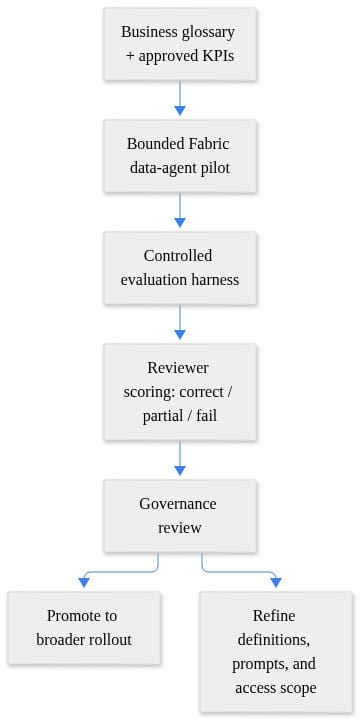
Then create a small evaluation harness. Two approved questions is enough to prove whether your definitions and sources are actually stable.
# Controlled evaluation harness for a bounded Fabric data-agent pilot
from dataclasses import dataclass, asdict
import json

@dataclass
class EvalCase:
    question: str
    expected_definition: str
    approved_sources: list[str]
    reviewer_outcome: str = "pending"

cases = [
    EvalCase("What counts as net revenue?", "Gross sales minus returns and discounts.", ["SalesLakehouse", "FinanceGlossary"]),
    EvalCase("How is active customer defined?", "A customer with at least one completed order in the last 90 days.", ["CustomerMart", "BusinessGlossary"]),
]

with open("fabric_agent_eval_cases.jsonl", "w", encoding="utf-8") as f:
    for case in cases:
        f.write(json.dumps(asdict(case)) + "\n")

print(f"Saved {len(cases)} approved evaluation cases.")
What matters is not whether the answer sounds plausible. It is whether the answer matches sanctioned business wording and approved source scope closely enough to survive finance, compliance, and executive use.
Where I’d put money first
If I were setting the next two quarters of Fabric spend, I would split it like this.
Fund now
- catalog, ownership, and stewardship operating practices
- governed semantic assets for the highest-value domains
- 2 or 3 cross-platform data patterns with named owners
- production standards around the default runtime
- workspace approval and ownership validation
Fund selectively
- Fabric data-agent use cases with tightly bounded data scope
- pilots with approved question sets, named reviewers, and hard promotion criteria
- business domains where the glossary already exists and people actually trust it
Watch carefully
- newly introduced or preview-labeled agent integrations
- broader intelligence-layer positioning that still needs operating clarity
- any rollout where semantic ownership is still fuzzy or supportability is hand-waved
This is the core opinion: the strongest Fabric signals point to a platform-governance decision, not just an AI-interface decision.
If you fund catalog discipline, semantic context, runtime standards, and interoperability patterns, Fabric gets strategically stronger. If you skip those and race to agents, Fabric will expose every unresolved ownership and definition problem you already have.
Rate your organization from 1 to 5 on this question:
Could your top 10 KPIs survive a Fabric data-agent rollout without conflicting definitions showing up in front of executives?
Comment with your score and the KPI that would break first.
#MicrosoftFabric #Datagovernance #EnterpriseAI
Sources & References
- Microsoft Fabric documentation - Microsoft Fabric
- What is Fabric IQ? - Microsoft Fabric
- What's new in Copilot Studio - Microsoft Copilot Studio
- Fabric data agent creation - Microsoft Fabric
- Runtime 2.0 in Fabric - Microsoft Fabric
- Get started with Microsoft Fabric - Training
- Lakehouse end-to-end scenario: overview and architecture - Microsoft Fabric
Try it yourself
Run this tutorial as a Jupyter notebook: Download runbook.ipynb (28 cells, 23 KB).