Azure API Management AI Gateway for Enterprise Governance
How Azure API Management’s AI Gateway Could Become the Control Point for Enterprise AI


Enterprise AI is going to fragment before governance catches up.
On this page
- The real platform decision is where AI requests get controlled
- Microservices already taught us this lesson
- Here’s the simplest pattern I’d start with
- Don’t confuse a promising choke point with finished governance
- The strategic move is to establish the control point early
- Sources & References
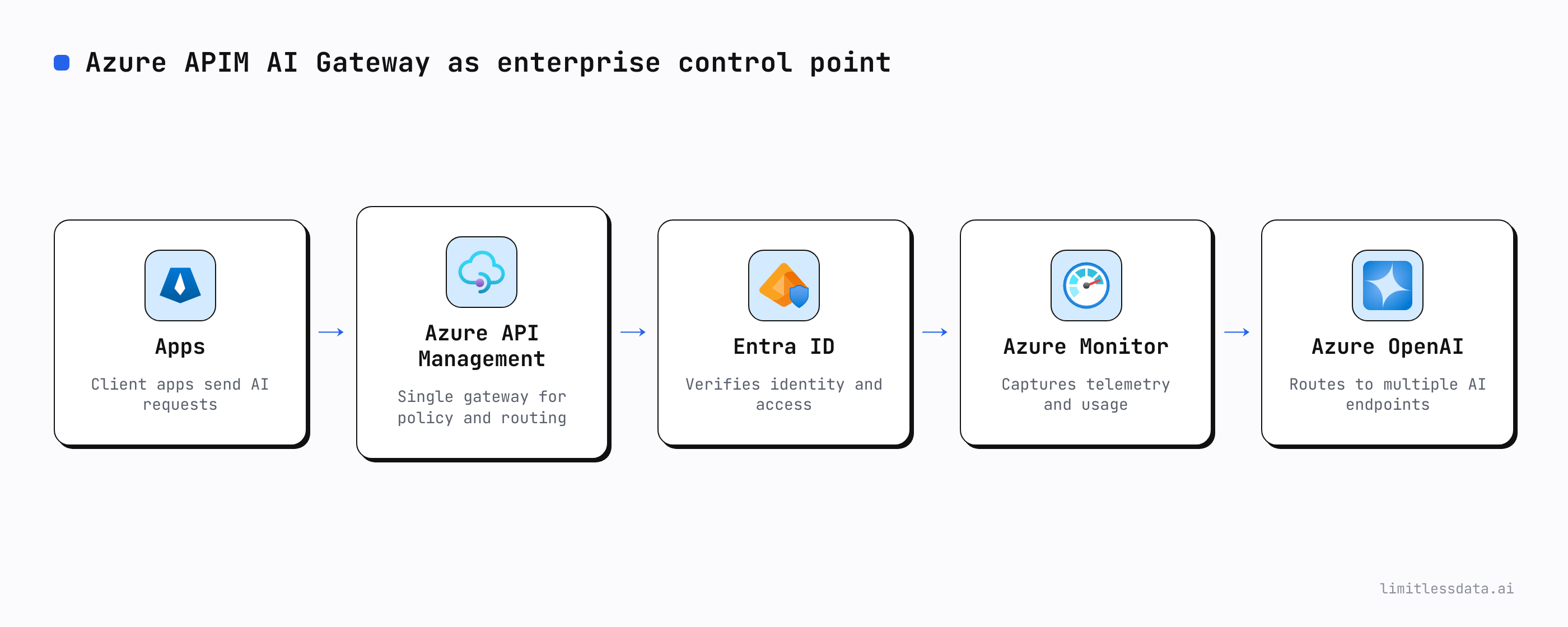
That’s why I think Azure API Management’s AI Gateway matters less as an “AI feature” and more as a control point. If serious AI traffic is forced through one accountable path, platform teams have a real chance to govern routing, identity, telemetry, and token burn before the estate turns into dozens of direct model integrations nobody owns.
The real platform decision is where AI requests get controlled
Teams love debating model choice. That’s the wrong first argument.
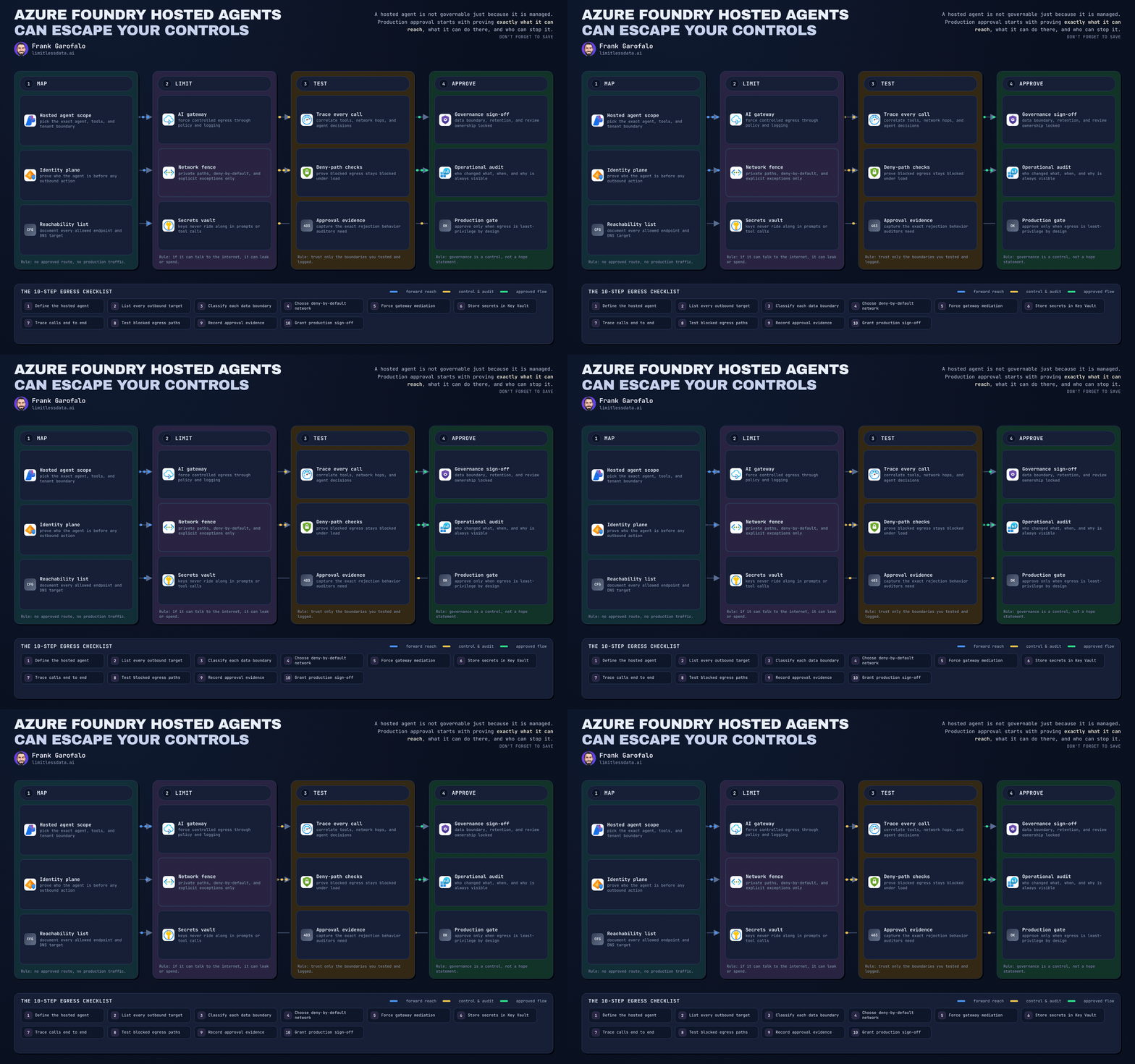
The enterprise mess shows up somewhere else: one app calls a model with its own secret, another logs prompts somewhere different, a third hardcodes provider routing in code, finance gets multiple invoices, security gets no unified view, and nobody can answer which workloads are consuming tokens. Microsoft positions Azure API Management’s AI gateway to manage AI endpoints, including language model APIs that follow a supported API format, and that matters because it creates a candidate choke point in front of the sprawl per the AI gateway capabilities docs.
In Q1, I worked with a 14-team platform group that found 11 separate AI keys spread across app settings, pipelines, and notebooks before they had even agreed on one production logging standard.
Microservices already taught us this lesson
We solved a version of this years ago.
When microservices spread, API gateways became the practical answer for cross-cutting concerns. Not because everything should be centralized, but because auth, traffic control, and observability had to be consistent somewhere. Azure API Management itself is built around that split: gateway, management plane, and developer portal, each serving a different part of the operating model per the APIM key concepts docs.
AI traffic has the same shape, plus one extra headache: consumption. Tokens turn every prompt into an operational and financial event.
That’s why platform teams should care now:
- Routing should not live buried in app repos and agent frameworks
- Policy enforcement should sit at a consistent boundary
- Observability should be on by default, not added after the first incident
- Cost governance should be tied to the same traffic path, because token usage gets ugly fast when every team connects directly
Product teams should still own prompts, UX, and outcomes. Platform teams should own the path.

Here’s the simplest pattern I’d start with
Do not overbuild this on day one. Put APIM in front of approved AI endpoints, make applications call the gateway URL, and standardize auth plus basic throttling first.
This tiny example shows the shape. The app calls APIM, not the model endpoint directly.
# Python: call APIM AI Gateway instead of the model endpoint directly
import os
import requests

gateway_url = "https://contoso-apim.azure-api.net/ai/chat/completions"
headers = {
    "Authorization": f"Bearer {os.environ['APIM_TOKEN']}",
    "Content-Type": "application/json",
}

payload = {
    "model": "gpt-4o-mini",
    "messages": [{"role": "user", "content": "Summarize this incident in 3 bullets."}],
}

response = requests.post(gateway_url, headers=headers, json=payload, timeout=30)
print(response.status_code, response.json())
Once traffic goes through the gateway, you can change backend routing, apply policy, and instrument usage without touching every application.
From there, define a clean split of responsibilities:
- Platform team owns approved endpoints, access standards, quotas, and logging expectations
- Product teams own prompts, application behavior, and business outcomes
- Security and FinOps plug into the same traffic path instead of running a parallel AI governance program

Don’t confuse a promising choke point with finished governance
A gateway helps. It does not solve privacy, compliance, prompt safety, or provider lock-in.
You still need explicit decisions on approved providers, exception handling, logging retention, quota ownership, and escalation paths when a workload misbehaves. The Cloud Adoption Framework already treats AI adoption and AI agent governance as broader disciplines, which is the right framing per the Cloud Adoption Framework.
My blunt take: if new production AI workloads are allowed to bypass a governed path by default, you’re not building a platform. You’re sponsoring future cleanup.
The strategic move is to establish the control point early
I would evaluate Azure API Management’s AI Gateway on four outcomes only:
- Can it centralize routing?
- Can it enforce access policy cleanly?
- Can it give me usable interaction telemetry?
- Can it make token consumption governable?
If the answer is yes, get the choke point in place before direct integrations spread. Retrofitting governance after 30 teams have wired themselves to providers is a miserable project.
Where does my argument break in your environment: routing, policy, observability, or token governance?
#AzureAI #EnterpriseAI #DataArchitecture
Sources & References
- AI gateway capabilities in Azure API Management
- Azure API Management - Overview and Key Concepts
- Cloud Adoption Framework for Microsoft - Cloud Adoption Framework
Try it yourself
Run this tutorial as a Jupyter notebook: Download runbook.ipynb (18 cells, 14 KB).