Azure Functions Skills for Enterprise Agent Architectures
Azure Functions Skills Is More Important Than It Looks: It Turns Serverless Into an Agent Execution Surface


42 lines of Python can define the line your agent must not cross.
On this page
- Why skills change the serverless conversation
- A simple pattern to start with
- Architecture choices matter
- The enterprise value is control, not novelty
Azure Functions Skills matters because it signals something bigger than “agents can call code now.” It turns serverless into a plausible enterprise action boundary for AI systems.
Models handle reasoning. Enterprise systems handle money, approvals, customer state, inventory, and side effects. You do not want an agent wired directly into every backend with a giant bag of raw tools. You want a narrow surface that can be discovered, invoked, monitored, and constrained.
I saw the failure mode firsthand: a support agent looked powerful until one bad parameter update opened the wrong customer case queue for 11,000 records. The problem was not model quality. The problem was action design.
Why skills change the serverless conversation
Skills give agents a cleaner consumption layer than dumping backend metadata into the context window.
What matters most is progressive disclosure: the agent sees a lightweight description first, then more detail only when needed. In a large enterprise catalog, that is exactly how you improve discoverability without blowing up context discipline.
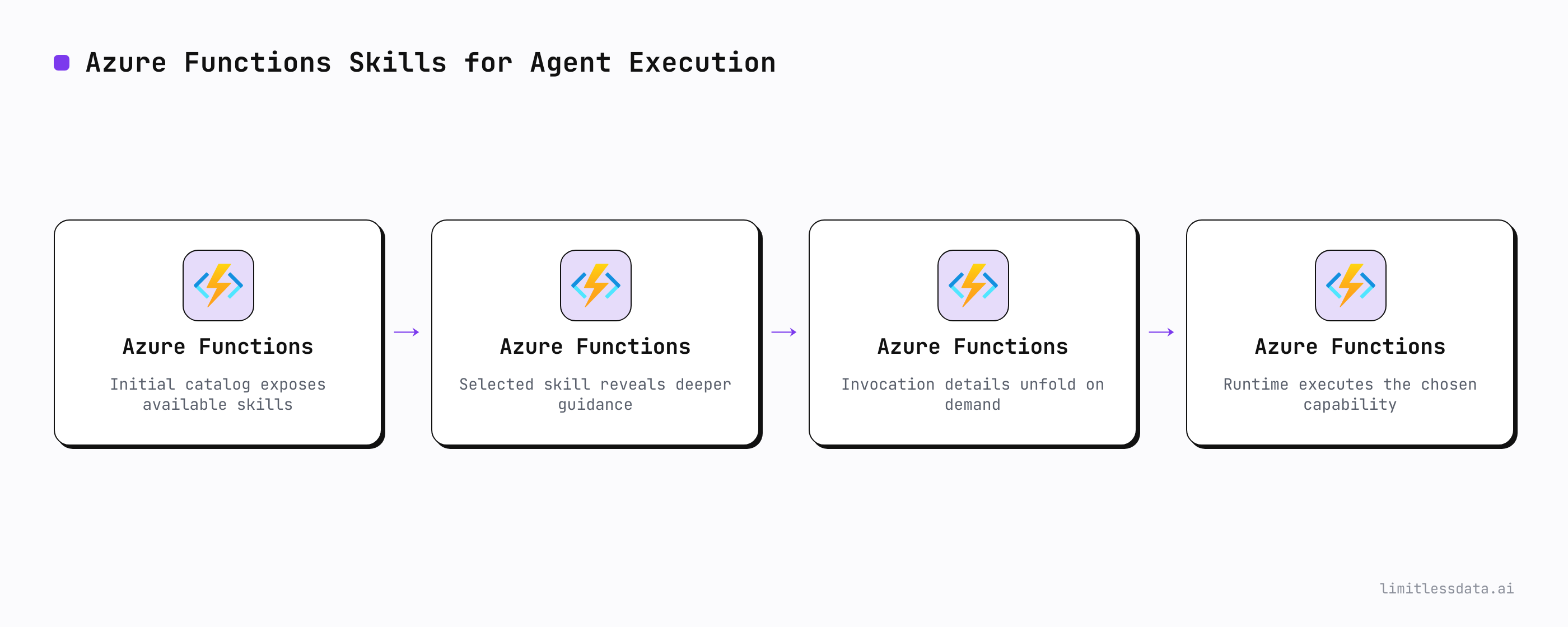
That is why Azure Functions is strategically interesting here. It fits naturally as the bounded execution layer for validation, retrieval, orchestration, and event-driven work.
A simple pattern to start with
Start with one reversible business action and make the contract painfully narrow.
# Python: Azure Function skill with narrow action, input validation, and bounded response contract
import azure.functions as func
import json, re

def main(req: func.HttpRequest) -> func.HttpResponse:
    body = req.get_json()
    customer_id = str(body.get("customerId", "")).strip()
    if not re.fullmatch(r"CUST-\d{6}", customer_id):
        return func.HttpResponse(
            json.dumps({"ok": False, "code": "INVALID_CUSTOMER_ID"}),
            status_code=400, mimetype="application/json"
        )

    result = {"customerId": customer_id, "tier": "gold", "eligible": True}
    response = {"ok": True, "action": "GetLoyaltyEligibility", "result": result}
    return func.HttpResponse(json.dumps(response), mimetype="application/json")
The lesson is simple: validate hard, return a bounded contract, and avoid spraying backend detail back to the agent. Not “let the agent call our CRM.” More like “let the agent ask one governed question.”
Architecture choices matter
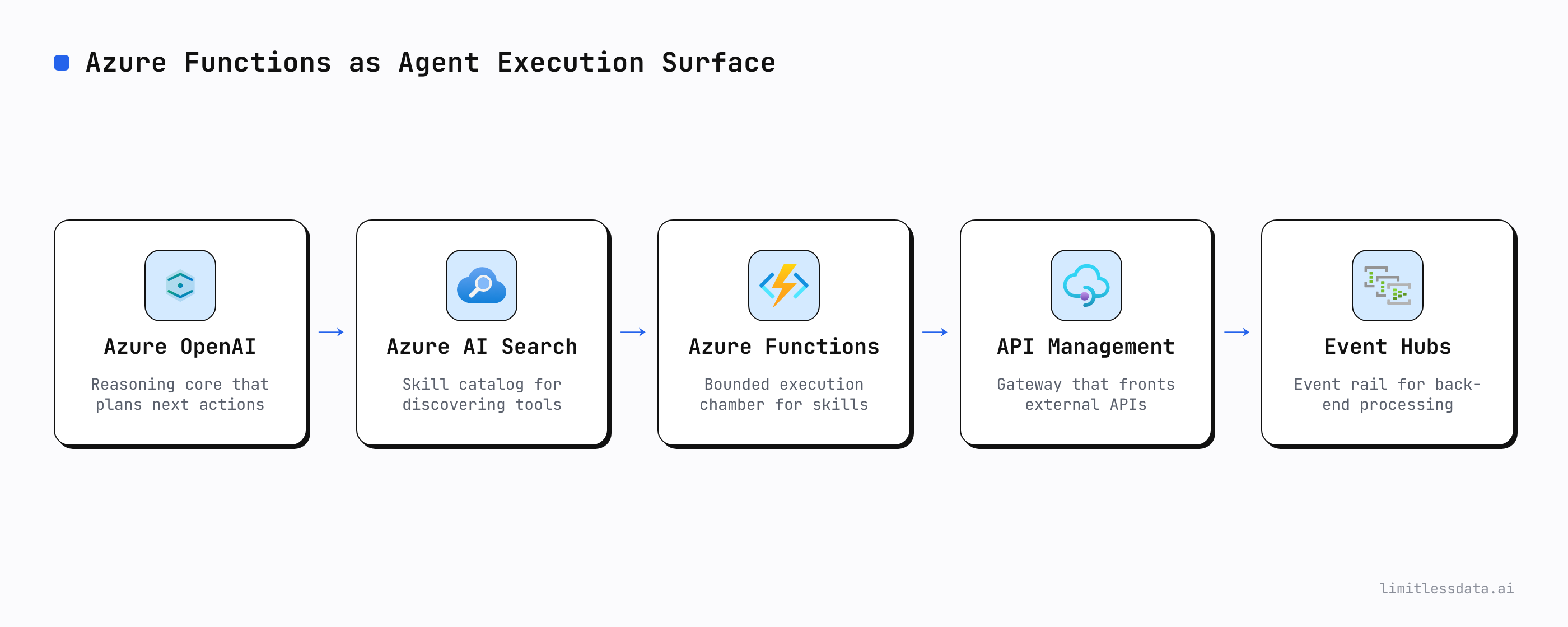
The practical pattern is straightforward:
- Agent + skill catalog at the interaction layer
- Azure Functions at the action-execution layer
- APIs for synchronous operations
- Events for async work
- Model service alongside the stack, not fused into it
The enterprise value is control, not novelty
A separate execution surface gives platform teams somewhere to stand.
My advice:
- Productize each skill-facing operation
- Keep scope narrow and purpose explicit
- Define failure behavior before rollout
- Refuse broad destructive actions until approval paths are proven
- Verify traces from agent decision to function call to downstream system

If you are evaluating Azure Functions Skills, do not treat it as another integration checkbox. Treat it as a candidate standard for the enterprise action plane.
Where does this break in your environment: skill discovery, identity, or the operational burden of treating Functions as an agent execution boundary?
#AzureAI #EnterpriseAI #DataArchitecture
Try it yourself
Run this tutorial as a Jupyter notebook: Download runbook.ipynb (22 cells, 17 KB).