Azure Multichannel Speech-to-Text for Contact Centers
How Real-Time Multichannel Speech-to-Text Expands Azure’s Voice and Contact-Center Story

“Why are we still arguing about transcript accuracy when the real failure is attribution?”
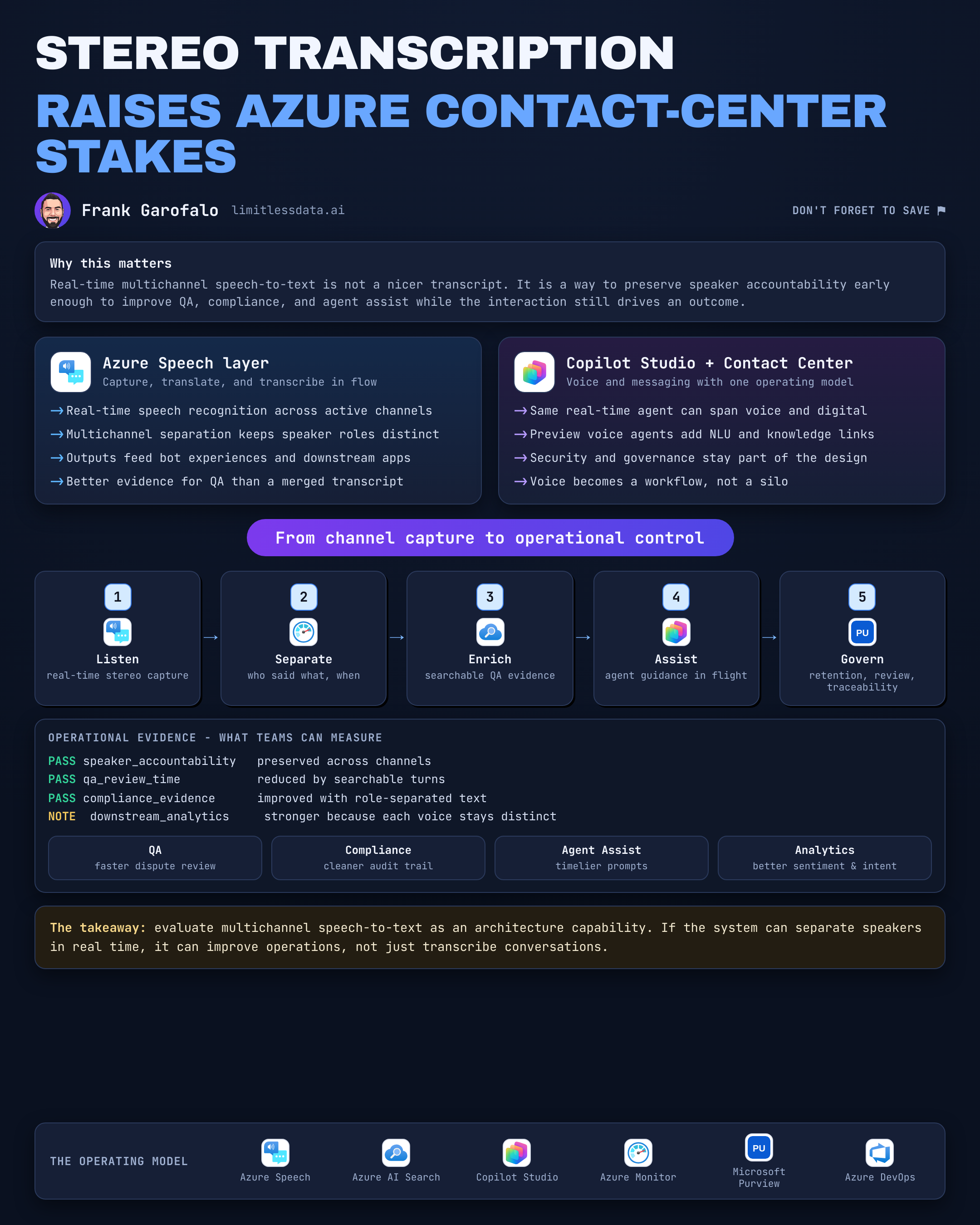
That question came up in a customer design review, and it gets to the heart of the issue. In contact centers, the value of speech-to-text is not producing a cleaner transcript after the call. It’s preserving who said what early enough to change the outcome while the interaction is still live.
That’s why I’m bullish on Azure’s voice story.
The pieces are there to build accountable, real-time conversation pipelines with Azure Speech, Dynamics 365 Contact Center, Copilot Studio, and Foundry Agent Service. But too many teams still evaluate speech-to-text like it’s a standalone transcription feature.
That’s the wrong frame.
For contact centers, multichannel speech-to-text should be treated as an architecture capability. If you preserve speaker accountability from the audio path through QA, summaries, compliance, and agent assist, you get something operationally useful. If you merge everyone into one transcript too early, you lose the chain of evidence and spend the next six months hoping summarization will rescue the design.
A few practical examples:
- QA needs to score agent behavior, not customer frustration.
- Compliance needs to know who actually made the disclosure or promise.
- Summaries need to preserve commitments and objections correctly.
- Real-time assist needs to react to the right speaker while the call is still live.
If your pipeline cannot answer “who said that?” with confidence, you do not have operational conversation intelligence. You have text exhaust.
The architecture discussion should start upstream:
- Preserve channel identity from telephony, CCaaS, SBC, or recording systems.
- Run recognition on separated streams.
- Normalize output into attributed events.
- Split those events into live assist, post-call enrichment, and analytical paths.
That is where Azure becomes compelling. Speech handles recognition. The agent layer handles interaction logic. The data platform handles governed persistence and analytics. Break that chain and the story weakens fast.
Here’s the architecture pattern I keep recommending in practice:
- Ingress
Audio enters from telephony or the contact-center platform as dual-channel or multichannel media. The non-negotiable requirement is that agent and customer streams remain distinct at capture time. If you start with a mono recording, you have already thrown away the most valuable signal.
- Recognition
Azure Speech performs streaming recognition on each channel independently. The output should not be treated as “the transcript.” It should be treated as a sequence of timestamped, attributed speech events with confidence, offsets, and channel metadata.
- Orchestration
Those events feed an agent layer: Dynamics 365 Contact Center for workflow context, Copilot Studio for orchestration, and Foundry Agent Service for more advanced reasoning or task execution. This is where “customer is objecting,” “agent missed disclosure,” or “refund intent detected” becomes actionable.
- Persistence
The event stream lands in a governed data platform for replay, QA, analytics, and model improvement. I prefer storing both the raw event log and curated conversation facts. One is your evidence trail; the other is your business-friendly abstraction.
- Consumption
Different workloads read different products: - Live assist reads low-latency events. - Supervisors read near-real-time alerts. - QA reads attributed turns and policy markers. - BI reads aggregated facts, not raw token streams.
That separation matters because the latency budget for live assist is radically different from the latency budget for post-call summarization. If your agent assist needs to intervene within 1–2 seconds, it cannot wait on the same pipeline that builds a polished summary 30 seconds after call completion.
A simple event model makes the difference between a demo and a platform. For example:
[[CODE:N]]
The point is not the syntax. The point is the contract.
If every downstream system receives a stable event with conversationId, speakerRole, channelId, offsetMs, and text, then you can build deterministic logic on top of it:
- Trigger an assist card only when
speakerRole=customer - Score a disclosure only when
speakerRole=agent - Reconstruct the timeline for disputes or audits
- Re-run enrichment later without reprocessing the entire audio estate
That is a much stronger design than passing around a giant blob of transcript text and asking every downstream team to infer speaker turns differently.
The trade-offs are real, and this is where a lot of architectures get hand-wavy.
Trade-off 1: multichannel fidelity vs implementation complexity Separated streams create better attribution and better downstream controls, but they require discipline at the telephony edge. SIP, SBC, recording, and CCaaS integrations all need to preserve channel mapping. That is more work than exporting a single recording file, but it avoids months of remediation later.
Trade-off 2: low latency vs richer enrichment A live assist path should optimize for speed and bounded context. Keep it narrow: intent, interruption risk, sentiment shift, disclosure detection. Don’t overload it with heavyweight summarization or broad retrieval steps. In most environments, sub-2-second reactions feel useful; 5+ seconds feels late.
Trade-off 3: raw event retention vs governance cost Keeping detailed event logs improves auditability and model debugging, but it increases storage, retention, and privacy obligations. That means clear policies for PII handling, redaction, retention windows, and replay access. Governance is not a postscript here; it is part of the architecture.
Trade-off 4: one unified pipeline vs workload-specific paths Teams love the elegance of one pipeline. Operations usually need three:
- a streaming path for live interventions,
- a near-real-time path for supervisor and workflow actions,
- a batch or micro-batch path for analytics and model tuning.
Trying to force all three into one path usually means one of them performs badly.
My take: the winning contact-center architecture is not the one with the most AI logos on the slide. It’s the one that preserves accountable conversation data from call routing through decision-making.
Azure has a credible voice and contact-center story when multichannel speech-to-text is treated as a core architectural capability, not a transcript feature:
- Preserve channel identity.
- Emit attributed events.
- Separate live, post-call, and analytical workloads.
- Govern the full lifecycle.
A practical benchmark I use with teams is simple:
- Can you identify the speaker correctly at every turn?
- Can you trigger an action in under 2 seconds for live assist?
- Can QA replay the exact sequence of attributed events?
- Can compliance prove who made a statement and when?
- Can analytics consume curated facts without touching sensitive raw audio?
If the answer is no to any of those, the problem is usually not “AI quality.” It is architecture quality.
Then the transcript becomes useful because it is attached to accountability.
If your current design merges speakers before the intelligence layer, you are building rework into the platform on day one.
I published the full breakdown as a LinkedIn Article, including the reference architecture, event model, scorecard, and implementation considerations.
Where does this break in your environment first: upstream telephony routing, live latency, or governance traceability?
#AzureAI #ContactCenter #DataArchitecture
Try it yourself
Run this tutorial as a Jupyter notebook: Download runbook.ipynb (25 cells, 19 KB).