Claude in Azure Foundry Changes Your AI Standards
Claude in Microsoft Foundry: What Enterprise AI Architects Should Evaluate First

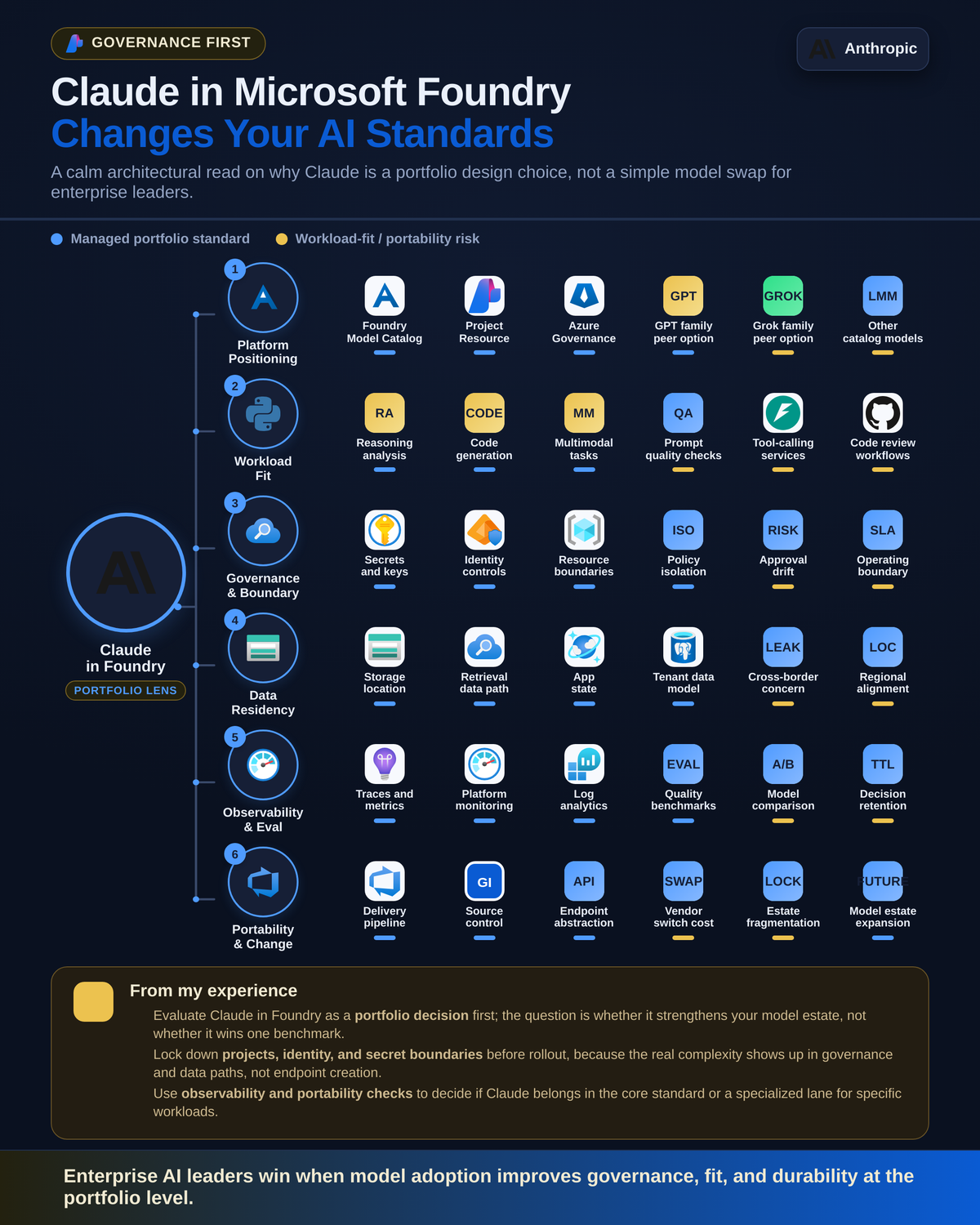
Claude in Microsoft Foundry is not just another model endpoint to approve. It is a platform design decision that can strengthen your enterprise AI portfolio—or quietly fragment it.
The capability-map framing matters here: the question is not whether Claude is “good.” It is where Claude belongs in a governed model estate that already includes multiple model families, workload types, and control boundaries.
Why this decision matters now
The wrong way to evaluate Claude in Microsoft Foundry is to ask, “Is it better than GPT?”
The better question is: “Does this model family deserve standard status in our enterprise AI estate, and for which workload classes?”
That distinction matters because Foundry is a model platform, not a single-model product. Microsoft positions it as a catalog of model families, including Claude, GPT, Grok, and others. So the architecture problem is no longer picking one winner. It is deciding which model families are approved for which jobs inside one governed platform.
If you wait until product teams independently adopt frontier models, you usually do not get innovation. You get prompt sprawl, duplicated evaluation pipelines, inconsistent safety controls, and support teams trying to explain why similar applications behave differently.
A CDO I advised in Q1 had 14 internal copilots across three business units before anyone realized each team had built its own prompt library, evaluation rubric, and escalation path for harmful outputs.
That is why Claude in Foundry should be evaluated first as a portfolio decision, not a feature comparison exercise.
Start with portfolio design, not model hype
The conventional move is to test Claude against your incumbent model and pick whichever output looks stronger.
That is incomplete architecture thinking.
Foundry’s own positioning suggests a portfolio mindset: different model families are intended for different strengths. In practice, that means enterprise architects should not treat Claude as a universal replacement. They should treat it as one candidate in a multi-model standard.
A practical sequence:
- Define workload classes first.
- Map approved model families to those classes.
- Standardize evaluation and governance before broad rollout.
A useful starting taxonomy:
- Default production assistants
- Low-latency transactional copilots
- Code-heavy engineering assistants
- Long-form reasoning and synthesis
- Multimodal review and document interpretation
- Agentic workflows with tool use and orchestration
Only after those categories exist should teams test Claude against peer Foundry models for the same class of work.
The first architectural questions to answer
Before you approve Claude, answer these in order.
1) Does this workload justify another frontier model family?
Every additional premium model family adds operational complexity: approval paths, tuning assumptions, cost profiles, support expectations, and incident patterns.
If the workload is already well served by an existing standard, adding Claude may create more entropy than value.
2) What specific workload fit would make Claude worth standardizing?
Microsoft documents dedicated Claude support in Foundry and presents it as a model family within the platform. That is meaningful.
But “supported” is not the same as “should be standard.”
The bar should be explicit workload fit, such as:
- code-centric assistants where output quality materially improves developer throughput
- advanced reasoning tasks where synthesis quality is measurably stronger
- multimodal review where users need image-plus-text understanding
- selected agent patterns where model behavior improves task completion under enterprise controls
3) What are the nonfunctional requirements?
Force the hard questions early:
- latency targets
- throughput expectations
- cost predictability
- safety policy enforcement
- auditability
- logging and tracing consistency
- regional and residency constraints
These are architecture gates, not procurement footnotes.
4) Does Claude improve portfolio resilience or just multiply variants?
A new model family is worth adding when it expands capability coverage or reduces concentration risk.
It is less compelling when it simply creates another way to answer the same prompt with a slightly different style.
Governance boundaries inside Foundry are the real story
This is the part many teams miss.
Foundry uses a layered architecture: a top-level resource for governance, projects for isolation, and connected Azure services for storage, search, and secrets. So model onboarding is not just an inference decision. It affects workload isolation, data landing zones, secret management, and the broader application boundary.
Architecture review should ask:
- What is governed centrally at the Foundry resource level?
- What is delegated to projects?
- Which connected services are required for Claude-enabled workloads?
- How will telemetry and evaluation results be normalized across projects?
That is also why evaluation discipline matters. Architecture boards should compare models under one enterprise harness, not from screenshots collected by separate teams.
Microsoft documents Foundry evaluation capabilities for generative AI models and agents, including quality, performance, and safety assessment. Those capabilities should be part of the approval path before any model family is declared “approved.”
Data residency and control boundaries deserve executive attention
Here is the issue that should be on every architecture checklist: current Microsoft Q&A guidance indicates Anthropic models in Microsoft Foundry run on Anthropic-hosted infrastructure rather than Azure infrastructure in the selected region.
That is not a minor implementation detail. It is a control-boundary decision.
For regulated enterprises, that changes the review immediately:
- data residency assumptions may not match the selected Azure region
- sovereignty requirements may trigger legal review
- customer contractual commitments may need reinterpretation
- internal data classification rules may require tighter workload scoping
This is why I would not recommend a blanket “Claude is approved” policy.
A better approach is tiered approval:
- Approved for low-risk workloads
- Approved for selected medium-risk workloads with documented controls
- Exception-only for regulated, residency-sensitive, or sovereignty-constrained workloads until legal, compliance, and security sign off
That is not anti-Claude. It is disciplined enterprise architecture.
The same caution applies to other platform details often cited from Microsoft Q&A, including infrastructure location, agent-pattern nuance, and subscription eligibility. Treat those as current documented guidance, not permanent guarantees.
Where Claude may genuinely fit better
Claude should not be dismissed. It should be used where it earns its complexity.
The strongest case for Claude in a Foundry portfolio is as a specialist standard, not necessarily a universal default. Based on Microsoft’s model-family positioning and Claude support in Foundry, the most credible candidate areas are:
- advanced reasoning workloads that require coherent long-form synthesis
- code generation and code-assistance scenarios
- multimodal analysis tasks
- selected agentic workflows where model behavior improves planning or task execution
Many enterprises will still keep another model family as the default for broad production use because defaults are usually chosen on operational maturity, cost efficiency, latency profile, and established support patterns—not just raw model prestige.
That is the key opinion here: benchmark chasing is rarely a sound architecture strategy on its own. The right comparison is business workload fit under enterprise constraints.
To make that concrete, build a reusable enterprise test set instead of relying on ad hoc prompts.
# Build a Foundry-oriented evaluation harness and export results for review.
import csv
import time

test_cases = [
    {
        "id": "security-002",
        "prompt": "How should privileged access be reviewed in a regulated environment?",
        "expected_keywords": ["access", "reviewed", "regulated"],
        "risk": "medium",
        "workload_class": "policy_assistant",
    }
]

models = ["claude", "gpt-4o"]

def invoke_foundry_model(model_name: str, prompt: str) -> dict:
    started = time.perf_counter()
    text = f"{model_name}: access reviewed with approvals, logs, and regulated controls."
    return {
        "model": model_name,
        "text": text,
        "latency_ms": round((time.perf_counter() - started) * 1000, 2),
    }

def score_quality(output: str, expected_keywords: list[str]) -> float:
    return round(
        sum(k in output.lower() for k in [x.lower() for x in expected_keywords]) / len(expected_keywords),
        2,
    )

with open("foundry_eval_results.csv", "w", newline="", encoding="utf-8") as f:
    writer = csv.DictWriter(
        f,
        fieldnames=["case_id", "workload_class", "model", "quality", "latency_ms", "safety"],
    )
    writer.writeheader()
    for case in test_cases:
        for model in models:
            result = invoke_foundry_model(model, case["prompt"])
            writer.writerow({
                "case_id": case["id"],
                "workload_class": case["workload_class"],
                "model": model,
                "quality": score_quality(result["text"], case["expected_keywords"]),
                "latency_ms": result["latency_ms"],
                "safety": "pass",
            })
What to observe: the point is not code sophistication. The point is one repeatable harness, one scoring method, and one review artifact across model families.
Operational implications of adding Claude to an existing Foundry estate
This is where otherwise solid AI programs get surprised.
Commercial eligibility is an architecture gate
Current Microsoft Q&A guidance indicates Claude in Foundry requires Enterprise or MCAE subscriptions. If that applies to your environment, commercial eligibility belongs at the start of architecture review, not at the end of procurement.
Cost predictability gets harder with another premium family
A second or third frontier model family complicates:
- chargeback
- quota planning
- approval workflows
- budget forecasting by business unit
If your FinOps model is immature, adding Claude too early can create friction unrelated to model quality.
Observability must stay consistent across families
Architects need one telemetry and incident model across the estate:
- request and response tracing
- latency baselines
- evaluation score history
- policy violation review
- fallback behavior tracking
If one model family is measured differently, fair governance becomes difficult.
Portability matters more as the model estate expands
Prompt and application abstractions should reduce lock-in. If policy, cost, or availability changes, teams need the option to substitute or fall back across approved models without rewriting the whole application stack.
Agent patterns are where fragmentation starts
Current Microsoft Q&A guidance suggests Claude is first-class for inference and usable with Microsoft agent framework patterns, but documentation is less explicit on parity across every Agent Service pattern, portal-visible workflow, and operational surface.
Architects should not assume that “first-class model support” means full parity everywhere.
That gap matters because agents are where split standards emerge fastest.
Yes, Microsoft guidance and Q&A show teams can call external or non-Foundry models through tools like Azure Functions or Logic Apps. But if that becomes the workaround for unclear or unsupported patterns, you now have:
- split control planes
- weaker tracing consistency
- less uniform policy enforcement
- harder support ownership
My recommendation is straightforward: define which agent patterns are officially supported with Claude before enabling broad team adoption.
If you do not, teams will create their own workarounds and call it innovation.
Use Foundry evaluations before you write standards
Microsoft’s responsible AI guidance points teams to Foundry evaluation tools for safety, hallucination, and quality assessment. Use them.
A practical enterprise process looks like this:
- Build a representative test set by workload class.
- Run the same tests against Claude and incumbent Foundry standards.
- Score quality, safety, latency, and cost indicators.
- Review results in architecture, security, and platform governance forums.
- Approve by workload class, not by corporate-wide hype cycle.
You also need a compact scoring view that architecture boards can review quickly.
# Summarize Foundry evaluation results for architecture board review.
import csv
from collections import defaultdict

summary = defaultdict(lambda: {"quality_total": 0.0, "count": 0, "latency_total": 0.0})

with open("foundry_eval_results.csv", "r", encoding="utf-8") as f:
    reader = csv.DictReader(f)
    for row in reader:
        model = row["model"]
        summary[model]["quality_total"] += float(row["quality"])
        summary[model]["latency_total"] += float(row["latency_ms"])
        summary[model]["count"] += 1

for model, stats in summary.items():
    avg_quality = round(stats["quality_total"] / stats["count"], 2)
    avg_latency = round(stats["latency_total"] / stats["count"], 2)
    print({"model": model, "avg_quality": avg_quality, "avg_latency_ms": avg_latency})
Exportable results create a defensible review artifact. Once model decisions are recorded against measurable criteria, your standards become easier to govern and easier to explain.
Bottom line: make Claude a deliberate standard, not a team-by-team exception
My position is simple: Claude in Microsoft Foundry is worth evaluating now, but only as part of a deliberate multi-model architecture standard.
Do not treat this as a beauty contest between logos. Treat it as a portfolio design decision with consequences for governance, procurement, observability, data residency, and portability.
For most enterprises, the practical standard is:
- one default model family for broad production use
- one or more approved specialist model families for clearly defined workload classes
- exception-only use for sensitive scenarios with unresolved control-boundary issues
Claude can absolutely belong in that middle tier where it clearly improves reasoning, code-centric work, or multimodal analysis—and where governance conditions are acceptable.
The biggest mistake is not choosing the wrong model. It is letting every team create its own model operating model while the Foundry portfolio expands around them.
If your Foundry standards still treat model onboarding as a feature request, you are already behind.
Architects: what does your current approval model look like?
Comment with:
- your current approval pattern
- your biggest blocker
- whether you would standardize Claude as a default, specialist, or exception-only model family
#AzureAI #EnterpriseAI #DataArchitecture
Sources & References
- What is Microsoft Foundry? - Microsoft Foundry
- Can Claude models be used with Foundry Agent Service's create_agent API (threads/runs pattern) for portal visibility? - Microsoft Q&A
- Claude models in Microsoft Foundry - Microsoft Foundry
- Get started with Claude in Microsoft Foundry - Training
- Azure AI Foundry Agent Service Support for LiteLLM/Non-Foundry Models - Microsoft Q&A
- Microsoft Foundry architecture - Microsoft Foundry
- Responsible AI for startup applications on Azure
- Run evaluations from the Microsoft Foundry portal - Microsoft Foundry
- The Claude on Foundry Starter Kit - Code Samples
- Timeline for Claude in Microsoft Foundry to run on Azure EU infrastructure - Microsoft Q&A
Try it yourself
Run this tutorial as a Jupyter notebook: Download runbook.ipynb (24 cells, 23 KB).