Copilot Spend Is the New Shadow IT Budget
Governing GitHub Copilot Spend Like Cloud


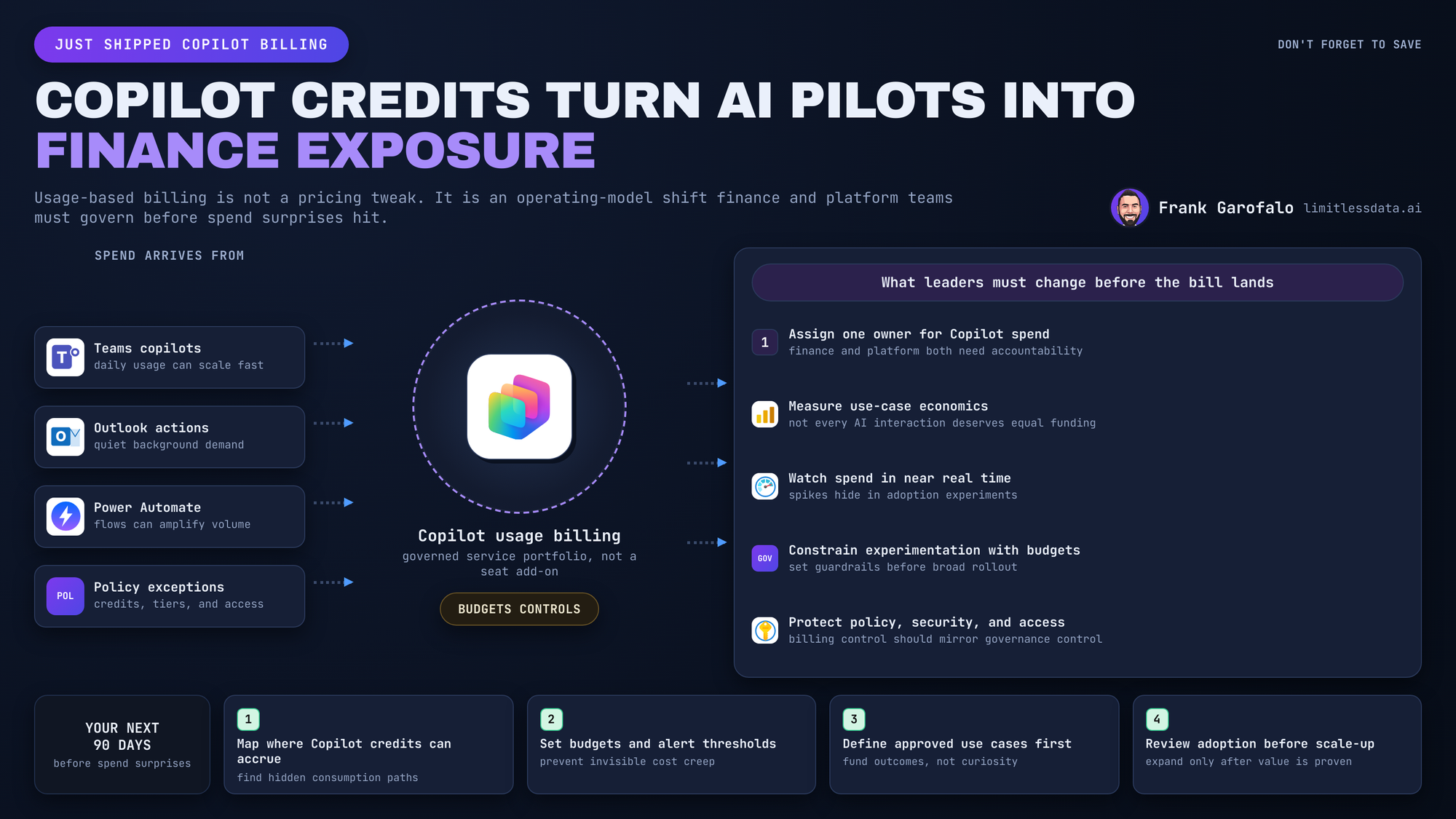
Copilot is not just a seat license. It is a governed platform surface with cloud-style cost, access, and risk dynamics.
That is the uncomfortable truth many enterprises are avoiding while they roll out GitHub Copilot as if it were only an IDE add-on. In regulated environments, that shortcut is how you lose control of spend, data boundaries, and accountability.
Why GitHub Copilot now behaves more like a governed platform
The conventional budgeting model is simple: buy licenses, assign them to developers, and call it productivity software. That model is still part of the picture, but on its own it is no longer sufficient for enterprise governance.
Microsoft documents GitHub Copilot as an enterprise-administered service with privacy, responsible AI, and governance considerations. My recommendation goes a step further: treat those documented capabilities as a signal that Copilot belongs inside the same operating model you already use for cloud platforms.
The bigger shift is technical. Microsoft Learn documents GitHub Copilot Agent Mode for autonomous development tasks, and it also documents Copilot-supported modernization workflows that can assess, recommend, fix, and validate modernization work. Once a tool can shape meaningful code changes and participate in cloud-facing engineering workflows, it stops behaving like stationery and starts behaving more like infrastructure.
If finance tracks Copilot only as flat seat spend while platform engineering ignores usage patterns, the organization is missing the real control problem.
The regulated enterprise mistake is calling it developer tooling
Labels drive governance.
If you call GitHub Copilot “developer tooling,” it tends to fall into the same bucket as a linter or editor theme. That is the wrong bucket. The wrong bucket means the wrong review path, the wrong owner, and the wrong controls.
In regulated enterprises, the real control domains are straightforward:
- data exposure through prompts, context, and connected systems
- model-assisted behavior that can alter code or workflow outcomes
- code provenance and review rigor
- approval workflows for higher-risk capabilities
- auditability of who used what, where, and under which policy
Microsoft’s Responsible AI training for GitHub Copilot documents risk-aware usage patterns. My recommendation is to convert that guidance into internal controls, especially for regulated repositories and higher-scope features.
A recent example: a 240-developer financial services platform team I advised found Copilot access enabled across payment repos, internal tooling, and sandbox projects with no repository classification model, no exception log, and no business-unit showback beyond a single monthly invoice.
That was not a tooling problem. It was a platform governance failure.
Govern Copilot with a cloud-style control model
Senior platform teams should govern GitHub Copilot the way they govern cloud services: with service catalogs, policy guardrails, environment segmentation, usage telemetry, and risk-based approvals.
That means four named owners, not one vague admin:
- service owner: accountable for the Copilot platform offering
- budget owner: accountable for showback, chargeback, and variance
- policy owner: accountable for technical guardrails and allowed configurations
- risk owner: accountable for regulated use cases, exceptions, and evidence
It also means you do not issue broad entitlements just because someone writes code. Access should be segmented by repository sensitivity, environment, and developer persona.
A practical internal service catalog might look like this:
- Baseline Assist: inline suggestions and chat in approved IDEs for lower-risk repos
- Agent Mode: additional approval, tighter telemetry, and restricted repo scope
- Modernization Workflows: time-bound access for approved transformation initiatives with explicit review gates
To make this operational, start with a simple showback pipeline. The point is not perfect accounting on day one. The point is proving that usage can be normalized, attributed, and reviewed like any other shared platform service.

Usage data becomes useful only after you normalize identities, join repository metadata, map business ownership, and apply policy tiers. That is standard FinOps logic. Most Copilot rollouts still do not have it.
A practical control model for Copilot spend
1) Classify repositories before you classify users
Start with repository metadata. Every repo should carry at least:
- business unit
- sensitivity or tier
- data handling designation
- environment relevance, if applicable
If you do not know which repos are Tier 1 versus Tier 3, you cannot sensibly govern where agentic features should operate.
A lightweight repo classification check is a good first guardrail. This example validates that a repository includes required metadata before Copilot-enabled workflows proceed.
# Check repository classification metadata before allowing Copilot-enabled workflows.
$repoRoot = Get-Location
$classFile = Join-Path $repoRoot ".github\repo-classification.json"

if (-not (Test-Path $classFile)) {
    throw "Missing classification file: $classFile"
}

$data = Get-Content $classFile -Raw | ConvertFrom-Json
$allowedTiers = @("Tier1", "Tier2", "Tier3")
if ($data.businessUnit -and $data.tier -in $allowedTiers -and $data.dataSensitivity) {
    Write-Output "Repository classification valid for $($data.businessUnit) / $($data.tier)"
} else {
    throw "Invalid repository classification metadata."
}
The important move is not the script itself. It is the policy decision that repository class must exist before privileged AI-assisted workflows are allowed.
2) Build showback that finance and engineering can both use
If the only artifact leadership sees is “we bought 400 licenses,” you do not yet have an operating model. Export a compact showback report by business unit, repo tier, and developer segment.
# Export a compact CSV showback report for finance or engineering leadership.
import csv

rows = [
    {"business_unit": "Payments", "repo_tier": "Tier1", "developer_segment": "PowerUser", "allocated_cost": 60.84},
    {"business_unit": "Data", "repo_tier": "Tier2", "developer_segment": "Casual", "allocated_cost": 23.40},
    {"business_unit": "Platform", "repo_tier": "Tier3", "developer_segment": "Standard", "allocated_cost": 27.30},
]

with open("copilot_showback.csv", "w", newline="", encoding="utf-8") as f:
    writer = csv.DictWriter(f, fieldnames=rows[0].keys())
    writer.writeheader()
    writer.writerows(rows)

print("Wrote copilot_showback.csv")
Use this as the basis for monthly reviews with engineering directors and finance partners. The governance win is not the CSV. The win is creating a shared language for Copilot consumption.
If you want to go further, you can use weighted allocation to reflect repo tier and developer segment. This next example is illustrative as a governance pattern, not a recommended production billing implementation.
# Allocate Copilot spend with weighted rates by repository tier and developer segment.
from decimal import Decimal

base_cost = Decimal("39.00")
tier_weight = {"Tier1": Decimal("1.30"), "Tier2": Decimal("1.00"), "Tier3": Decimal("0.70")}
segment_weight = {"PowerUser": Decimal("1.20"), "Standard": Decimal("1.00"), "Casual": Decimal("0.60")}

records = [
    {"user": "ana", "repo": "checkout-api", "bu": "Payments", "tier": "Tier1", "segment": "PowerUser"},
    {"user": "ben", "repo": "data-lake", "bu": "Data", "tier": "Tier2", "segment": "Casual"},
    {"user": "cara", "repo": "docs-site", "bu": "Platform", "tier": "Tier3", "segment": "Standard"},
]

for r in records:
    weighted = base_cost * tier_weight[r["tier"]] * segment_weight[r["segment"]]
    print({
        "business_unit": r["bu"],
        "repo": r["repo"],
        "tier": r["tier"],
        "segment": r["segment"],
        "allocated_cost": f"{weighted.quantize(Decimal('0.01'))}"
    })
The invoice is not literally billed this way. The value is managerial: connecting cost discussion to risk and business value, not just license counts.
Treat agent mode like privileged automation
This is where many teams get too casual.
Microsoft Learn documents GitHub Copilot Agent Mode for autonomous development tasks. Microsoft also documents modernization agents that assess, recommend, fix, and validate modernization work. Those are vendor-documented capabilities. My recommendation is to govern them more like privileged automation than classic code completion.
For sensitive repositories or regulated SDLC stages, require:
- approved use case
- repository classification
- human review checkpoint
- exception logging for nonstandard usage
- narrower entitlement scope than baseline assist
You should also enforce workstation and IDE baselines. If your cloud platform team would not tolerate unmanaged production tooling, your Copilot rollout should not tolerate unmanaged extension sprawl either.
This example checks whether a developer workstation matches an approved VS Code extension baseline for Copilot-enabled development.
# Enforce approved VS Code extension baseline for Copilot-enabled development.
$approved = @(
    "GitHub.copilot",
    "GitHub.copilot-chat",
    "ms-python.python"
)

$installed = @(
    "GitHub.copilot",
    "GitHub.copilot-chat",
    "ms-python.python",
    "random.unapproved-extension"
)

$unapproved = $installed | Where-Object { $_ -notin $approved }
if ($unapproved.Count -gt 0) {
    Write-Output "Non-compliant extensions detected:"
    $unapproved | ForEach-Object { Write-Output " - $_" }
} else {
    Write-Output "Extension baseline is compliant."
}
Pair this with a documented exception path. Governance without an exception process becomes shadow IT.
A second useful control is policy-aligned editor settings. This sample is illustrative and assumes the Windows VS Code user settings path.
# Apply policy-aligned Copilot editor settings in a user VS Code profile.
$settings = @{
    "github.copilot.enable" = @{
        "*" = $true
        "plaintext" = $false
        "scminput" = $false
    }
    "github.copilot.inlineSuggest.enable" = $true
    "editor.inlineSuggest.enabled" = $true
    "telemetry.telemetryLevel" = "error"
}

$path = Join-Path $HOME "AppData\Roaming\Code\User\settings.json"
$folder = Split-Path $path -Parent
if (-not (Test-Path $folder)) { New-Item -ItemType Directory -Path $folder -Force | Out-Null }
$settings | ConvertTo-Json -Depth 5 | Set-Content -Path $path -Encoding UTF8
Write-Output "Updated policy-aligned settings at $path"
The point is simple: if a regulated team says AI assistance should be disabled in certain text contexts, that decision should be implemented technically, not left in a slide deck.
Build Copilot FinOps before finance asks for it
If your organization already has a cloud FinOps motion, reuse it.
Track at least four things separately:
- purchased licenses
- active users
- higher-scope workflows such as agentic tasks or modernization efforts
- business-unit allocation
Then define metrics executives can actually use:
- cost per active developer
- cost per accepted change
- cost per modernization initiative
- exception rate by repo tier or business unit
You also need variance detection.
# Flag budget variance and low-value usage patterns for Copilot governance.
budget_by_bu = {"Payments": 120.0, "Data": 80.0, "Platform": 50.0}
actual_by_bu = {"Payments": 156.0, "Data": 61.0, "Platform": 54.0}
accepted_per_user = {"ana": 200, "ben": 18, "cara": 72}
cost_per_user = {"ana": 39.0, "ben": 39.0, "cara": 39.0}

for bu, budget in budget_by_bu.items():
    actual = actual_by_bu.get(bu, 0.0)
    variance = actual - budget
    status = "ALERT" if variance > 0 else "OK"
    print(f"{status} {bu}: budget=${budget:.2f} actual=${actual:.2f} variance=${variance:.2f}")

for user, accepted in accepted_per_user.items():
    unit_cost = cost_per_user[user] / max(accepted, 1)
    if accepted < 25 or unit_cost > 1.0:
        print(f"REVIEW user={user} accepted={accepted} cost_per_accept=${unit_cost:.2f}")
Not every licensed user produces the same value, and not every business unit should get the same tolerance for variance. That is why Copilot needs showback and review, not blanket renewal.
Compliance teams need evidence, not just vendor reassurance
Vendor documentation is useful, but it is not your control framework.
Use Microsoft’s compliance, privacy, and responsible AI materials as inputs. Those sources document capabilities and governance considerations. My recommendation is to turn them into an internal evidence pack that can survive audit, budget review, and risk challenge.
That evidence pack should include:
- approved use cases
- restricted or prohibited use cases
- data handling rules by repo tier
- review checkpoints for agentic features
- exception logs
- monthly usage and showback reports
- workstation and IDE baseline compliance results
This is also where existing enterprise frameworks should absorb Copilot rather than creating parallel bureaucracy. Tie Copilot governance into software supply chain review, SDLC control gates, and AI governance expectations where applicable.
What CIOs should demand in the next quarterly review
Do not ask, “How many Copilot licenses did we buy?”
Ask for:
- a Copilot service inventory
- segmentation by repo risk tier and business unit
- active usage versus purchased licenses
- exception counts for agentic or higher-risk workflows
- evidence that policy baselines are enforced
- showback by engineering portfolio
- a documented owner for service, policy, budget, and risk
My position is simple: GitHub Copilot has crossed from developer convenience into enterprise platform capability. The organizations that recognize that early will control spend and risk more effectively. The ones that wait will end up reverse-engineering policy after an audit, a budget surprise, or a bad automation incident.
Where does this break in your environment: repo classification, agent-mode approvals, or showback by business unit?
#GitHubCopilot #FinOps #PlatformEngineering
Sources & References
- Azure developer documentation
- Microsoft Compliance
- Building Applications with GitHub Copilot Agent Mode - Training
- GitHub Copilot modernization overview
- Responsible AI with GitHub Copilot - Training
Try it yourself
Run this tutorial as a Jupyter notebook: Download runbook.ipynb (22 cells, 18 KB).