Enterprise Agent Memory Governance for Microsoft AI
Your agents are only as good as their memory: what EvoLib gets right about enterprise learning loops

Last quarter I watched a team celebrate an agent that had “learned” from 40,000 support interactions—right up until legal asked a simple question: show me which behaviors came from which records, who approved them, and how to remove one bad lesson by Friday.
On this page
- The agent-memory debate starts in the wrong place
- Memory is a data governance problem before it is an AI feature
- The governed learning loop
- Build the control plane around the learning loop
- Make human feedback controlled evidence, not raw training exhaust
- The executive scorecard
- The practical implication of the EvoLib signal
That is the real bottleneck for enterprise agents: not generation quality, but whether learned behavior can be traced, challenged, retained, or removed under governance.
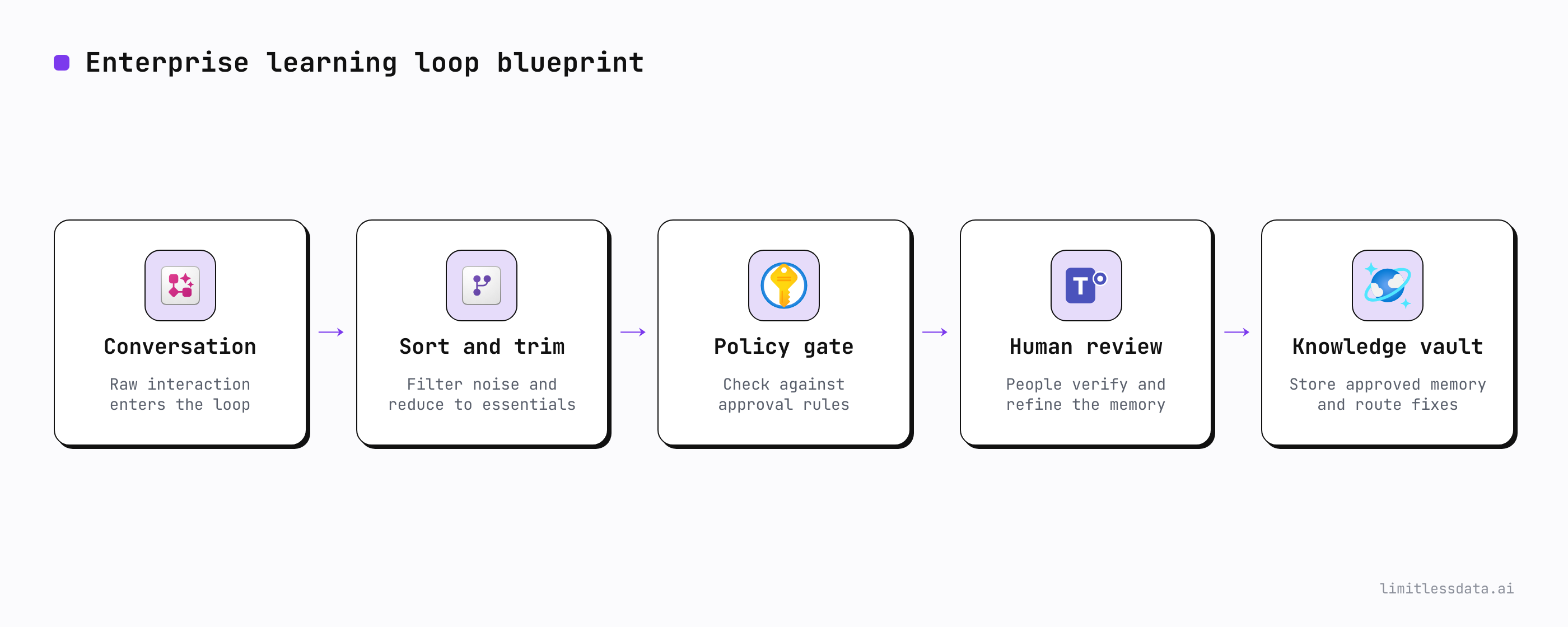
EvoLib (a new open-source library for building autonomous agents) is a useful signal because it pushes the market toward learning loops. Good. We need that. But if your idea of memory is “keep stuffing transcripts into a vector store and hope retrieval gets smarter,” you are not building enterprise learning. You are building a new unmanaged data estate with better marketing.
The agent-memory debate starts in the wrong place
A lot of teams still frame the problem like this: buy a better model, add a bigger context window, tune retrieval, and the agent becomes production-ready. That is backwards.
Microsoft’s agent guidance discusses the key components of a robust system: conversations, memory and persistence, workflows, and an agent harness in the Microsoft Agent Framework docs. The point is not a rigid implementation sequence. The point is that once an agent starts retaining and reusing information, you are no longer just generating tokens. You are operating a learning system.
That changes the question from “Can the agent remember?” to “Can the organization govern what the agent is allowed to retain and reuse?”
I’m using EvoLib here as a market signal, not a product recap. Stateless agents hit a wall. Durable learning matters. But in an enterprise, durable learning has to behave like a governed data lifecycle, not an opaque AI feature.
In Q1, a 14-person platform team I worked with had six internal agents running against ticketing, runbooks, and change records, and nobody could answer who owned the promoted memory after a Sev 2 rollback note started showing up as if it were standing policy. That is the failure mode. Not hallucination. Ownership.
Memory is a data governance problem before it is an AI feature
Here’s my definition:
Enterprise memory is retained organizational data plus the rules that govern its collection, access, reuse, review, correction, retention, and deletion.
Transcripts can be memory candidates. Tool outputs can be memory candidates. Human feedback can be memory candidates. Incident lessons can be memory candidates. None of them become durable memory just because an embedding exists.
The anti-pattern is everywhere: dump prompts, responses, tool traces, and thumbs-up signals into a vector database, call it “memory,” and optimize only for retrieval relevance. That works for demos. It fails leadership review in about ten minutes.
Why? Because retrieval relevance is not enough. You also need:
- provenance
- authorization context
- lifecycle ownership
- review state
- retention policy
- correction path
- deletion path
- audit trail
Microsoft IQ describes a unified intelligence layer where agent and Copilot interactions are grounded in a shared, evolving understanding of the organization in the Microsoft IQ docs. That ambition is right. It also raises the stakes: shared understanding without governance becomes shared contamination.
If ten agents can all learn from the same pool, one bad memory is no longer a local bug. It is an organizational defect.
The governed learning loop
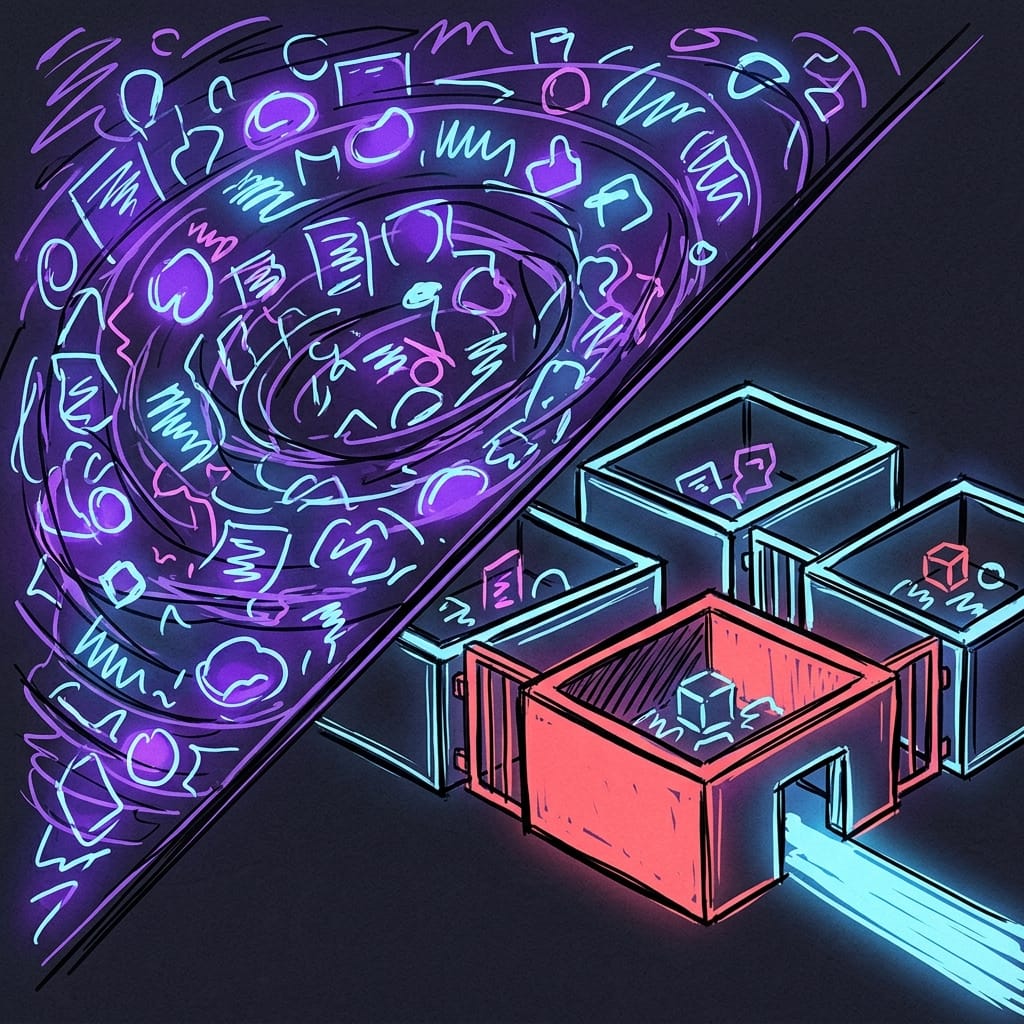
This is the operating model I want teams to implement:
- Capture an interaction
- Classify and minimize the candidate memory
- Apply authorization and policy checks
- Route for feedback or approval
- Publish a versioned reusable record
The first design decision is separating ephemeral context from durable knowledge.
Ephemeral context
- current conversation state
- short-lived task variables
- temporary tool outputs
- session-specific preferences
Durable knowledge
- approved runbooks
- validated lessons learned
- reusable policy interpretations
- sanctioned process guidance
- organization-approved facts
Those categories should not share the same retention and review rules. Session memory can expire aggressively. Durable memory needs metadata, ownership, and explicit promotion.
Here is the shape of a governed memory-write gate:
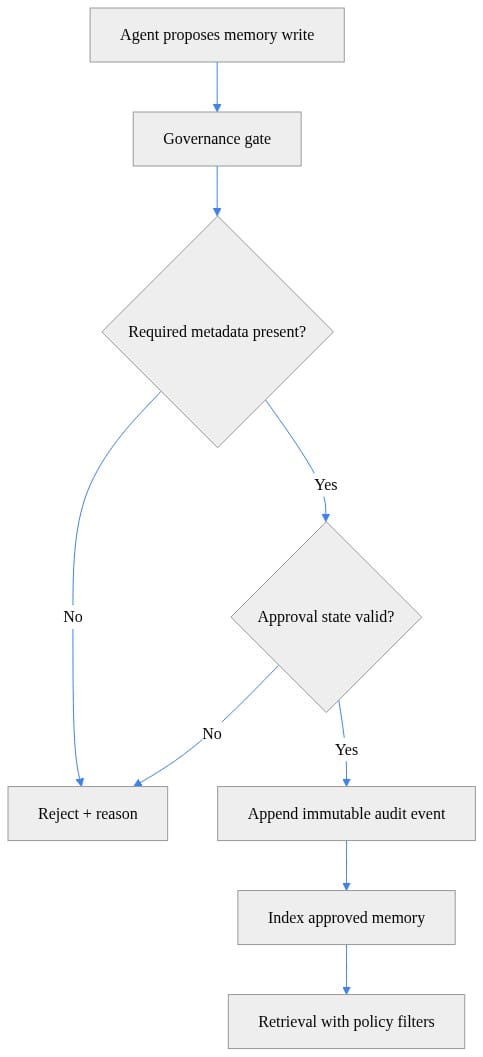
What matters: the memory write is not direct. The agent proposes. Governance decides. Only approved records get indexed for retrieval.
At minimum, every durable memory record should carry:
- content or normalized reference
- provenance or source event ID
- owner
- sensitivity classification
- approved audience
- creation timestamp
- approval state
- review status
- retention or expiry rule
- correction or revocation reference if superseded
And here’s a compact Python example:
# Governed memory-write gate with provenance, ownership, classification, retention, approval, and immutable audit.
from dataclasses import dataclass, asdict
from datetime import date
import hashlib, json

@dataclass
class MemoryRecord:
    content: str; provenance: str; owner: str; classification: str
    retention_until: str; approval_state: str

def validate(record: MemoryRecord) -> None:
    allowed = {"public", "internal", "confidential"}
    assert all(asdict(record).values()), "missing required field"
    assert record.classification in allowed, "invalid classification"
    assert date.fromisoformat(record.retention_until) >= date.today(), "expired retention"
    assert record.approval_state == "approved", "not approved"

def append_audit(record: MemoryRecord) -> dict:
    payload = json.dumps(asdict(record), sort_keys=True).encode()
    return {"event": "memory_write_approved", "hash": hashlib.sha256(payload).hexdigest()}

record = MemoryRecord("Runbook: rotate keys quarterly", "ticket:CHG-1042", "secops", "internal", "2027-12-31", "approved")
validate(record)
audit_event = append_audit(record)
index_doc = {"record": asdict(record), "audit": audit_event}
print(index_doc)
If your memory layer cannot reject writes for missing metadata, it is not governed.
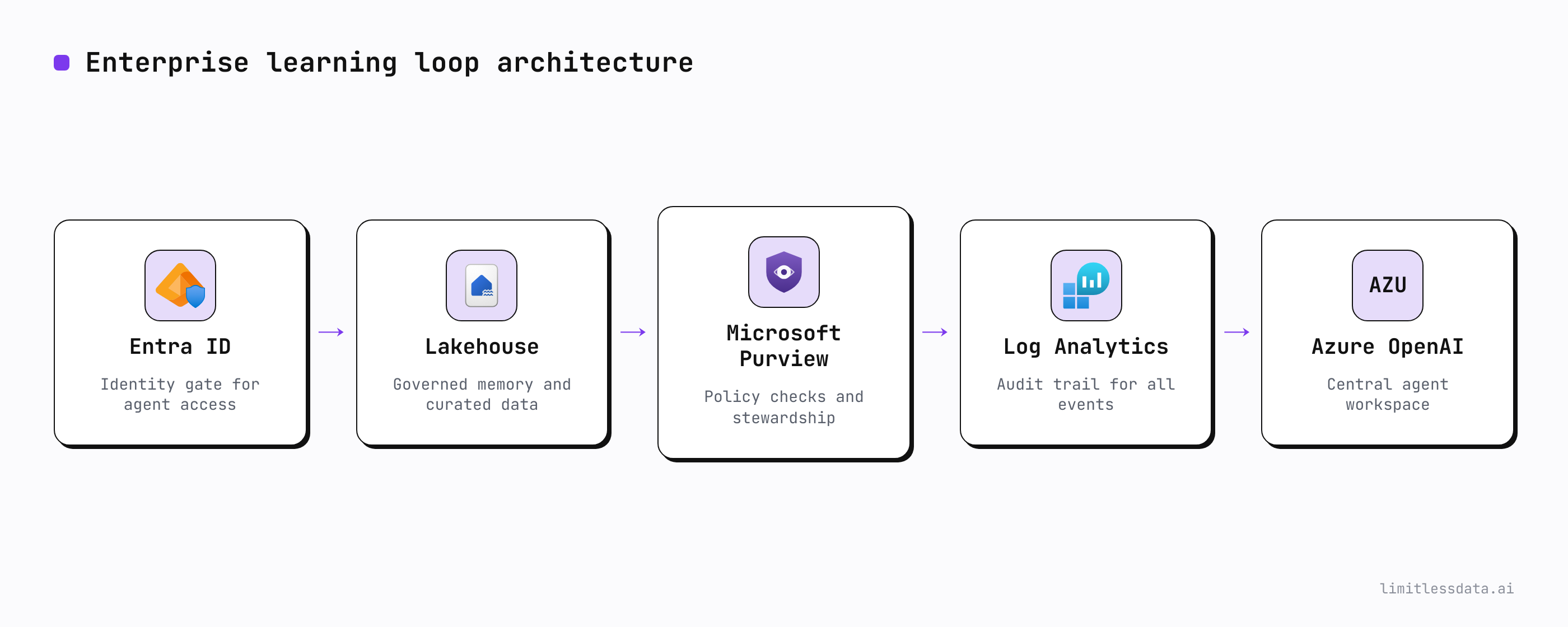
Build the control plane around the learning loop
The control plane is where most enterprise agent programs either get serious or stay theatrical.
Identity belongs at the boundary. Microsoft Entra Agent ID is explicitly about enterprise-grade protection, Zero Trust, and governance at scale in the Entra Agent ID docs. Every agent needs a governed identity, scoped access, and policy enforcement before memory even enters the conversation.
Then anchor stewardship in a governed data platform. Microsoft Fabric is positioned as a unified platform for organizational data and analytics in the Fabric docs. That matters because memory stewardship is a data-platform problem: lineage, ownership, policy, review, and observability.
What should the control plane instrument?
- memory write attempts
- approved promotions
- rejected promotions with reason
- retrieval events
- policy denials
- feedback events
- corrections
- revocations
- rollbacks
- review expirations
Role clarity matters too:
- data owner: content legitimacy
- platform owner: controls, reliability, observability
- business owner: usefulness and adoption
- risk/compliance owner: review expectations and exceptions
A memory system without inspection, rollback, and deletion controls is just a new unmanaged data estate.
Make human feedback controlled evidence, not raw training exhaust
A thumbs-up is not durable knowledge.
Neither is a successful tool call. Neither is a user prompt. Neither is a one-off workaround buried in a chat.
Human feedback needs classification before promotion. I use four buckets:
- immediate task correction
- knowledge correction
- policy escalation
- product-quality signal
That classification determines what happens next. Immediate task correction might stay session-local. Knowledge correction might become a candidate memory. Policy escalation should route to human review. Product-quality signal belongs in evaluation and telemetry, not durable memory by default.
Microsoft’s hosted agents guidance calls out cross-cutting concerns teams often manage with open-source frameworks: security, memory persistence, scaling, instrumentation, and version rollbacks in the hosted agents docs. Version rollback matters because learned behavior changes production outcomes. If you can version prompts but not memory, you are governing the wrapper and ignoring the payload.
Here is a compact learning-loop example:
# Minimal enterprise learning loop: capture feedback, propose memory, gate it, then retrieve it later.
from datetime import date, timedelta

feedback = {"incident": "INC-77", "lesson": "Pin API version for billing client", "owner": "finops"}
candidate = {
    "content": feedback["lesson"],
    "provenance": f"incident:{feedback['incident']}",
    "owner": feedback["owner"],
    "classification": "internal",
    "retention_until": (date.today() + timedelta(days=365)).isoformat(),
    "approval_state": "approved",
}
required = {"content", "provenance", "owner", "classification", "retention_until", "approval_state"}
approved = required.issubset(candidate) and candidate["approval_state"] == "approved"
memory_index = [candidate] if approved else []
print(memory_index[0]["content"] if memory_index else "rejected")
And for teams already drowning in memory sprawl, start with a governance-gap export:
# Export governance gaps: inventory memory records missing owner, retention, or review metadata.
$records = @(
    [pscustomobject]@{ Id = "mem-001"; Owner = "secops"; RetentionUntil = "2027-12-31"; LastReviewed = "2026-06-01" },
    [pscustomobject]@{ Id = "mem-002"; Owner = "";       RetentionUntil = "2027-03-01"; LastReviewed = "2026-05-15" },
    [pscustomobject]@{ Id = "mem-003"; Owner = "ops";    RetentionUntil = "";           LastReviewed = "" }
)

$gaps = $records | Where-Object {
    [string]::IsNullOrWhiteSpace($_.Owner) -or
    [string]::IsNullOrWhiteSpace($_.RetentionUntil) -or
    [string]::IsNullOrWhiteSpace($_.LastReviewed)
} | Select-Object Id, Owner, RetentionUntil, LastReviewed

$path = Join-Path $PWD "memory-governance-gaps.csv"
$gaps | Export-Csv -Path $path -NoTypeInformation
Write-Output "Exported $($gaps.Count) records to $path"
Boring is good. Governance wins on repeatable inventory, not clever demos.
The executive scorecard
If I’m talking to a CIO, CISO, or CDO, I want six answers immediately:
- What does this agent retain?
- Who owns each retained class of memory?
- Who can access it?
- Which policy admitted it?
- When was it last reviewed?
- How is it corrected or deleted?
The metrics I actually care about:
Governed-memory coverage
- percentage of durable memories with complete provenance
- percentage with assigned owner
- percentage with sensitivity classification
- percentage with retention metadata
- percentage with current review state
Learning-loop quality
- review latency
- correction latency
- rollback success rate
- policy denial rate
- retrievals linked to approved records
- stale memory rate
Vanity metrics are a trap:
- total memories stored
- embedding volume
- retrieval count
- “learning rate” without quality controls
The practical implication of the EvoLib signal
EvoLib gets one big thing right: enterprise agents need learning loops.
Where teams go wrong is treating that learning loop as an AI feature instead of a governed data lifecycle. The memory layer has to support provenance, access control, review, retention, correction, deletion, and auditable change records. Otherwise “adaptive” just means “harder to control.”
Microsoft’s stack points to the right component model: agent frameworks for orchestration, identity for access governance, interaction surfaces for work, and a governed data platform for stewardship.
My opinion is simple: do not call an agent adaptive until your organization can audit, correct, and retire what the agent learned.
Rate your team’s current agent-memory discipline from 1 to 5: could you revoke one bad learned behavior this week, with proof of what changed?
#EnterpriseAI #Datagovernance #AIAgents
Try it yourself
Run this tutorial as a Jupyter notebook: Download runbook.ipynb (30 cells, 31 KB).