Fabric Spark Demos Hide the Jobs That Actually Fail
Fabric Spark Production Patterns: The Missing Guide for Reliable Analytics Pipelines


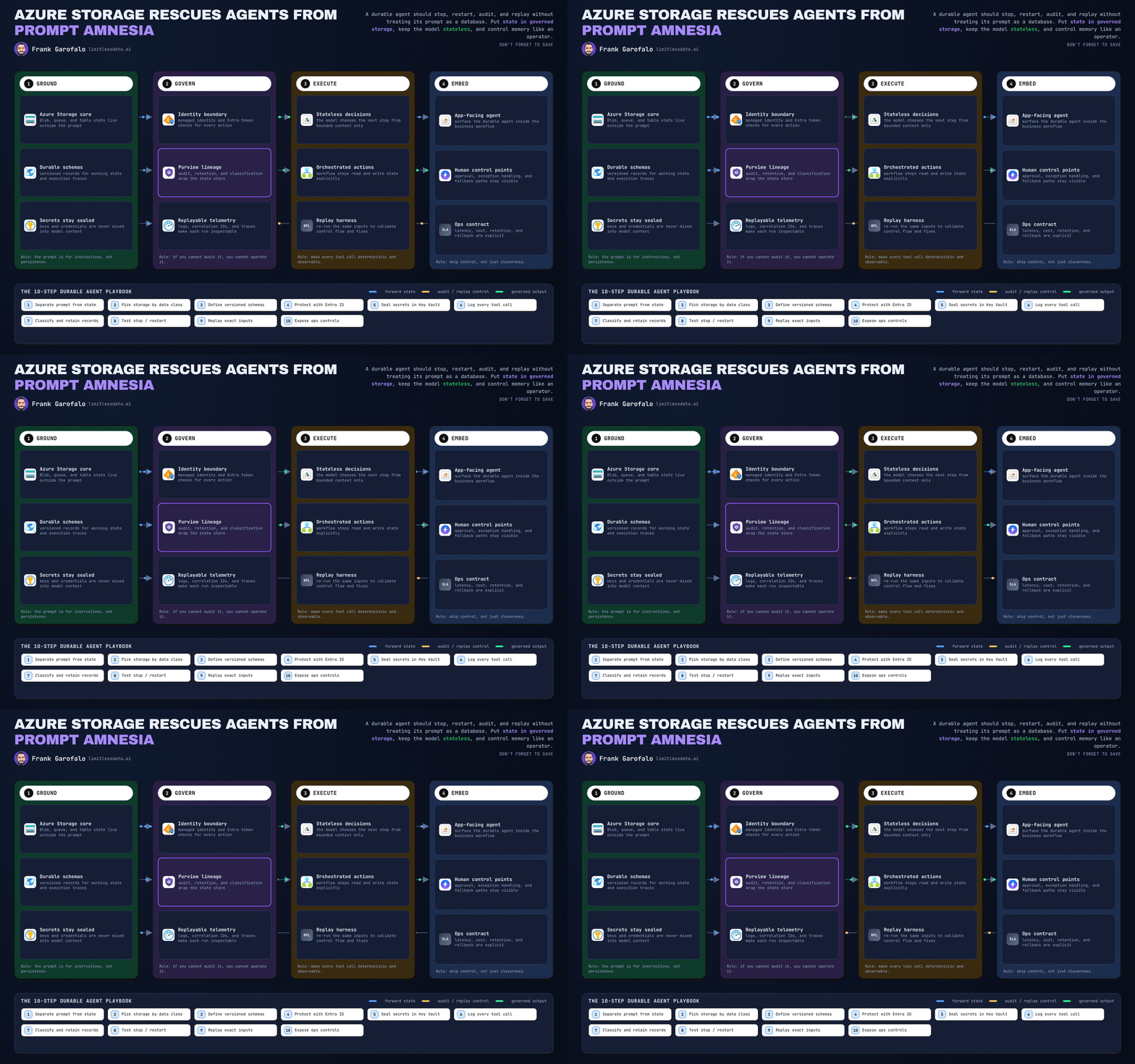
Fabric Spark does not need more notebook demos. It needs an operating model.
Fabric adoption is accelerating, but many teams are still operating Spark like they are in a workshop, not a production estate. The gap is no longer feature availability. It is whether your pipelines survive retries, bad upstream data, dependency drift, and 3 AM reruns without human heroics.
That is the uncomfortable truth: the missing guide for Fabric Spark is not another clever transformation notebook. It is disciplined orchestration, idempotent data design, explicit dependency control, observability, and governance patterns that turn attractive demos into reliable analytics pipelines.
Microsoft is explicitly positioning Fabric as an end-to-end analytics platform across ingestion, Spark, real-time analytics, and BI, which is exactly why isolated notebook success is not enough. The engineering problem is now cross-service reliability, not just Spark syntax mastery. That direction is visible in Microsoft Learn’s end-to-end Fabric training, the ingestion learning path that spans Dataflows Gen2, pipelines, Spark, and KQL databases, and the DP-700 study guide, which includes ingestion, transformation, orchestration, monitoring, and security as core skills rather than optional extras.
The maturity gap is now the real Fabric problem
The conventional wisdom says Fabric teams mainly need more examples: more notebooks, more shortcuts, more feature walkthroughs.
I think that is wrong.
Fabric already gives teams the building blocks for serious analytics systems. Data Factory in Fabric is positioned as the next generation of Azure Data Factory, which makes orchestration a first-class capability inside the platform, not a side utility. Fabric’s lakehouse guidance also frames the estate as an end-to-end system from movement to engineering to BI. Once you accept that, a production failure rarely lives inside one notebook. It usually appears at the boundaries: ingestion timing, dependency ordering, permissions, environment drift, or a handoff between OneLake, pipeline execution, and Spark output.
Last quarter, a 14-person retail data team I advised spent two nights replaying a sales pipeline because a notebook retry appended duplicate daily partitions after an upstream schema tweak landed at 1:17 AM.
That is the demo-to-production gap in one sentence.
Polished notebook demos optimize for immediacy. Production pipelines optimize for reruns, failure isolation, traceability, and cost predictability. Those are different design goals. If your team is still treating notebooks as both the compute engine and the control plane for critical workloads, you are usually optimizing for the wrong outcome.
What breaks after the demo phase
The failures are predictable, and they repeat across teams:
- duplicate writes after retries
- partial table updates after a notebook dies mid-run
- hidden state in interactive sessions
- package drift between development and production
- upstream schema changes that arrive without warning
- “green” jobs that still publish bad data because row counts, null rates, or freshness were never checked
This is why I reject the idea that Spark reliability is mainly a code-quality issue. It is a systems issue.
Fabric training for ingestion already reinforces that production solutions are multi-tool workflows, not notebook-only implementations. If your orchestration logic is embedded inside notebooks with ad hoc branching, sleeps, and hand-built retry loops, you have hidden the operational state in the least observable layer. Pipelines and job definitions exist for a reason: they make dependencies visible, retries explicit, and ownership clearer.
A reliable Fabric estate should look more like a controlled assembly line than a scientist’s bench.
Treat notebooks as compute units, not default control planes
This is the production pattern I am willing to defend strongly: notebooks are excellent development surfaces and useful execution units, but they are usually weak primary control surfaces for operations.
Use pipelines for orchestration. Use parameterized notebooks or Spark job definitions for execution. Use workspace role design to control who can read data, who can run jobs, and who can modify artifacts.
That split matters because Fabric workspace roles are not just administrative labels. They determine who can read data through OneLake APIs and Spark, and who can create or modify notebooks, pipelines, and Spark job definitions. In production, that means role design directly affects reliability, change control, and blast radius, not just access convenience.
Here is the shape of the control flow you actually want: an orchestrator passes a run ID and watermark into a bounded Spark unit, the unit validates data, writes to staging, and only then promotes curated output.

Notice what this pattern does: it makes the unit of work explicit, gives you a traceable run identifier, and separates validation from promotion. That is the foundation for safe retries.
The trade-off is real. You lose some ad hoc flexibility. You gain supportability, auditability, and predictable rerun behavior. For shared, business-critical pipelines, that is usually the right trade.
A practical rule of thumb:
- use notebook-led orchestration for exploration, small-team workflows, low-criticality jobs, or early-stage pipelines with limited blast radius
- use pipeline/job-definition patterns when runs must be repeatable, observable, permissioned, and supportable by someone other than the original author
The non-negotiable pattern is idempotency
If you remember one thing from this post, make it this: rerun safety is the core design requirement for Fabric Spark.
In Fabric terms, idempotency means a failed or repeated run converges to the same correct target state without manual cleanup. Not “usually works.” Not “an engineer can fix it quickly.” The same correct state.
That requires concrete design choices:
- deterministic partition replacement instead of blind append
- merge-based upserts where the business entity truly changes over time
- write-ahead staging zones before curated promotion
- explicit run identifiers and watermarks for replay safety
- validation gates before publish
This is a simple illustrative example of an idempotent write pattern: read from a bounded watermark, derive deterministic partitions, deduplicate on business keys, validate, and overwrite only the intended partition window.
# Minimal idempotent Spark write with run metadata and validation gates
from pyspark.sql import SparkSession, functions as F

spark = SparkSession.builder.getOrCreate()
run_id = "2026-06-22T10:00:00Z"
watermark = "2026-06-21T00:00:00Z"

src = spark.table("bronze.orders").where(F.col("updated_at") >= F.lit(watermark))
df = (src
      .withColumn("run_id", F.lit(run_id))
      .withColumn("p_date", F.to_date("updated_at"))
      .dropDuplicates(["order_id", "updated_at"]))

assert df.filter(F.col("order_id").isNull()).count() == 0, "Null business key"
assert df.count() > 0, "No rows to process"

(df.repartition("p_date")
   .write.mode("overwrite")
   .format("delta")
   .partitionBy("p_date")
   .option("replaceWhere", "p_date >= '2026-06-21'")
   .saveAsTable("silver.orders_staging"))
What to observe here: the logic bounds the write scope with replaceWhere, tags rows with run_id, and refuses to proceed if a business key is null or if there is nothing to process. In production, the overwrite predicate should be parameterized from the same bounded input window used to build the dataset, so the source filter and replacement boundary stay exactly aligned. That alignment is what prevents accidental partition mismatch.
Also, the repeated count() actions here are illustrative. On large Spark workloads, production implementations should minimize full scans, combine metric collection where possible, or use more targeted checks so validation does not become the most expensive part of the pipeline.
Mirroring raises the stakes further. Fabric mirroring is designed to bring operational data into OneLake with low latency and low cost for downstream analytics. That is useful, but it also means downstream Spark jobs will increasingly process fresher and more frequently changing data. The more often you run, the more dangerous non-idempotent design becomes. Freshness without duplicate safety is just faster corruption.
Retries, dependencies, and promotion discipline
Retries are not a checkbox. They are architecture.
A transient failure is not the same as a deterministic failure. A temporary read issue or short-lived service interruption may justify a retry. A broken schema, bad source data, or a changed package version does not. Blind retries on deterministic failures only multiply cost and duplicate output.
My rule is simple: retry only when the unit of work is bounded, observable, and idempotent.
A lightweight retry wrapper can be useful inside a notebook for a narrow transient action, but it should never be the main resilience strategy. The orchestration layer should own task-level retries; the data design should make reprocessing safe; the alerting layer should escalate when repeated failures indicate a systemic problem.
# Simple retry wrapper for transient Spark actions in production notebooks
import time
from pyspark.sql import SparkSession

spark = SparkSession.builder.getOrCreate()

def with_retry(action, retries=3, delay=5):
    for attempt in range(1, retries + 1):
        try:
            return action()
        except Exception:
            if attempt == retries:
                raise
            time.sleep(delay)

result = with_retry(lambda: spark.table("silver.orders").count())
print(f"Validated target row count: {result}")
Use that pattern sparingly. In production, retries should target known transient failure classes rather than catching every exception indiscriminately. The point is not “add retries everywhere.” The point is “know exactly what is safe to retry.”
The same discipline applies to dependencies. Package and environment drift causes more production pain than most teams admit because it turns a stable notebook into a different program across workspaces. Standardized artifacts, explicit library baselines, and controlled promotion between dev, test, and prod matter more than another helper function.
A promotion flow should be deliberate: commit artifacts, deploy standardized versions into test, inject environment parameters, smoke test, then promote approved versions.

What to observe next: the promotion path is explicit and auditable. That is how you reduce “works in dev” failures.
Observability must include data outcomes, not just job status
A green pipeline is not proof of a healthy analytics system.
Many Fabric teams stop too early. They monitor run status, maybe duration, and call it done. But a successful Spark execution can still publish incomplete partitions, stale data, duplicate keys, or null-heavy outputs. Production observability has to cross three layers:
- orchestration status
- Spark execution telemetry
- data quality outcomes
The minimum useful signals are not exotic:
- run ID
- source watermark
- input and output row counts
- latency
- partition coverage
- schema drift events
- null and duplicate checks
- business-rule failures
- final target table and status
A run metadata table is a simple but powerful pattern because it gives you replay safety, auditability, and triage context in one place.
# Run metadata table pattern for replay safety and observability
from pyspark.sql import SparkSession, Row

spark = SparkSession.builder.getOrCreate()
run = Row(
    pipeline_name="orders_silver",
    run_id="2026-06-22T10:00:00Z",
    source_watermark="2026-06-21T00:00:00Z",
    target_table="silver.orders",
    status="Succeeded",
    rows_written=125430
)

meta_df = spark.createDataFrame([run])
(meta_df.write
    .mode("append")
    .format("delta")
    .saveAsTable("ops.pipeline_runs"))
That metadata becomes more valuable when paired with validation gates before promotion. Here is a lightweight example that checks row count, null business keys, and duplicate keys before overwriting the curated target.
# Lightweight data quality checks before promotion to curated table
from pyspark.sql import SparkSession, functions as F

spark = SparkSession.builder.getOrCreate()
df = spark.table("silver.orders_staging")

checks = {
    "row_count_positive": df.count() > 0,
    "no_null_order_id": df.filter(F.col("order_id").isNull()).count() == 0,
    "no_duplicate_keys": df.groupBy("order_id").count().filter("count > 1").count() == 0
}

failed = [name for name, ok in checks.items() if not ok]
if failed:
    raise ValueError(f"Validation failed: {', '.join(failed)}")

spark.sql("CREATE TABLE IF NOT EXISTS silver.orders USING DELTA AS SELECT * FROM silver.orders_staging WHERE 1=0")
spark.sql("INSERT OVERWRITE TABLE silver.orders SELECT * FROM silver.orders_staging")
Again, the exact checks are not the point. The operating model is: no promotion without evidence. And as with the earlier example, repeated count() calls are fine for teaching the pattern but should usually be consolidated or replaced with cheaper metrics collection in large-scale production jobs.
This is also where medallion-style transitions earn their keep. Bronze-to-silver-to-gold is useful when each transition has explicit contracts and failure behavior. Schema contracts, null thresholds, uniqueness checks, freshness windows, and quarantine paths are reliability controls, not optional polish.
Cost control starts with orchestration discipline
Teams often blame Spark cost on one expensive query. That is usually the wrong diagnosis.
In Fabric, cost pain often comes from unnecessary reruns, oversized jobs, poor dependency sequencing, and recomputing more data than the business change actually requires. Retries without idempotency and observability are not just reliability risks; they are cost multipliers.
The practical fixes are boring and effective:
- process incrementally where possible
- bound each run by watermark or partition window
- selectively recompute only affected partitions
- use staging and promotion rather than repeated full rewrites
- schedule with explicit windows and dependency order
- fail fast when data quality gates break instead of pushing bad data downstream
Azure Architecture Center guidance consistently emphasizes patterns and design decisions over isolated implementation tricks. That is the right lens here. Cost-optimized systems are often the same systems that are easiest to operate because both require clear units of work and fewer accidental reruns.
A pragmatic production blueprint for Fabric teams
Here is the operating model I recommend for Fabric Spark production work:
- an ingestion service appropriate to the source, including mirroring where it fits
- an orchestration layer in Fabric pipelines
- parameterized Spark notebooks or job definitions as bounded execution units
- curated lakehouse layers with explicit promotion rules
- embedded data quality gates before publish
- centralized run metadata and monitoring
- workspace role design aligned to least privilege and promotion control
Ownership should be equally explicit:
- platform team owns standards, observability, dependency baselines, and promotion mechanics
- domain teams own transformations, business rules, and data contracts
- governance and security teams own role design, access policy, and audit expectations
That is the missing middle between chaotic notebook culture and overengineered platform bureaucracy.
Fabric is ready for serious analytics workloads. Microsoft’s own learning paths and certifications make that clear by treating orchestration, monitoring, and security as core engineering concerns, not side topics. But the platform does not save teams from workshop habits. You still have to choose production discipline.
My six-question audit for any Fabric Spark pipeline is blunt:
- Can it rerun safely?
- Can it fail loudly?
- Can it explain cost?
- Can it prove data quality?
- Can it survive dependency drift?
- Can another engineer operate it at 3 AM without tribal knowledge?
If the answer to any of those is no, you do not have a production pipeline. You have a successful demo.
Rate your Fabric Spark operating model from 1 to 5: how confident are you that a failed overnight rerun would recover without manual cleanup?
#MicrosoftFabric #Apachespark #DataEngineering
Sources & References
- Azure Architecture Center - Azure Architecture Center
- Ingest Data with Microsoft Fabric - Training
- Study Guide for Exam DP-700: Implementing Data Engineering Solutions Using Microsoft Fabric
- Azure Well-Architected Framework - Microsoft Azure Well-Architected Framework
- Introduction to end-to-end analytics using Microsoft Fabric - Training
- AI Architecture Design - Azure Architecture Center
- Roles in workspaces in Microsoft Fabric - Microsoft Fabric
- Lakehouse end-to-end scenario: overview and architecture - Microsoft Fabric
- Mirroring - Microsoft Fabric
- Introduction to Azure Data Factory - Azure Data Factory
Try it yourself
Run this tutorial as a Jupyter notebook: Download runbook.ipynb (20 cells, 14 KB).