Guided Copilot in VS Code for Azure App Delivery
How Guided Copilot in VS Code Could Change the Azure App Build Loop

A team lost 10 days because nobody agreed on the first repo shape.
I watched this happen on a 14-person app team during a Q2 migration push: half the group started in the Azure portal, three developers scaffolded locally, one person hand-built GitHub Actions, and by the second Friday we had code, no consistent deployment path, and a security review blocking secrets in appsettings files.
That’s why Guided Copilot in VS Code matters to me.
Not because I want autonomous coding theater. Because I want a more repeatable path from an idea to a runnable Azure app with fewer bad branch points in the first mile.
The real win is the build loop, not the autocomplete.
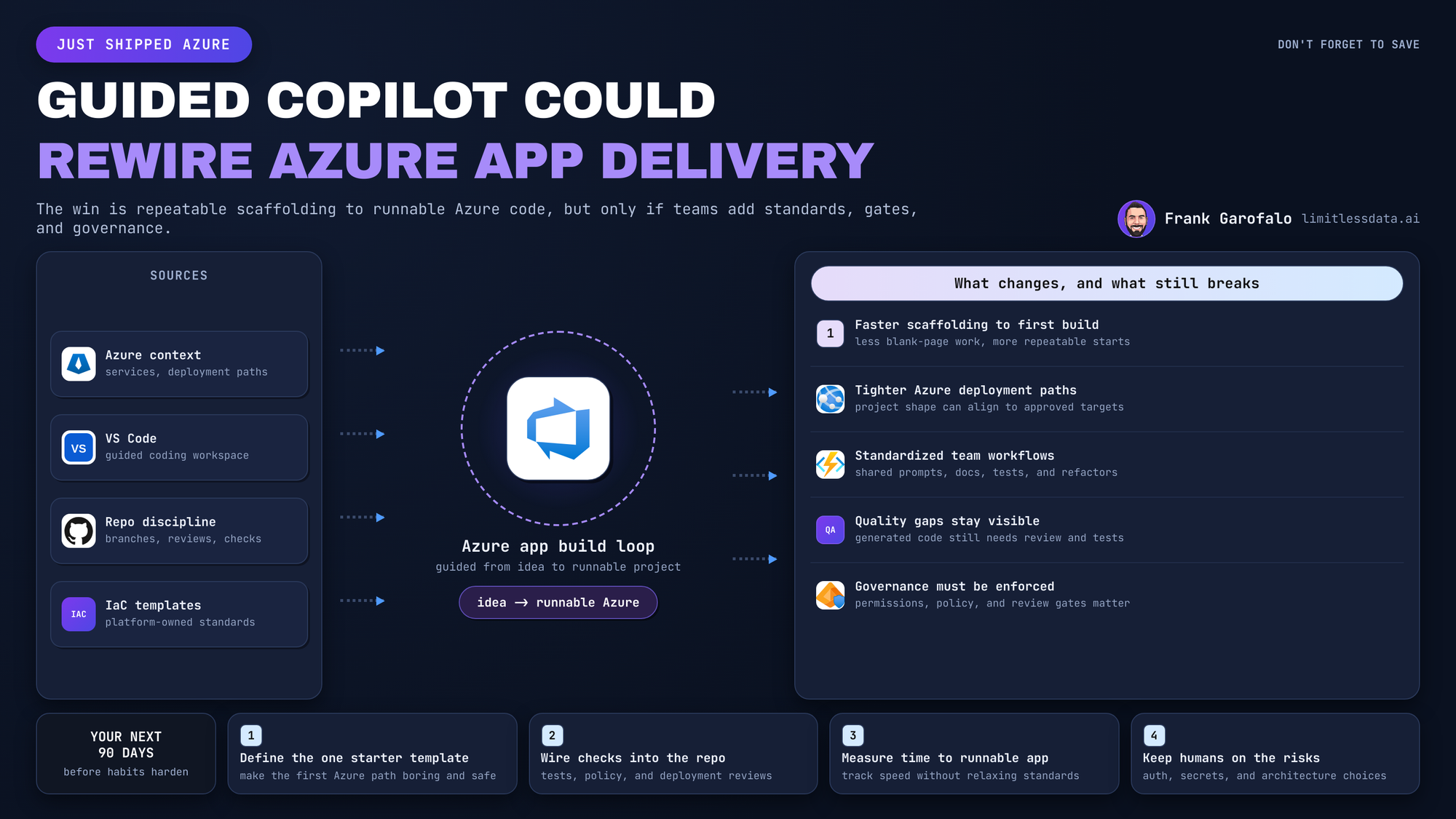
If guidance shows up inside the editor, it can shape the decisions that create most of the drift: repo layout, test setup, docs, environment boundaries, identity assumptions, and deployment shape. Microsoft already supports Azure development across multiple languages in Microsoft Learn, and its GitHub Copilot training in VS Code already leans into app development, testing, documentation, and refactoring. If Guided Copilot extends that into opinionated project setup, platform teams finally get a front door where standards can show up before entropy does.
If your approved path lives in a wiki, people ignore it. If it lives in a starter repo, teams fork it and drift. If it shows up in the build flow they already use, adoption gets a lot better.
That only works if scaffolding is treated like a platform product.
To me, that means approved templates, IaC entry points, CI checks, identity defaults, and observability baselines packaged for internal teams to consume. A simple validation step can check for a README.md, a ci.yml, and an approved IaC entry point like Bicep, Terraform, or azure.yaml before code ever enters the pipeline. Boring by design is exactly what you want at the start of an Azure app build loop.
Guidance accelerates, but governance is what keeps the path safe.
A good experience should move developers toward source control, validation, infrastructure-as-code, and automated deployment, not portal clicks and manual setup. But better guidance does not remove review responsibility. It raises the stakes because more people can move faster.
Before broad rollout, platform leaders should answer four questions:
- Which sources are allowed to shape guidance?
- Which templates and deployment paths are approved?
- How are generated changes reviewed?
- How are exceptions recorded and revisited?
My 3-step playbook:
- Standardize 1-2 common Azure app archetypes.
- Implement guardrails with templates, IaC, and policy checks.
- Measure time-to-first-deployment, not just lines of code.
If Guided Copilot in VS Code can cut first-mile chaos and funnel teams into approved delivery paths, it will matter a lot. If it just helps people write more code faster, the enterprise impact will be modest.
That’s my opinion after years of watching “developer acceleration” die in the gap between a working local app and a governed Azure deployment.
Where does this break in your environment: template rigidity, IaC discipline, or review gates?
#GitHubCopilot #AzureDevOps #PlatformEngineering
Try it yourself
Run this tutorial as a Jupyter notebook: Download runbook.ipynb (13 cells, 13 KB).