Incremental Migration to Microsoft Fabric Warehouse
Incremental Migration to Fabric Warehouse: A Safer Path Off Legacy Database Objects

60 minutes of mirroring can save 6 months of bad cutover decisions.
That’s the real announcement.
On this page
- 60 minutes of mirroring can save 6 months of bad cutover decisions.
- Why phased migration works better
- The Fabric migration pattern I’d actually use
- Tooling is Acceleration, Evidence is the Criterion
- The takeaway
The mistake I still see is treating database modernization like a single weekend event. Data moves. Views move. Stored procedures move. Semantic models move. Report behavior changes. Ownership changes. Stack all of that into one cutover and programs stall.
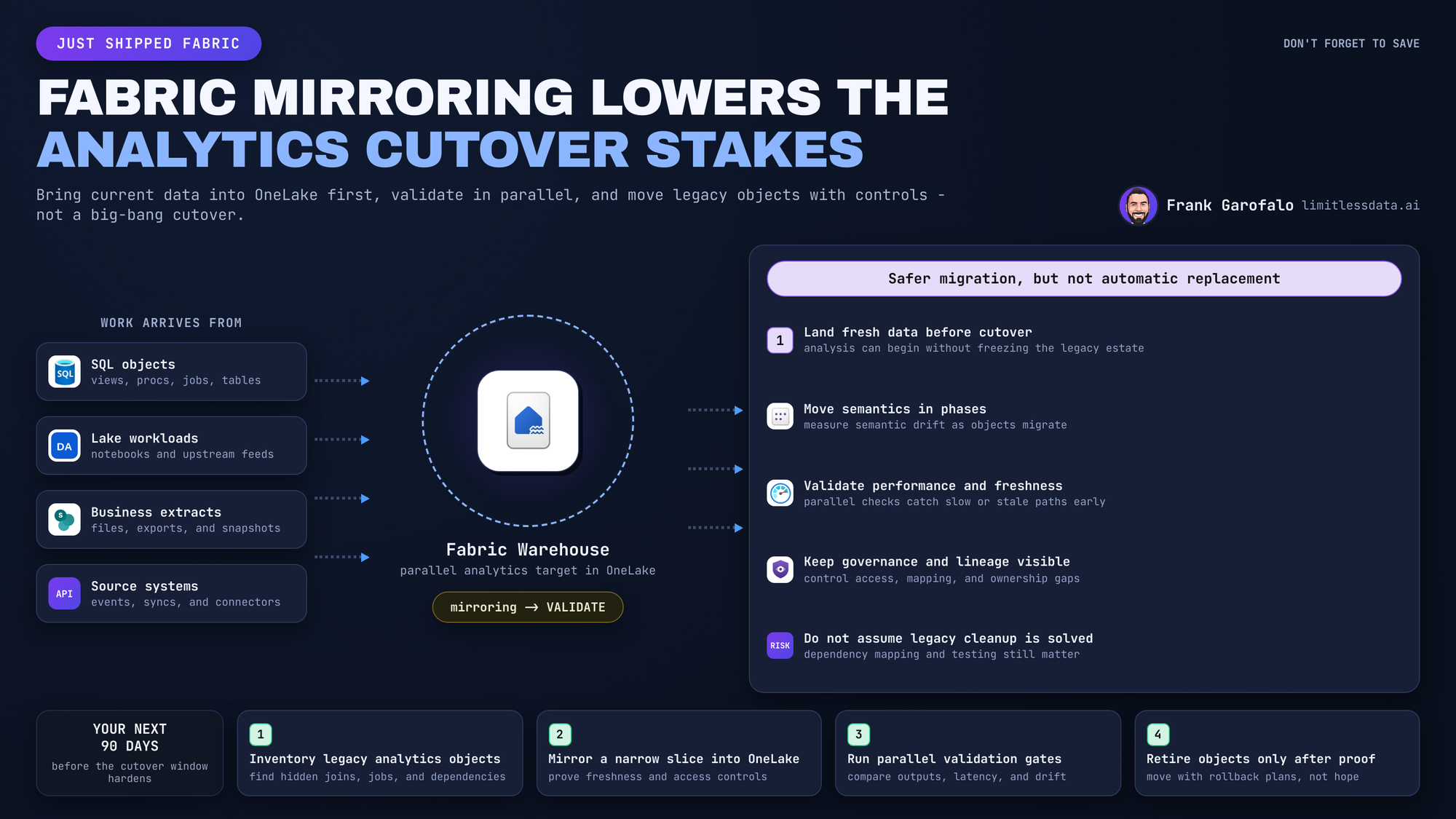
Fabric changes that conversation because you can get current source data into OneLake early and validate behavior before ripping out legacy database objects. Mirroring gives teams a low-friction way to query fresh operational data in parallel while they migrate selectively instead of betting everything on a big-bang weekend.
Why phased migration works better
A legacy analytics estate is a contract, not a pile of tables.
That contract includes row-level assumptions, naming quirks, batch timing, downstream Power BI models, ugly but business-critical views, and the one finance procedure nobody wants touched during quarter close.
In one recent program, the blocker wasn’t data copy speed. It was proving which old “temporary” views still drove executive reporting. That’s why phased adoption wins: current data lands in OneLake, the business can start validating analytics behavior, and engineering can move objects in waves with less risk.
The Fabric migration pattern I’d actually use
My playbook is simple:
- Mirror the source first so fresh data is available in OneLake immediately.
- Choose workload placement on purpose: lakehouse, warehouse, or eventhouse based on fit, not familiarity.
- Inventory objects, classify ownership and criticality, and map dependencies.
- Pick one bounded migration wave.
- Run source and target side by side.
- Promote only after evidence, not optimism.
The “right” first wave is usually boring: low dependency count, known owner, validated outputs, minimal blast radius. That’s exactly what you want.
A simple scorecard output might look like this:
object               score   wave    validated   retrigger
dbo.dim_customer         4   Wave 1  True        False
dbo.vw_sales             7   Wave 2  True        False
dbo.usp_close_month     29   Wave 3  False       True
That tells the story fast: start with the stable, low-risk object, not the politically important one with unknown ownership and constant change.
Long migrations also require re-migration. Source schemas change. Definitions drift. New consumers appear halfway through the program. If your plan assumes one export and one final cutover date, it’s already wrong.
Tooling is Acceleration, Evidence is the Criterion
Migration helpers, preview tooling, and familiar interfaces like SSMS are useful because they reduce manual grind. I’ll take that head start every time. But generated output is not proof of equivalence.
You still need dependency mapping across upstream feeds, database objects, semantic models, reports, schedules, and embedded consumers. And you still need semantic validation. A Warehouse object can be technically correct while the semantic layer, report logic, or performance profile drifts enough to break trust with the business.
So the decision framework I’d put in front of architecture leaders is straightforward: rank each object or workload by business value, dependency complexity, sensitivity, performance risk, and reversibility. Then define exit criteria per wave: reconciled data, functional test pass, security review, representative performance validation, named owner, and documented rollback path.
Calendar dates are terrible cutover criteria. Evidence is the criterion.
The takeaway
Fabric gives you a better modernization shape: current data in OneLake, early access to analytics services, and a path to move legacy objects selectively instead of all at once.
It does not remove the hard parts. You still need testing, dependency mapping, performance validation, ownership, and governance. But it changes where you take risk, and that’s the whole game.
Where does this phased Fabric Warehouse approach break down most often in your environment: dependency sprawl, semantic drift, performance, or ownership?
#MicrosoftFabric #DataArchitecture #AnalyticsEngineering
Try it yourself
Run this tutorial as a Jupyter notebook: Download runbook.ipynb (14 cells, 13 KB).