AI-Native Data Engineering Operating Model With Fabric
The AI-Native Data Engineer: Why Fabric, dbt, Devcontainers, and Copilot Are Converging

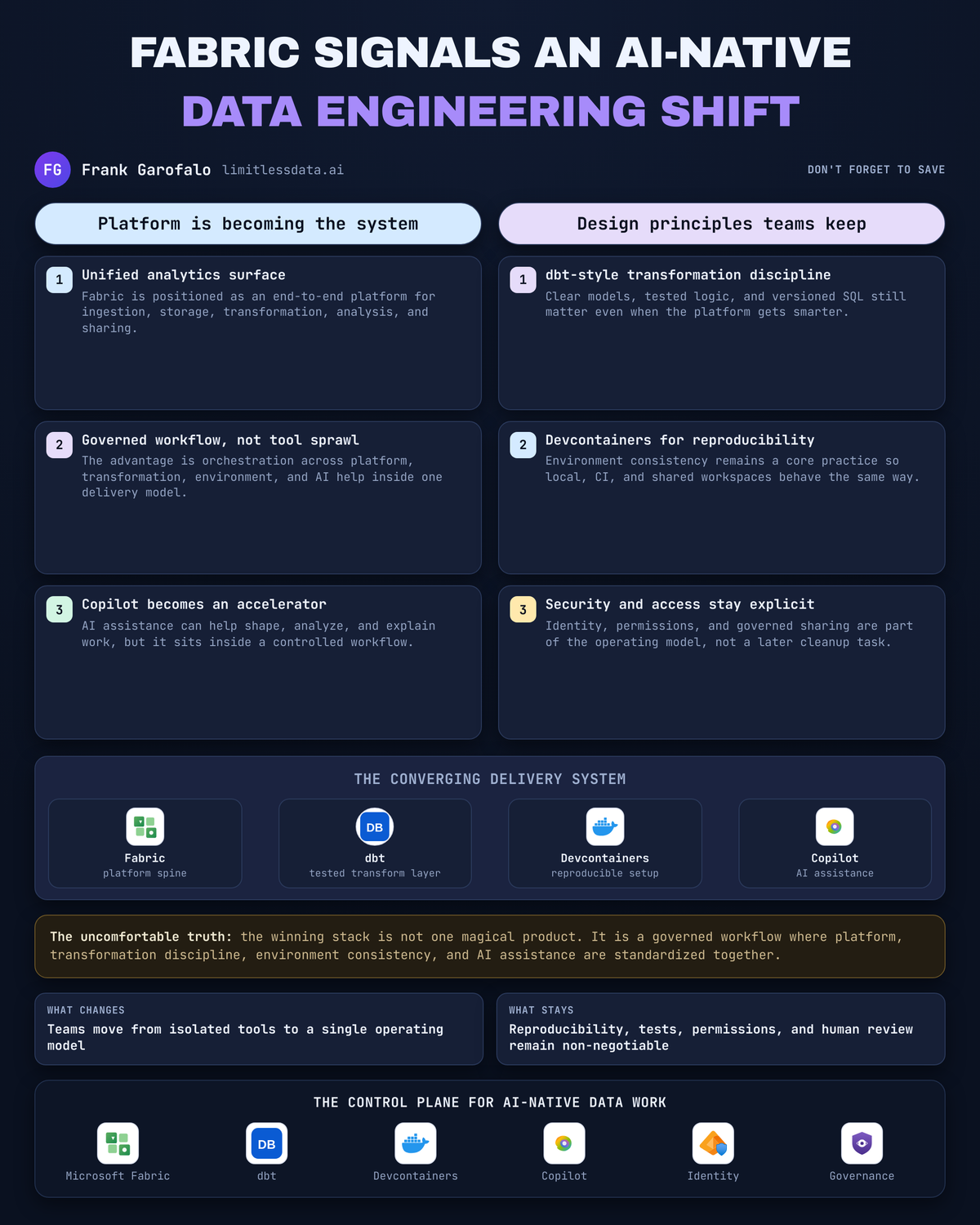
72 hours is enough to expose a broken data-engineering operating model.
On this page
- The real shift is workflow convergence
- Why the AI-native engineer needs a different operating model
- Fabric is a convergence signal, not a replacement for engineering rigor
- The durable control plane is governance plus reproducibility
- A practical AI-native workflow you can stand up this week
- From data products to AI-consumable organizational context
- Microsoft-centric convergence versus fragmented alternatives
- What leaders should standardize now
- Sources & References
That’s about how long it takes a smart team to discover they don’t have a tooling problem at all. They have a workflow problem: one platform for storage, another pattern for transforms, five different local setups, and AI sprinkled on top like it somehow fixes the seams. It doesn’t. The next advantage is a governed delivery system where platform, transformation, dev environment, and AI assistance work together.
TL;DR: The future of data engineering isn’t about picking the best tool, but about building one coherent workflow. This post breaks down how Microsoft Fabric (platform), dbt (discipline), Devcontainers (reproducibility), and Copilot (assistance) are converging into a single, governed delivery system for the AI era.
The real shift is workflow convergence
The market keeps trying to sell this as a product bake-off. Fabric versus Snowflake. dbt versus native transforms. Copilot versus every other assistant. That framing is already stale.
The strategic question now is simpler and much more uncomfortable: can your team move from raw data to governed AI-consumable context through one coherent workflow?
That workflow has four layers:
- the analytics platform
- the transformation discipline
- the reproducible developer environment
- the AI assistance layer
If any one of those is ad hoc, the whole thing wobbles.
Microsoft is making this convergence obvious. Fabric is explicitly positioned as a unified platform spanning ingestion, storage, transformation, analysis, and sharing, with an end-to-end view across data and analytics workloads per the Fabric overview. That matters less as a vendor slogan and more as a market signal: the winning pattern is not isolated best-of-breed tools glued together by tribal knowledge.
Senior leaders need to stop asking, “What tool should we add?” and start asking, “What delivery contract are we standardizing?”
Why the AI-native engineer needs a different operating model
A modern data engineer is no longer just moving rows and scheduling jobs. The job now spans:
- ingestion and storage patterns
- transformation logic
- semantic meaning
- governed access
- AI-facing consumption paths
That last one changes the economics.
Once AI assistants start generating SQL, documentation, tests, semantic descriptions, or natural-language answers from enterprise data, inconsistency gets expensive fast. A metric with three definitions is no longer a dashboard annoyance. It becomes an organization-wide hallucination generator.
Back in Q1, I worked with a 14-person data team that lost nine business days because two engineers had different local Python/dbt setups and produced different compiled artifacts against the same branch; the bug only surfaced after a semantic model refresh hit the CFO dashboard. That’s the kind of failure people still call “developer friction” right up until it becomes an executive escalation.
This is why I keep pushing two old-school disciplines into every AI conversation:
- dbt-style transformation rigor
- devcontainer-style environment consistency
dbt matters because it treats transformation logic like software: explicit, reviewable, testable, versioned. Whether you use dbt itself or borrow its discipline, the point is the same. Your business logic cannot live as undocumented magic inside somebody’s notebook and still be trusted by AI systems.
Devcontainers matter because reproducibility is not a nice developer convenience. It is a control surface. If every engineer hand-assembles their local toolchain, you do not have a platform. You have a collection of lucky coincidences.
Fabric is a convergence signal, not a replacement for engineering rigor
Here’s the part people get wrong: Fabric does not remove the need for engineering discipline. It raises the payoff for having it.
Microsoft’s pitch is straightforward. Fabric is a single platform for implementing data analytics solutions that integrate, transform, and store data, which is exactly how Microsoft frames the learning path and product story in its Fabric training content. If you run a Microsoft-heavy estate, that can reduce pointless handoffs between data platform teams, BI teams, and the people trying to operationalize AI on top.
That reduction in seams is real. Fewer products to stitch together often means fewer identity gaps, fewer duplicated governance policies, and fewer “who owns this layer?” meetings.
But let’s be adults about maturity boundaries. Microsoft states that Copilot and other generative AI features in Fabric and Power BI are in preview, intended to help transform and analyze data, generate insights, and create visualizations and reports per the Copilot in Fabric overview. Preview is useful. Preview is directional. Preview is not your excuse to pretend production controls are solved.
So my opinion is blunt: Fabric is an important signal of where the stack is going, but it does not replace source control, review gates, tests, environment standards, ownership, or semantic accountability. If consolidation doesn’t improve control, delivery speed, and clarity of ownership, it’s just a prettier sprawl.
The durable control plane is governance plus reproducibility
The durable advantage here is not “we have AI features.” Everybody will have AI features.
The durable advantage is that your team can deliver governed changes repeatedly without drama.
That starts with a platform contract. Mine usually includes:
- identity and access patterns
- approved paths to source and serve data
- source control requirements
- environment definitions
- review and release gates
- ownership of semantic meaning
If you want a simple picture of the target state, this is the one I’d put in front of an architecture review. It shows the point I keep making: Fabric, dbt discipline, a reproducible dev environment, and Copilot-style assistance are strongest when they operate as one system, not as disconnected purchases.
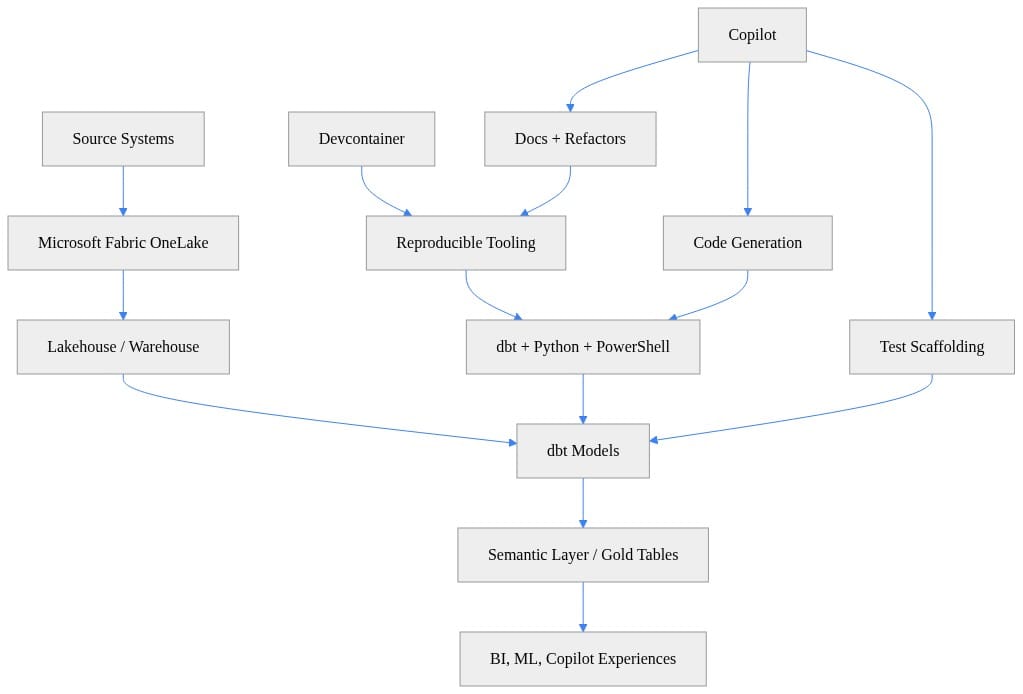
Look at the flow, not the boxes. Source systems land into the platform. Transformations are explicit. Semantic outputs feed BI, ML, and Copilot experiences. The devcontainer standardizes the tooling. Copilot accelerates code, tests, and docs, but it plugs into the workflow instead of bypassing it.
Here’s a lightweight devcontainer example I’d use to prove the operating model with a team. It gives every engineer the same Python base, PowerShell, Git, and a consistent extension set. This is illustrative, not production gospel, but it demonstrates the discipline.
// Devcontainer for a reproducible AI-native data engineering workspace
{
  "name": "fabric-dbt-ai-native",
  "image": "mcr.microsoft.com/devcontainers/python:3.11",
  "features": {
    "ghcr.io/devcontainers/features/powershell:1": {},
    "ghcr.io/devcontainers/features/git:1": {}
  },
  "postCreateCommand": "pip install dbt-core dbt-duckdb pandas pyarrow",
  "customizations": {
    "vscode": {
      "extensions": [
        "ms-python.python",
        "ms-vscode.powershell",
        "GitHub.copilot"
      ]
    }
  }
}
What I want you to notice is not the package list. Notice that the environment is declared. That means onboarding gets faster, machine drift drops, and “works on my laptop” stops being a release strategy.
Then I’d pair that with a minimal dbt project skeleton so transformation logic starts life as versioned software instead of improvised SQL fragments.
# Minimal dbt project showing how transformation logic becomes versioned software
name: fabric_ai_native_demo
version: "1.0.0"
config-version: 2

profile: fabric_ai_native_demo

model-paths: ["models"]

models:
  fabric_ai_native_demo:
    bronze:
      +materialized: view
    silver:
      +materialized: table
    gold:
      +materialized: table
Once that exists, the conversation changes. Reviews become concrete. Tests become expected. AI assistance has a stable target to generate against.
If you’ve read my take on Fabric Data Factory shrinking the pipeline stack, this is the same argument one layer up: integration value only pays off when the workflow around it is disciplined.
A practical AI-native workflow you can stand up this week
I’m a big believer in proving architecture with a tiny working loop before drawing the enterprise diagram. In my home lab, that usually means spinning up a clean repo in a devcontainer on a Proxmox-backed VM, validating the workflow locally, and only then wiring it into the bigger Azure/Fabric path.
Start with fake bronze data so the team can focus on delivery mechanics instead of waiting on upstream systems.
# Generate a small bronze dataset locally to simulate landing data before dbt transforms it
import pandas as pd
from pathlib import Path

df = pd.DataFrame(
    [
        {"user_id": 1, "event_type": "view", "event_ts": "2026-08-10T09:00:00"},
        {"user_id": 1, "event_type": "click", "event_ts": "2026-08-10T09:05:00"},
        {"user_id": 2, "event_type": "view", "event_ts": "2026-08-10T10:00:00"},
    ]
)

out = Path("data")
out.mkdir(exist_ok=True)
df.to_parquet(out / "bronze_events.parquet", index=False)
print(df)
That gives you a small local parquet dataset to simulate landed raw events. Nothing fancy. Good. Fancy is where teams hide broken process.
Next, make the transformation explicit with a dbt model. This is the discipline I want organizations to standardize: clear inputs, clear outputs, and logic that can be reviewed by another human.
-- A focused dbt model that turns raw events into a reusable silver layer
with source_events as (
    select
        user_id,
        event_type,
        cast(event_ts as timestamp) as event_ts
    from {{ ref('bronze_events') }}
),

sessionized as (
    select
        user_id,
        event_type,
        date_trunc('day', event_ts) as event_date
    from source_events
)

select
    user_id,
    event_date,
    count(*) as event_count
from sessionized
group by 1, 2
The key pattern is simple:
- raw-ish input becomes a reusable silver layer
- timestamps are normalized
- aggregation logic is visible
- the output is stable enough to feed downstream semantic definitions
Now run it like software, not like artisanal analytics.
# Run dbt like a software delivery step: parse, test, build, and document
$ErrorActionPreference = "Stop"

dbt parse
dbt debug
dbt build --select silver+
dbt test
dbt docs generate

Write-Host "dbt pipeline completed successfully."
That sequence matters. Parse. Debug. Build. Test. Generate docs. Even in a demo, I want engineers to feel the release cadence. AI-native teams that skip this and jump straight to “let Copilot write the SQL” are building a faster path to inconsistent junk.
Finally, add a post-build validation step. Again, not because this exact check is magical, but because the habit is.
# Use Python to validate transformed outputs the same way a CI job would
import duckdb

query = """
select user_id, event_date, event_count
from read_parquet('target/**/*.parquet', union_by_name=true)
where event_count < 0
"""

result = duckdb.connect().execute(query).fetchall()
assert result == [], f"Found invalid aggregates: {result}"
print("Quality check passed: no negative event counts.")
If that tiny loop works, you’ve got the seed of the operating model:
- reproducible environment
- explicit transforms
- testable outputs
- AI assistance inside guardrails
That is far more important than whether your assistant generated 20 lines of YAML for you.
From data products to AI-consumable organizational context
This is where the conversation gets interesting.
Microsoft describes Fabric data agents as a preview capability for building conversational Q&A systems using generative AI in the Fabric data agent documentation. That’s not a toy feature. It’s a signal that the platform is moving from “store and query data” toward “package governed context for conversational use.”
And the broader direction is even clearer. Fabric IQ is described as a distribution layer intended to make intelligence consistently available across Fabric workloads, Foundry, and Copilot Studio in the Fabric IQ overview. Pair that with Microsoft IQ’s enterprise intelligence story and you can see the shape of the future: shared organizational context, exposed across analytics and agent experiences.
That future only works if somebody owns the semantics.
Making data conversational does not reduce the need for data-product ownership. It increases it. The moment an agent can answer a question from “enterprise data,” the definition of enterprise data becomes a governance issue, a product issue, and a trust issue all at once.
I’ve written before that Fabric data agents turn governance into product design. Same story here. If your gold layer is messy, if your definitions drift, if access rules are inconsistent, then your shiny AI experience is just a nicer interface on top of confusion.
Microsoft-centric convergence versus fragmented alternatives
I’m not interested in lazy vendor tribalism. There are real tradeoffs here.
A Microsoft-centric stack can offer a cleaner path across analytics, enterprise productivity, and AI extension points. That matters if your users already live in Microsoft 365, your identity plane is centered there, and your governance model benefits from fewer boundaries.
A fragmented stack can preserve specialized choices and existing investments. Sometimes that is absolutely the right answer. But if you choose fragmentation, own the cost honestly:
- more integration seams
- more identity mapping
- more governance translation
- more developer environment drift
- more accountability gaps
Those are not theoretical costs. They show up in onboarding time, release failures, duplicated definitions, and security review fatigue.
There is still modularity inside the Microsoft ecosystem, which is the part some critics miss. Microsoft documents that Copilot Studio agents can be linked to other agents, including external sources such as Fabric data agents, in its what’s new documentation. That means “integrated” does not have to mean “monolithic.” You can still compose capabilities. You just do it inside a more coherent control plane.
What leaders should standardize now
If I were setting direction for a data organization today, I would standardize the seams before standardizing every product.
That means:
1. Standardize source control and review
No direct-to-prod heroics. Transformation logic, semantic definitions, prompts, and environment config all belong in version control.
2. Standardize environment reproducibility
Devcontainer-style definitions or an equivalent. Every engineer starts from the same baseline.
3. Standardize transformation discipline
Use dbt or dbt-like practices. Explicit models. Tests. Documentation. Reviewable changes.
4. Standardize approved data access paths
Decide how data is exposed to BI, ML, agents, and copilots. Make that path governed and repeatable.
5. Standardize AI boundaries
Be explicit about what assistants may access, generate, and operationalize. Drafting SQL is one thing. Executing changes against governed assets is another.
6. Standardize ownership
Every semantic domain needs an accountable owner. “The platform team owns it” is not ownership. That’s avoidance.
Measure the results with operational metrics that actually matter:
- onboarding time for a new engineer
- number of unreproducible release issues
- test coverage on transformation assets
- clarity of data ownership by domain
- reliability of approved context for AI-facing experiences
That’s the operating-model shift. Not more tools. Better seams.
The teams that win this cycle will not be the ones with the flashiest demo. They’ll be the ones that standardize platform, transformation, environment, and AI assistance into one governed workflow so they can absorb new capabilities without rebuilding the shop every quarter.
Where does this break in your environment: platform standardization, dbt-style discipline, devcontainers, or AI guardrails?
#MicrosoftFabric #Dbt #DataArchitecture
Sources & References
- Microsoft Fabric documentation - Microsoft Fabric
- Official Microsoft Power Platform documentation - Power Platform
- Microsoft 365 Copilot hub
- Fabric data agent creation - Microsoft Fabric
- What is Fabric IQ? - Microsoft Fabric
- Microsoft IQ documentation
- What's new in Copilot Studio - Microsoft Copilot Studio
- Get started with Microsoft Fabric - Training
- Architect AI Solutions For Business Productivity - Training
- Overview of Copilot in Fabric - Microsoft Fabric
Try it yourself
Run this tutorial as a Jupyter notebook: Download runbook.ipynb (28 cells, 21 KB).