Microsoft Copilot Usage-Based Billing Governance Guide
Microsoft Copilot’s Usage-Based Billing Model: What Finance and Platform Teams Need to Know

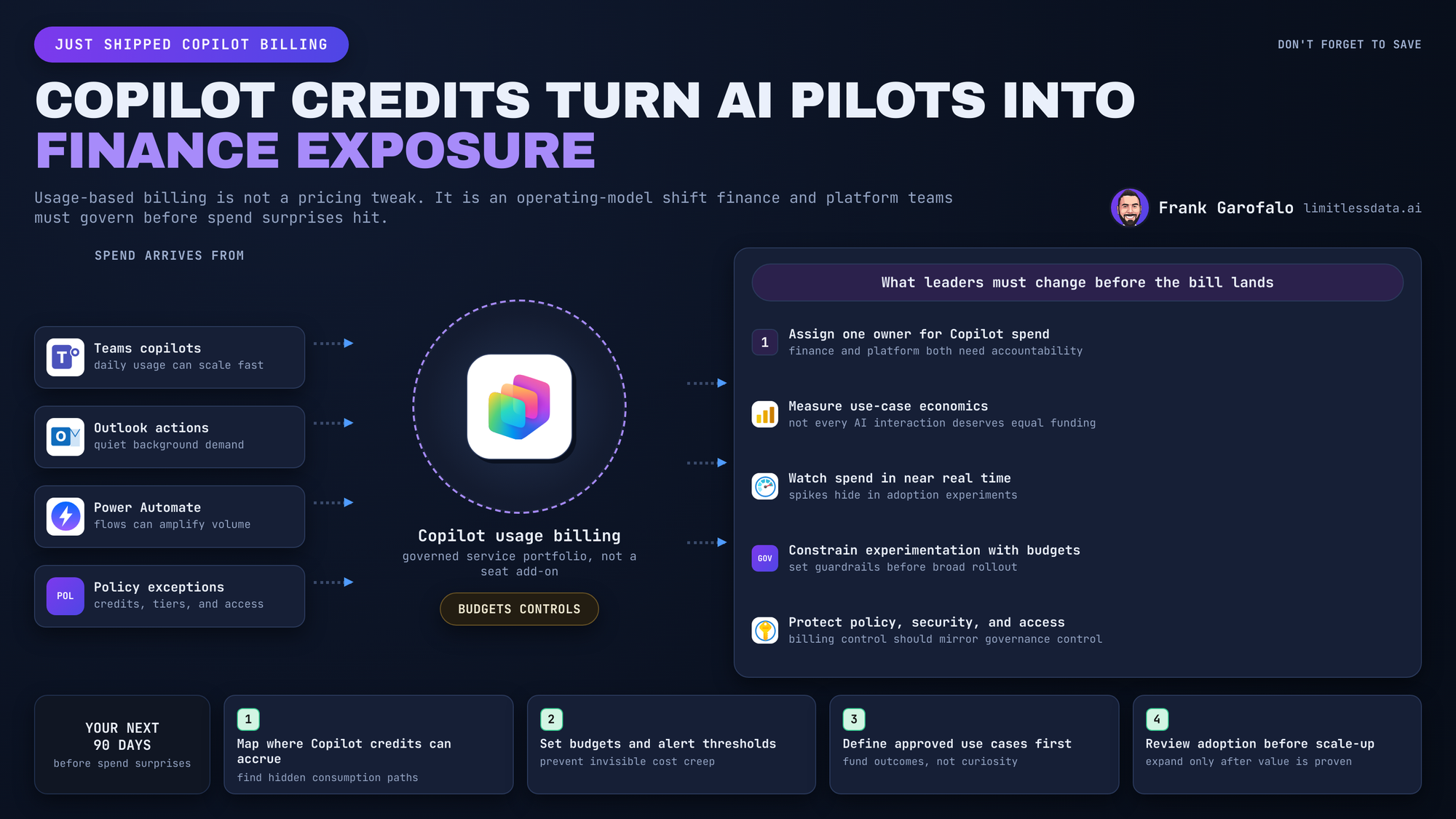
Copilot usage-based billing just moved AI spend into operations.
If your finance team still treats Copilot like a seat-count exercise, you are already behind. Microsoft is expanding Copilot experiences where spend is governed through usage-based billing and Copilot Credits, which means AI cost now behaves more like cloud consumption than classic SaaS licensing, with Cost Management spending policies available to control access and credit spending for supported experiences per the Microsoft docs.
On this page
- The budget model has changed
- Where Copilot Credits enter the estate
- Variable AI spend needs different economics
- Build shared ownership before the pilot becomes a program
- Make attribution and guardrails nonnegotiable
- Segment adoption by use case, not license availability
- The failure modes finance leaders should expect
- Put Copilot spend on the board-level agenda
- Sources & References
That shift matters because budgets built for entitlements answer one question: how many people are allowed to use the thing? Consumption billing answers a different one: which workloads deserve another dollar?
I’m bullish on Copilot. I’m also allergic to lazy rollout logic. Broad availability is not proof of broad value. A scaled deployment needs evidence that a specific workflow, agent, or experience creates enough business outcome to justify the variable spend it drives.
The budget model has changed
Seat-based software is easy to explain in a steering committee. You buy 5,000 licenses, allocate them by function, track adoption, and argue about renewal.
Usage-billed AI blows that up.
Now the cost curve depends on behavior:
- how often people invoke the experience
- how many retries they trigger
- how the workflow routes requests
- whether the agent design creates waste
- whether the audience is broad, narrow, or totally uncontrolled
That is not a procurement problem. That is an operating model.
A CDO I worked with in Q4 had 12 internal AI assistants live across HR, legal, and operations before anyone could tell me which VP owned the monthly burn on three of them. That is how “innovation” turns into a finance escalation.
The right mental model is service portfolio management. You do not fund “Copilot” as one blob. You fund a set of AI services with different economics, different owners, and different expected returns.
If you want the organizational version of this argument, I laid out the people side of it in Microsoft 365 Copilot Adoption, Burnout and Governance. The billing angle just makes the need for discipline a lot less optional.
Where Copilot Credits enter the estate
Microsoft has made this pretty plain if you read the admin docs instead of the launch headlines.
For supported AI experiences, Microsoft documents usage-based billing controls through Copilot Credits and Cost Management spending policies. Those policies are the lever for access and spend control, not just after-the-fact reporting, per the Cost Management guidance.
The surface area leaders need to inventory is growing:
- Copilot Cowork includes usage-based billing in its governance guidance alongside plugins, models, browser use, security, and compliance per the admin governance docs
- SharePoint is adding agentic Copilot capabilities for questions, workflows, and content creation over SharePoint content
- Copilot Studio is increasingly central for agents, workflows, and apps
- Power Platform remains the broader control plane where many teams will actually build and manage apps, automations, analytics, and agents
That means the old “we’ll let one platform team sort it out later” approach is dead on arrival. Your inventory has to include:
- business unit
- environment
- owner
- audience
- billing path
- expected value
- stopping rule
Here’s the simple operating picture I use when I explain this to finance and platform teams together.
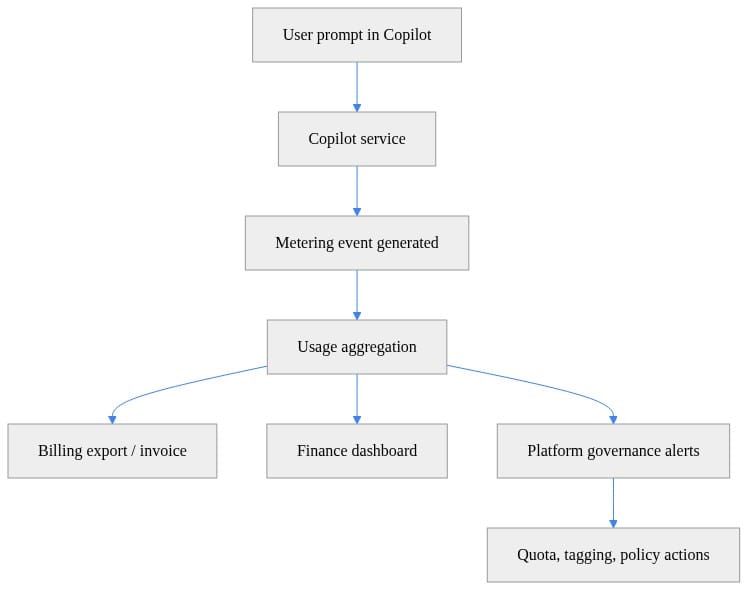
What I want people to notice in that flow is the split after metering. The same usage event feeds billing, finance visibility, and platform action. If those three tracks are disconnected, you will reconcile invoices after the money is gone instead of steering behavior while it is happening.
One more important point: Microsoft describes Copilot Credit pre-purchase plans as commit units bought at discounted tiers in a purchasing currency for a specific product per the Copilot Credit reservation docs. Good buying mechanics help. They do not replace governance. I’ve watched too many enterprises confuse pre-purchase with control.
Variable AI spend needs different economics
This is where finance teams usually get irritated, and honestly they should.
An annual seat budget gives you predictability. A consumption portfolio gives you forecast, actuals, variance, and behavior management. Different game.
You need unit economics for each funded workload. Not vague adoption metrics. Actual business units of value.
Examples:
- finance: completed close-package draft reviewed by an analyst
- HR: resolved employee request without escalation
- legal ops: validated first-pass document workflow
- sales ops: approved account brief generated from governed sources
- SharePoint: successful answer or content artifact created from approved content
If you do not define the unit of value, you cannot tell whether cost growth is healthy demand or expensive noise.
Average cost is the trap here. I see teams celebrate a nice blended number while one ugly workflow is quietly burning budget with retries, oversized prompts, or bad routing logic. Popular services can hide terrible sub-patterns.
This is the same reason I push hard on workload-level controls in Microsoft 365 Copilot Enterprise AI Governance Controls. Aggregate visibility makes executives feel good. Attribution is what lets you act.
A lightweight estimator is enough to start the conversation. You do not need a data warehouse before you need math.
# Estimate monthly Copilot spend from usage events and a unit rate
from dataclasses import dataclass

@dataclass
class UsageEvent:
    user: str
    business_unit: str
    units: int

events = [
    UsageEvent("alice", "Finance", 1200),
    UsageEvent("bob", "Engineering", 3400),
    UsageEvent("carol", "Finance", 800),
]

rate_per_1k_units = 2.50
total_units = sum(e.units for e in events)
estimated_cost = (total_units / 1000) * rate_per_1k_units

print(f"Total units: {total_units}")
print(f"Estimated monthly cost: ${estimated_cost:.2f}")
That example is intentionally simple. The point is to force a monthly estimation habit around billable units and rates, then compare estimate versus actual. Once teams see even a rough cost curve, the conversation gets a lot more disciplined.
From there, roll the same logic up by business unit for showback.
# Roll up usage cost by business unit for chargeback or showback
from collections import defaultdict

events = [
    {"business_unit": "Finance", "units": 1200},
    {"business_unit": "Engineering", "units": 3400},
    {"business_unit": "Finance", "units": 800},
    {"business_unit": "HR", "units": 600},
]

rate_per_1k_units = 2.50
cost_by_bu = defaultdict(float)

for event in events:
    cost_by_bu[event["business_unit"]] += (event["units"] / 1000) * rate_per_1k_units

for bu, cost in sorted(cost_by_bu.items()):
    print(f"{bu}: ${cost:.2f}")
What to do next: put that rollup in front of finance and the business owners every month. If a department cannot explain the top two drivers of its AI consumption, it is not ready for broad rollout.
Build shared ownership before the pilot becomes a program
This is the part enterprises consistently delay, and it always costs more later.
Here is the ownership split I recommend.
Finance owns:
- funding rules
- forecast cadence
- showback and eventual chargeback policy
- executive reporting
- exception approval thresholds
Platform owns:
- service inventory
- environment and access design
- policy implementation
- telemetry and monitoring
- budget guardrails
- operational review of outliers
Business owners own:
- use-case hypothesis
- approved audience
- measurable outcome
- redesign or retirement decision
- narrative for why this workload should scale
And yes, you need a small AI cost council. Keep it lean. Finance lead, platform lead, security voice, and one business sponsor from the workloads under review. Meet monthly. Approve stage changes. Kill bad experiments. Fund good ones harder.
That sounds bureaucratic until you compare it with the alternative, which is six teams discovering the same billing lesson independently.
In my home lab, I do a tiny version of this with Proxmox clusters and Azure services: every new service gets an owner, purpose, resource boundary, and stop condition before it touches shared capacity. Enterprises need the same muscle, just with more zeros and more politics.
Make attribution and guardrails nonnegotiable
Every funded Copilot experience should have a minimum metadata pack:
- business unit
- named owner
- environment
- agent, workflow, or app identifier
- intended audience
- expected business value
- budget stage
No metadata, no funding. Simple.
Then put staged guardrails around the lifecycle.
Stage 1: experiment
- small audience
- hard budget cap
- fixed review date
- showback only
- no automatic expansion
Stage 2: departmental rollout
- validated use case
- owner confirmed
- usage trend monitored
- variance reviewed monthly
- explicit budget increase approved
Stage 3: enterprise service
- stable attribution
- outcome evidence
- operational support model
- stronger controls
- candidate for chargeback if allocation quality is mature
If you need a dead-simple threshold monitor, start there. Fancy dashboards can wait.
# Flag budget overruns early with a simple threshold-based monitor
monthly_budget = 25.00
current_spend = 19.75
forecasted_new_usage_units = 2600
rate_per_1k_units = 2.50

projected_spend = current_spend + (forecasted_new_usage_units / 1000) * rate_per_1k_units
threshold = 0.9 * monthly_budget

print(f"Projected spend: ${projected_spend:.2f}")
if projected_spend >= threshold:
    print("ALERT: projected spend is above 90% of budget")
else:
    print("OK: projected spend is within budget")
This is not production monitoring. It is a forcing function. Teams should see projected spend crossing 90% of budget before finance sees the invoice.
And if you are running sandboxes or test identities, review them aggressively. Cheap experimentation is fine. Anonymous experimentation is how you end up funding nonsense.
# Enforce a simple governance rule by disabling high-cost test accounts from a review list
$accounts = @(
    [pscustomobject]@{ User = "test-bot-01"; MonthlyCost = 18.20; Environment = "Sandbox" }
    [pscustomobject]@{ User = "analyst-01"; MonthlyCost = 7.10; Environment = "Prod" }
    [pscustomobject]@{ User = "test-bot-02"; MonthlyCost = 22.40; Environment = "Sandbox" }
)

$threshold = 15.00

$accounts |
    Where-Object { $_.Environment -eq "Sandbox" -and $_.MonthlyCost -gt $threshold } |
    ForEach-Object {
        "Review required: $($_.User) exceeded sandbox threshold at $($_.MonthlyCost)"
    }
What to observe: sandbox activity has to be bounded on purpose. If your highest-cost test accounts never trigger review, your controls are decorative.
Segment adoption by use case, not license availability
One of the dumbest enterprise habits is funding AI based on who can access it rather than what the workload is supposed to accomplish.
Break the portfolio into three buckets:
- contained experiments
- repeatable team workflows
- business-critical services
That segmentation changes everything:
- experiments get low caps and fast kill decisions
- repeatable workflows get optimization attention
- business-critical services get stronger telemetry, support, and governance
This is especially important as Microsoft broadens the build surface. Copilot Studio’s release notes call out preview usage-based billing for agents, workflows, and apps powered by the GitHub Copilot harness, measured in Copilot Credits per the release notes, and Microsoft describes that harness as a redesigned authoring and runtime environment for building AI agents in Copilot Studio per the overview. Translation: the estate is getting more composable, which is great for builders and dangerous for anyone pretending cost attribution will sort itself out.
That is why I keep coming back to portfolio discipline. Low-value or high-variance workloads are redesign candidates. They are not proof that the whole Copilot strategy failed. Bad economics in one workflow usually means one of four things:
- the audience is wrong
- the workflow is too open-ended
- the routing is inefficient
- the owner never defined value in the first place
If you are dealing specifically with engineering-side spend behavior, I covered the parallel pattern in GitHub Copilot Spend Governance for Engineering Leaders. Same movie, different org chart.
The failure modes finance leaders should expect
Let’s call these out plainly.
Uncontrolled experimentation Teams enable experiences without a named budget owner or a stopping rule. Spend accumulates under a vague innovation banner until someone asks for more money.
Poor workload attribution Consumption is visible in aggregate, but no one can map it cleanly to a business unit, owner, or use case. This is the fastest path to executive distrust.
Equal-value fallacy Leaders assume every Copilot interaction is productive because the capability is impressive. It isn’t. Some interactions are gold. Some are theater.
Procurement-first planning A pre-purchase commitment gets treated like governance. It is not. It is a purchasing mechanism. Demand discipline still decides whether the spend was smart.
The teams that avoid these traps do one thing differently: they run Copilot like a governed service portfolio, not a feature blast.
Put Copilot spend on the board-level agenda
By the time the conversation hits the board or the executive committee, the view should be brutally simple:
- committed capacity
- consumption trend
- budget variance
- top workloads
- attribution coverage
- outcome evidence by segment
No one at that level needs a prompt-count vanity chart. They need to know which workloads deserve another dollar and which ones need to be constrained, redesigned, or shut down.
My take is straightforward: organizations that scale Copilot responsibly will normalize AI cost ownership the same way they normalized cloud cost ownership. Finance and platform teams have to jointly own the loop. Procurement starts it. Operations governs it. Business outcomes justify it.
If your team is still measuring success mainly by availability or raw adoption, you are tracking the wrong scoreboard.
Rate your organization from 1 to 5 on this specific question: can you tie Copilot consumption to a named owner, a budget, and a measurable business outcome today?
#EnterpriseAI #Microsoft365copilot #FinOps
Sources & References
- Official Microsoft Power Apps documentation - Power Apps
- Official Microsoft Power Platform documentation - Power Platform
- Dynamics 365 Finance documentation
- Managing AI experiences enabled by usage-based billing
- Agents powered by the GitHub Copilot Harness overview - Microsoft Copilot Studio
- Get started with Copilot in SharePoint - SharePoint in Microsoft 365
- What's new in Copilot Studio - Microsoft Copilot Studio
- Manage Copilot Cowork for your organization
- Copilot Credit P3 - Microsoft Cost Management
- Get access to Copilot Studio Standard harness - Microsoft Copilot Studio
Try it yourself
Run this tutorial as a Jupyter notebook: Download runbook.ipynb (32 cells, 23 KB).