AI Search Relevance Requires Data Platform Design
Why AI Search Relevance Is Becoming a Data Platform Problem, Not Just an App Feature

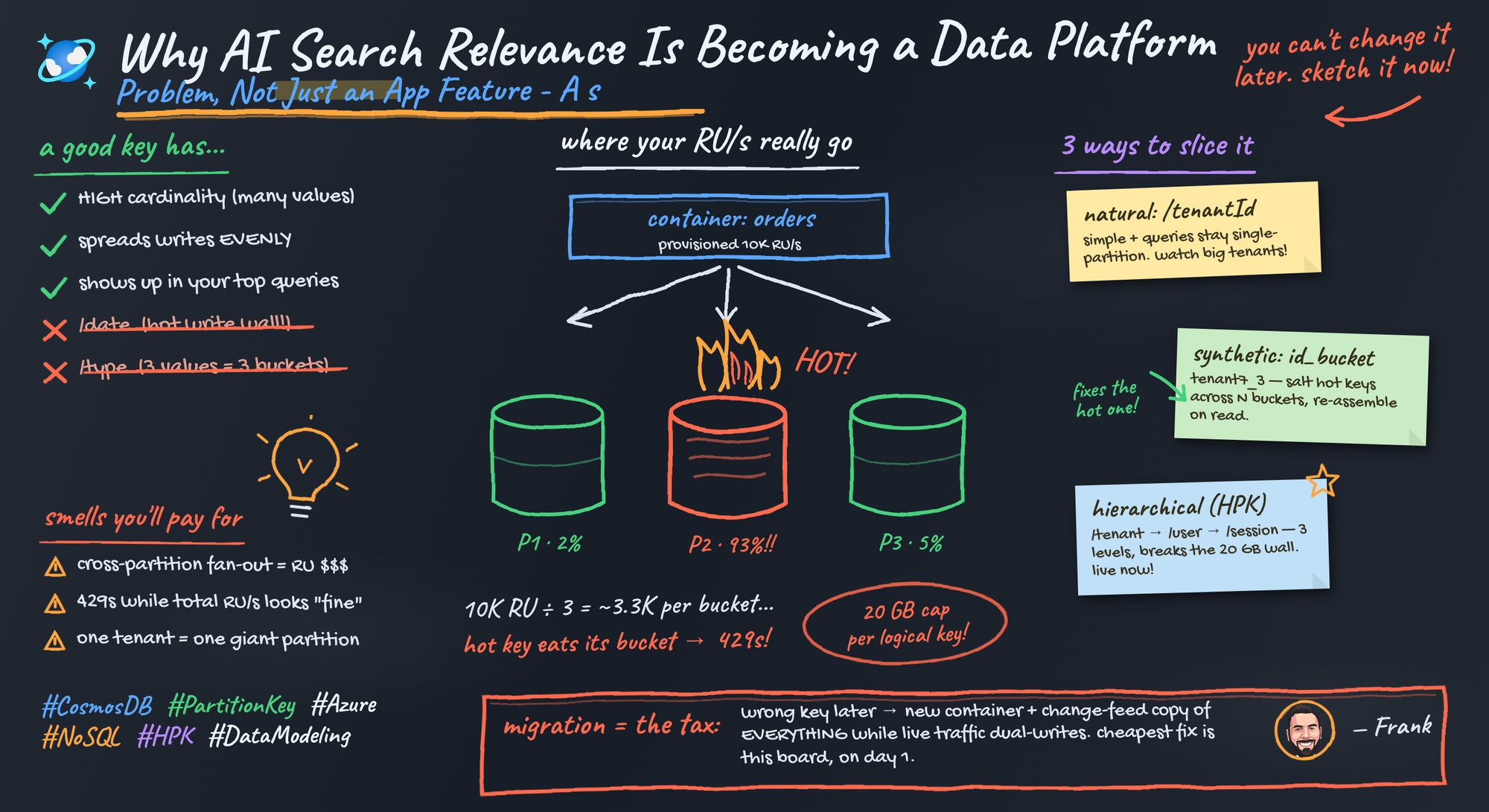
Search relevance is becoming a data platform job, and a lot of teams are still staffing it like a UI feature. If your AI search feels weak, the bottleneck is usually upstream: the system that decides what content exists, who can see it, how fresh it is, and which signals survive long enough to rank.
On this page
- Why the evidence points upstream
- The relevance stack starts before retrieval
- What app teams miss when they own search alone
- Build a relevance platform, not a collection of retrieval hacks
- Operate relevance like a production data product
- The trade-offs leaders need to say out loud
- The operating model change that actually matters
- Sources & References
A polished chat box and a better model will not rescue a bad retrieval substrate. They just make the failure sound more fluent.
That’s the contrarian point I want leaders and builders to sit with: AI search relevance should be operated as a data-platform capability, not treated as an app-team feature with a few prompts and a reranker bolted on at the end.
The old pattern was simple. An application team owned an index, tuned a query, watched click-through, and called it search relevance. That model worked when the content set was narrow, the security model was local, and the ranking inputs lived inside one product boundary.
That is not the enterprise reality anymore.
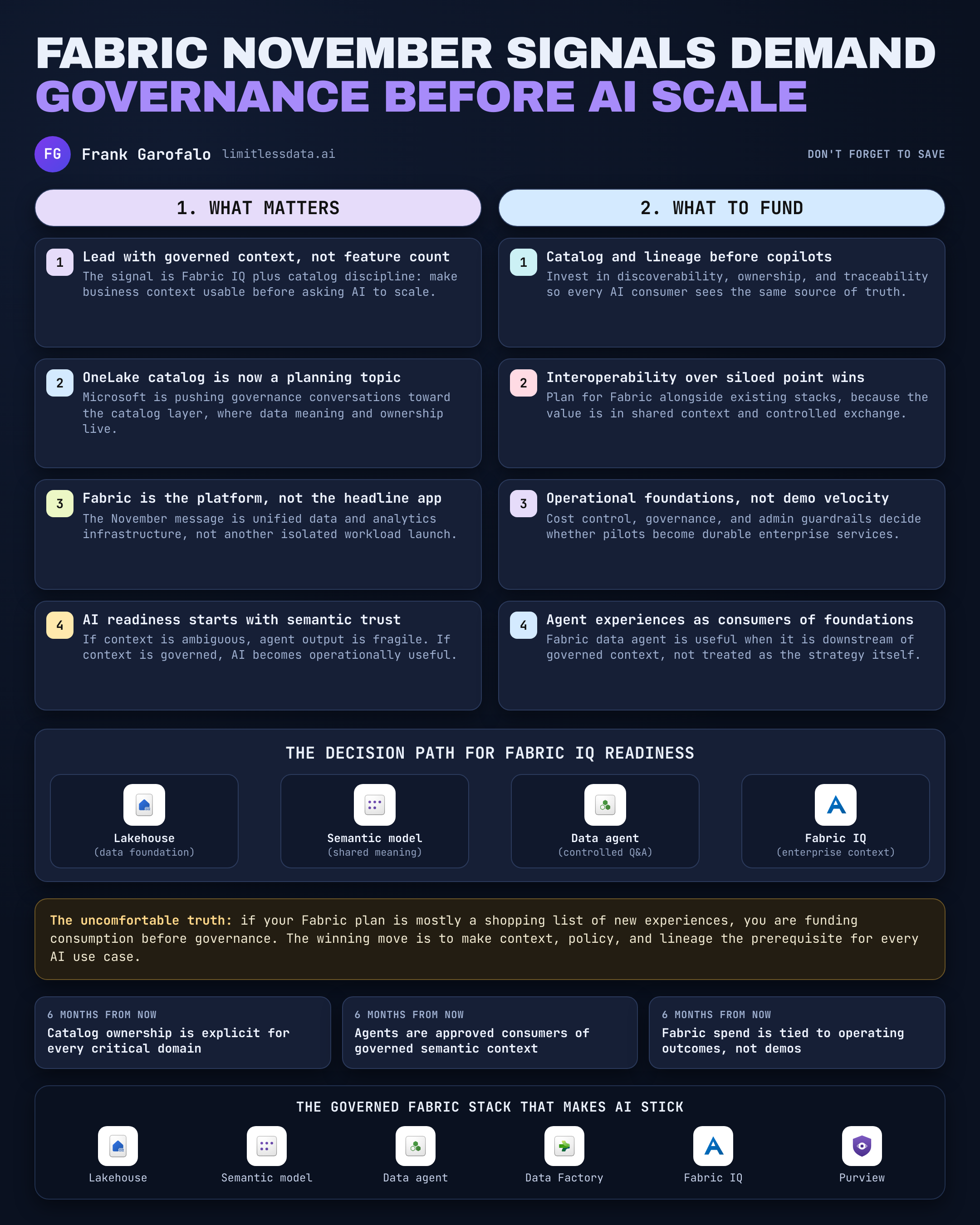
Today the platform has to provide governed content, durable identifiers, metadata standards, security context, freshness guarantees, and observable ranking inputs. App teams still matter. They own interaction design, task framing, and domain-specific tuning. But if the platform feeds them stale chunks, broken ACLs, and junk metadata, the app team is dead on arrival.
In Q1, I worked with a 14-person internal AI team that spent 19 days tuning prompts for a policy assistant before anyone noticed 31% of the “irrelevant” answers were coming from stale SharePoint content with inherited permissions nobody had reviewed since a 2022 reorg.
Why the evidence points upstream
The market is telling you where this is headed.
Microsoft Fabric is positioned as a unified platform for organizational data and analytics needs, not as a collection of isolated app-side tricks per the Fabric overview. Azure Databricks is described the same way: a unified platform for enterprise-grade data, analytics, and AI at scale, integrated with storage and security in your cloud account, per the Azure Databricks introduction.
That matters because AI retrieval inherits the exact same platform concerns as every other serious data workload:
- source quality
- transformation logic
- identity propagation
- policy enforcement
- observability
- operational ownership
If your sources, pipelines, security boundaries, and metadata contracts are shared across domains, retrieval quality is a platform concern. Full stop.
This is also why I keep pushing teams away from the fantasy that every product squad should invent its own relevance stack. Centralize the foundations. Decentralize the domain judgment. That operating model scales. The other one creates seven indexes, five conflicting metadata definitions, and a security review nobody wants to sign.
The relevance stack starts before retrieval
People talk about retrieval like it begins at query time. It doesn’t. It begins the moment you decide what a retrievable unit actually is.
1) Chunking is a data-modeling decision
Chunking defines the unit that can be retrieved, secured, refreshed, evaluated, and cited back to the user. That is not a cosmetic preprocessing step. That is data modeling.
If your chunk is too large, you drag noise into the candidate set and bury the answer. If it is too small, you lose business meaning and create ranking chaos. If chunk boundaries ignore document structure, ownership, or lifecycle state, your search system will happily retrieve fragments that are technically similar and operationally useless.
That’s why I treat chunk design the same way I treat entity design in transactional systems: explicit IDs, lineage, parent-child relationships, timestamps, and policy inheritance. I wrote about this directly in Azure Cosmos DB Data Modeling for AI Applications because too many teams still think retrieval quality is independent of data shape.
2) Metadata is ranking infrastructure
Metadata is not admin garnish. It is ranking infrastructure.
Useful enterprise ranking signals usually include:
- source system
- owner
- business domain
- content type
- created and modified timestamps
- lifecycle state
- geography or region
- sensitivity or confidentiality labels
- approval status
- audience or entitlement hints
When those fields are missing, inconsistent, or delayed, relevance degrades fast. You can’t reliably boost authoritative content if “owner” is blank on 40% of the corpus. You can’t demote obsolete policy docs if lifecycle state never leaves “published.” You can’t filter for region if half the estate uses “US” and the other half uses “United States.”
3) Freshness is an operational contract
If a source changes at 9:05 and your index catches up at 3:00 PM, that lag is not a search bug. It is a platform SLO failure.
For AI search, freshness has to be measurable: source change detection, ingestion latency, index update latency, and stale-document rate. If you don’t instrument those, you’ll spend weeks blaming the model for a pipeline problem.
A simple way to start is to compare source and index timestamps and flag stale content as a first-class operational signal:
# Detect stale indexed documents by comparing source and index timestamps
from datetime import datetime, timedelta, timezone

source = {"D1": datetime.now(timezone.utc), "D2": datetime.now(timezone.utc) - timedelta(hours=1)}
index = {"D1": datetime.now(timezone.utc) - timedelta(minutes=5), "D2": datetime.now(timezone.utc) - timedelta(days=2)}

stale = []
for doc_id, src_ts in source.items():
    idx_ts = index.get(doc_id)
    if idx_ts is None or idx_ts < src_ts:
        stale.append({"doc_id": doc_id, "source_ts": src_ts.isoformat(), "index_ts": idx_ts.isoformat() if idx_ts else None})

print(stale)
What to observe: this is the bare minimum sanity check. Before you tune ranking, prove that the indexed timestamp is keeping up with the source. If it isn’t, stop touching prompts.
4) Access control is a hard boundary
Relevance without security trimming is fake relevance.
If the system cannot safely restrict discovery to content the requester is allowed to access, then the result set is untrustworthy by definition. Microsoft says organizations preparing for Copilot may need time to review SharePoint sites, validate permissions, and implement governance controls before broad discoverability, per the restricted content discovery guidance.
That guidance is bigger than Copilot. It applies to every enterprise AI search experience. If your permissions are messy upstream, your relevance evaluation is contaminated downstream.
Here’s the pattern I want teams to enforce before ranking, not after:
# Enforce metadata and authorization filters before ranking to keep relevance trustworthy
chunks = [
    {"chunk_id": "c1", "region": "US", "acl": {"alice", "bob"}, "score": 0.91},
    {"chunk_id": "c2", "region": "EU", "acl": {"bob"}, "score": 0.95},
    {"chunk_id": "c3", "region": "US", "acl": {"alice"}, "score": 0.72},
]

user = "alice"
filters = {"region": "US"}

eligible = [
    c for c in chunks
    if c["region"] == filters["region"] and user in c["acl"]
]
ranked = sorted(eligible, key=lambda x: x["score"], reverse=True)

for item in ranked:
    print(item["chunk_id"], item["score"])
What to observe: metadata filters and ACL checks happen before final ranking. That keeps the candidate set trustworthy. If you rank first and trim later, your metrics lie and your latency usually gets worse.
What app teams miss when they own search alone
A lot of app teams still approach relevance with a local mindset:
- build an index for my feature
- add embeddings
- tune top-k
- add reranking
- watch engagement
That’s useful, but it misses the shared substrate. Search quality in the enterprise is constrained by upstream systems that app teams do not control:
- content onboarding
- schema and metadata standards
- identity and group propagation
- retention and lifecycle rules
- exception handling
- source-of-truth conflicts
- data product ownership
- incident response
This is exactly why unified platform thinking matters. Microsoft’s Cloud Adoption Framework explicitly includes guidance around unified data platforms tied to landing zones and operational processes, per the Cloud Adoption Framework. The point is not “put everything in one place.” The point is “run shared capabilities like a platform with clear operations.”
That same operating model is where AI search needs to land.
If you want a related angle on this, I covered the governance side in Fabric Data Agent API Turns Governance Into Product Design and the broader org model in AI-Native Data Engineering Operating Model With Fabric.
Build a relevance platform, not a collection of retrieval hacks
Here’s the architecture conversation I have with teams now.
An app-owned search stack usually focuses on:
- local index quality
- query rewriting
- UX presentation
- click metrics
- prompt formatting
A data-platform-owned relevance stack adds:
- shared ingestion contracts
- canonical document and chunk IDs
- metadata validation rules
- authorization propagation patterns
- freshness SLOs
- evaluation datasets
- reusable retrieval APIs
- ranking-signal logging
- incident paths back to source systems
This is the lifecycle I want teams to operate:
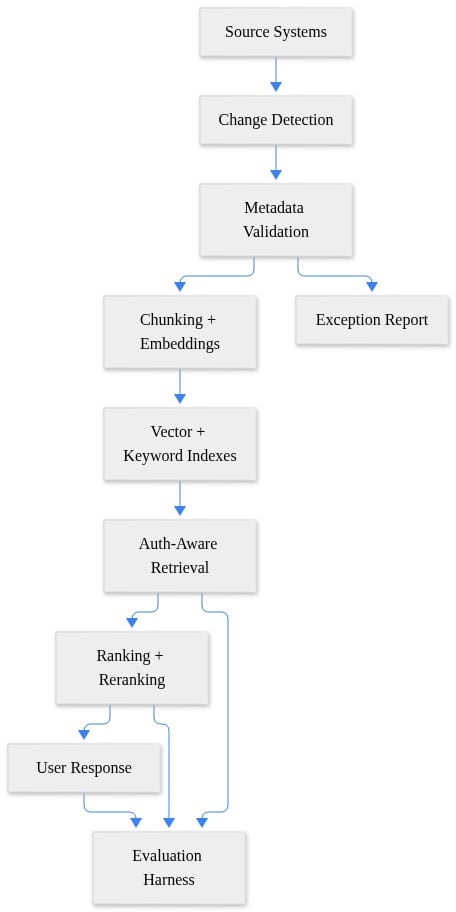
What to observe: the important boxes are not just embeddings and ranking. Change detection, metadata validation, auth-aware retrieval, and evaluation are where enterprise search lives or dies.
And this is how I want the query path instrumented:
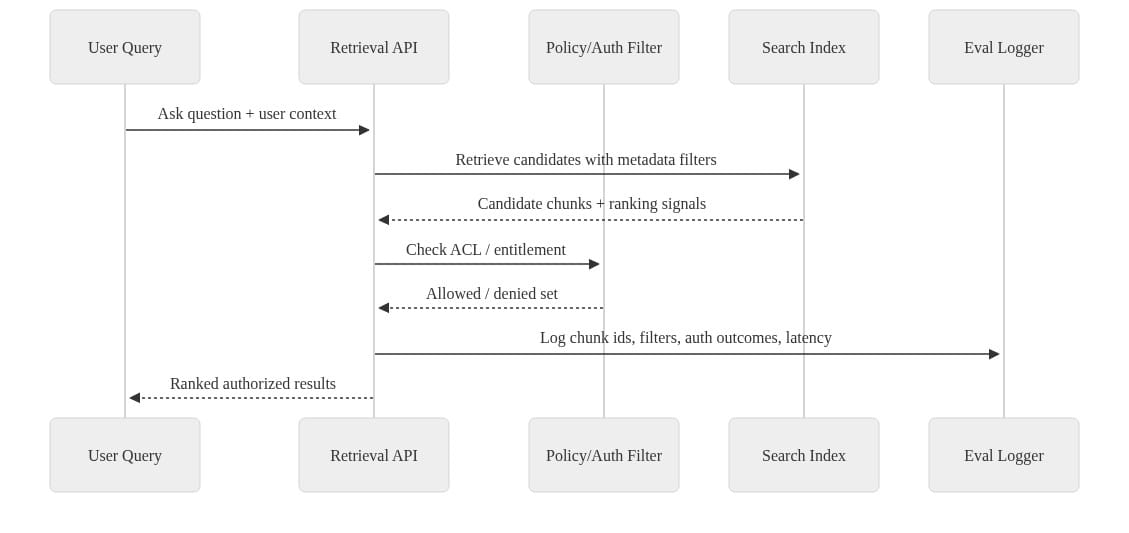
What to observe: log filters, candidate chunks, auth outcomes, and latency on every request path you care about. If you can’t explain why a result was eligible, you don’t have a production relevance system. You have a demo.
Operate relevance like a production data product
This is where the conversation usually gets real. Once you accept that relevance is a platform capability, you need platform controls.
I recommend measuring at least these:
- ingestion freshness by source
- chunk coverage by corpus and document type
- metadata completeness by required field
- authorization pass/block rates
- candidate-set quality
- final-rank quality
- end-to-end latency
- cost per query path or retrieval stage
And I separate two things aggressively:
Offline evaluation
This tells you whether the retrieval and ranking behavior is good.
Live operational monitoring
This tells you whether the pipeline is healthy right now.
Teams blend those together and then wonder why they can’t diagnose failures. A precision drop and an ingestion outage are different classes of incident.
A lightweight evaluation harness makes this visible fast:
# Retrieval evaluation harness capturing filters, auth outcomes, ranking signals, latency, and judgments
from dataclasses import dataclass, asdict
import json, time

@dataclass
class EvalRecord:
    query: str; chunk_id: str; filters: dict; auth_allowed: bool
    ranking_signals: dict; latency_ms: float; judgment: str

tests = [{"query": "SOC2 retention policy", "filters": {"region": "US"}, "allowed_docs": {"c1"}}]
retrieved = [{"chunk_id": "c1", "doc_id": "d1", "score": 0.91, "bm25": 12.4, "semantic": 0.88, "region": "US"}]

records = []
for t in tests:
    start = time.perf_counter()
    for r in retrieved:
        auth_allowed = r["chunk_id"] in t["allowed_docs"]
        judgment = "relevant" if auth_allowed and r["score"] > 0.9 else "non_relevant"
        records.append(EvalRecord(
            query=t["query"], chunk_id=r["chunk_id"], filters=t["filters"],
            auth_allowed=auth_allowed,
            ranking_signals={"final": r["score"], "bm25": r["bm25"], "semantic": r["semantic"]},
            latency_ms=(time.perf_counter() - start) * 1000, judgment=judgment
        ))

print(json.dumps([asdict(x) for x in records], indent=2))
What to observe: capture ranking signals, auth outcomes, filters, judgments, and latency in one record shape. That gives you the ability to trace a bad experience back to a pipeline stage instead of arguing about the model in Slack for three days.
Then compute simple KPIs that expose platform problems early:
# Compute simple relevance KPIs from evaluation records to expose data-platform issues
records = [
    {"query": "SOC2 retention policy", "chunk_id": "c1", "auth_allowed": True, "judgment": "relevant", "latency_ms": 42},
    {"query": "SOC2 retention policy", "chunk_id": "c9", "auth_allowed": False, "judgment": "non_relevant", "latency_ms": 42},
    {"query": "EU invoice rules", "chunk_id": "c3", "auth_allowed": True, "judgment": "non_relevant", "latency_ms": 65},
]

total = len(records)
relevant = sum(r["judgment"] == "relevant" for r in records)
blocked = sum(not r["auth_allowed"] for r in records)
p_at_k = relevant / total if total else 0.0
auth_block_rate = blocked / total if total else 0.0
avg_latency = sum(r["latency_ms"] for r in records) / total if total else 0.0

print({"precision_at_k": round(p_at_k, 2), "auth_block_rate": round(auth_block_rate, 2), "avg_latency_ms": round(avg_latency, 1)})
What to observe: even basic metrics like precision-at-k, auth block rate, and average latency tell you whether you have a relevance issue, a permissions issue, or both.
The operational side matters just as much. I like to block or at least flag ingestion when required metadata is missing, because “we’ll fix it later” becomes six months of ranking drift:
# Produce an exception report artifact for a retrieval ingestion pipeline
$exceptions = @(
    [pscustomobject]@{ DocumentId='D2'; MissingFields='Title,Owner'; Severity='Error' },
    [pscustomobject]@{ DocumentId='D7'; MissingFields='Region'; Severity='Warning' }
)

$reportPath = Join-Path $PWD 'ingestion-exceptions.csv'
$exceptions | Export-Csv -Path $reportPath -NoTypeInformation

if ($exceptions.Where({ $_.Severity -eq 'Error' }).Count -gt 0) {
    Write-Host "Blocking ingestion. See $reportPath"
    exit 1
}

Write-Host "No blocking exceptions. Report saved to $reportPath"
What to observe: exception reporting is not bureaucracy. It is what prevents low-quality content from poisoning your retrieval layer.
The trade-offs leaders need to say out loud
None of this is free.
Cost
Richer metadata extraction, more frequent refresh, multi-stage retrieval, and broader evaluation all add spend. Good. Spend it deliberately. The alternative is hidden cost in bad answers, user distrust, and duplicated app-team effort.
Performance
Security trimming and metadata filtering can improve safety and precision while increasing latency or shrinking the eligible candidate set. That’s a design trade-off, not a bug.
Governance
Broad discoverability increases usefulness. It also increases exposure risk if permissions are sloppy. Leaders need to decide where they want friction: before rollout in governance review, or after rollout in incident response.
Standardization
A platform should standardize foundations, not force one universal ranking policy on every domain. Legal search, field-service search, and engineering search should not rank identical signals the same way. Shared plumbing, domain-specific judgment.
The operating model change that actually matters
The biggest shift here is organizational, not algorithmic.
Domains should own:
- content meaning
- metadata semantics
- quality judgments
- business-specific ranking preferences
The platform should own:
- dependable ingestion
- identity and policy enforcement
- observability
- reusable retrieval primitives
- evaluation infrastructure
- escalation paths
When a relevance issue shows up, the triage path should look like this:

What to observe: many “search problems” are really freshness, metadata, ACL, or indexing problems. Fix the pipeline, not just the interface.
That is the whole thesis.
AI search relevance is becoming a data platform problem because the limiting factors are upstream: content quality, metadata quality, governance quality, security boundaries, and operational signals. App teams still have real work to do. They just cannot carry the whole burden anymore, and pretending they can is how enterprises end up with expensive demos and weak production outcomes.
Rate your organization from 1 to 5: are you running a reusable relevance platform, or just accumulating AI search features with different indexes and different rules?
#EnterpriseAI #DataArchitecture #MicrosoftFabric
Sources & References
- Microsoft Fabric documentation - Microsoft Fabric
- Cloud Adoption Framework for Microsoft - Cloud Adoption Framework
- Restrict discovery of SharePoint sites and content - SharePoint in Microsoft 365
- What is Azure Databricks? - Azure Databricks
Try it yourself
Run this tutorial as a Jupyter notebook: Download runbook.ipynb (34 cells, 31 KB).