Clinical AI Platform Readiness for Healthcare Leaders
Healthcare AI Is Entering Its Platform Phase — and That Changes What Leaders Should Evaluate First

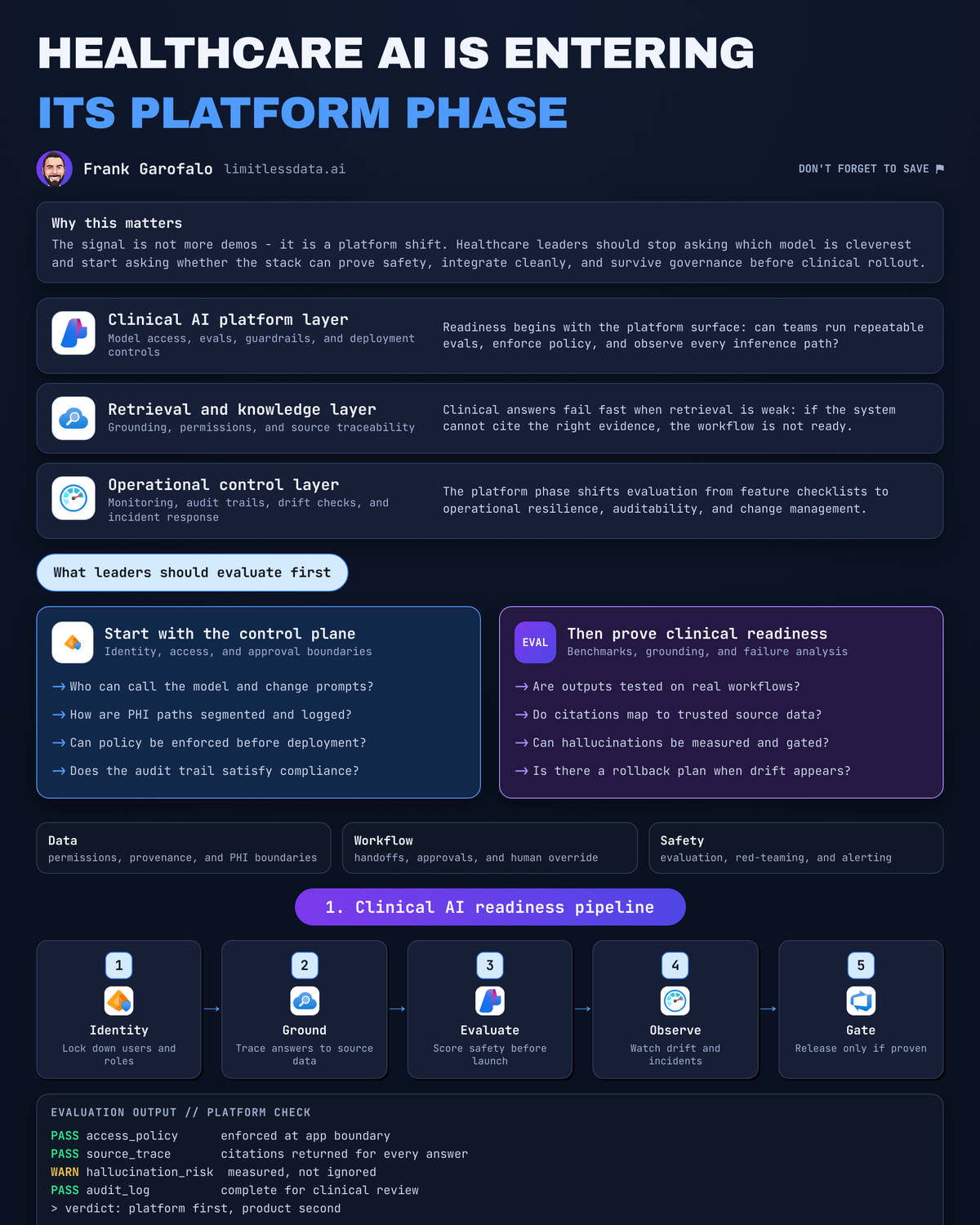
A hospital demo can fool a boardroom in 90 seconds. Production reality shows up in month 9.
On this page
- The market just changed the unit of evaluation
- General availability does not equal clinical readiness
- Evaluate the stack before you evaluate the story
- Use deployment criteria, not feature checklists
- Radiology is a better example than a generic AI demo
- Sources & References
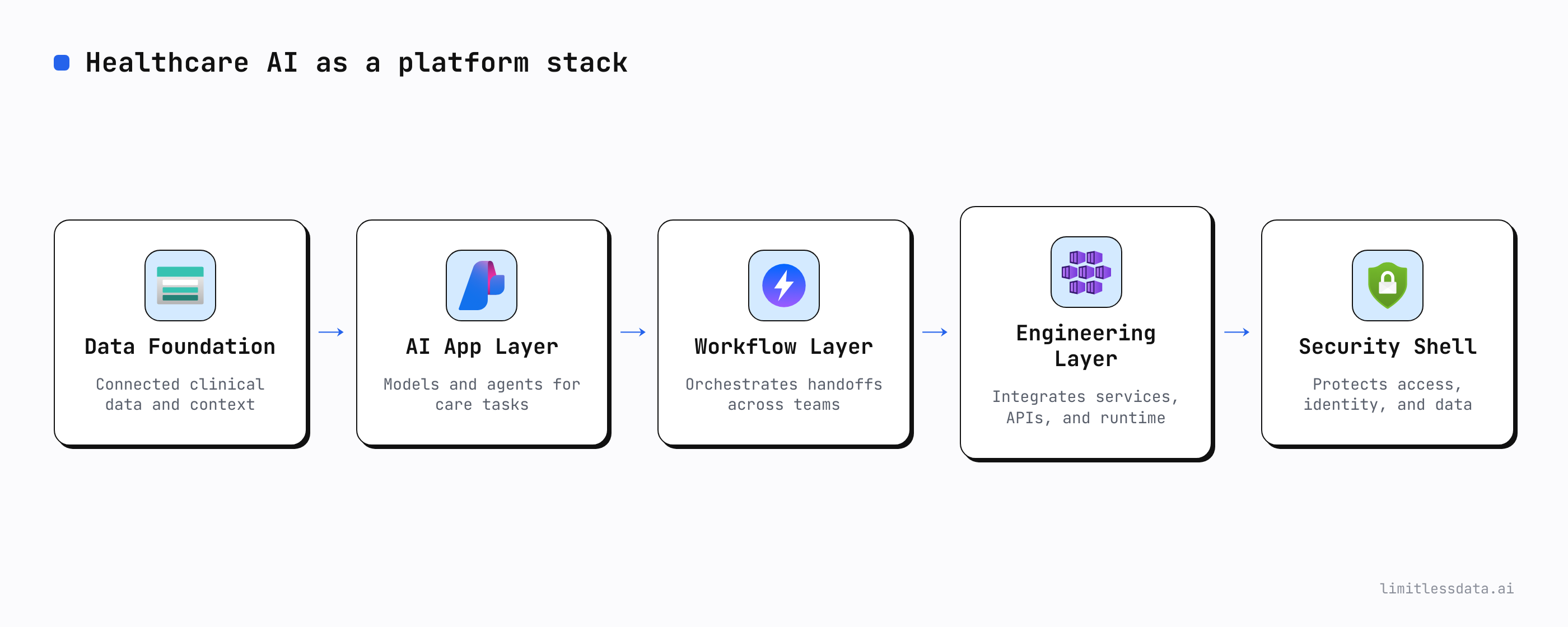
Healthcare AI is entering its platform phase, and that changes what leaders should evaluate first. Microsoft’s documentation now spans the layers that actually matter in deployment: a unified data and analytics platform in Microsoft Fabric, an AI app and agent factory in Azure AI Foundry, workflow and app tooling across Power Platform, and healthcare-specific guidance under Microsoft for Healthcare. That is the signal.
The market just changed the unit of evaluation
Healthcare leaders used to get pulled into AI through one shiny thing: a copilot demo, a summarization use case, a specialty workflow, a research prototype.
That is not the right lens anymore.
The unit of evaluation is now the full stack required to operationalize AI in clinical environments: data, app lifecycle, workflow integration, controls, review, security, and outcomes. In one failed triage assistant pilot I reviewed, the model was the least interesting part of the postmortem. The real failure was ownership of escalation when low-confidence recommendations hit a nurse workflow.

General availability does not equal clinical readiness
A product can be generally available and still be nowhere near usable in care delivery at your organization.
A polished interface does not prove workflow fit. A convincing demo does not prove auditability. A research result does not prove local safety, governance, or accountability. If your health system cannot answer who reviews outputs, who owns exceptions, what gets logged, and what metric improves, you are still in exploration.

Evaluate the stack before you evaluate the story
- Data foundation: can your teams organize, govern, and expose the right analytics and operational data for intended use?
- AI lifecycle: can you build, deploy, evaluate, and govern apps and agents at scale across environments?
- Workflow layer: can you connect agents, apps, and automation to real human work?
- Engineering layer: do you have the implementation muscle to maintain this after the pilot team leaves?
- Security architecture: can your security strategy actually be translated into operational controls, as Microsoft frames in the SC-100 exam guide?
If I were briefing a CIO or CMIO, I would score governance before model quality.
# Python: score a healthcare AI platform on governance-first criteria
weights = {
    "integration": 0.20,
    "governance": 0.30,
    "monitoring": 0.20,
    "security": 0.20,
    "workflow_fit": 0.10,
}

vendor = {
    "integration": 8,
    "governance": 9,
    "monitoring": 7,
    "security": 9,
    "workflow_fit": 6,
}

score = sum(vendor[k] * w for k, w in weights.items())
print(f"Platform readiness score: {score:.1f}/10")
The code illustrates a key point: governance and security weights dominate the score. In healthcare, that’s not bureaucracy—it’s deployment reality.
Use deployment criteria, not feature checklists
Instead of feature checklists, use deployment criteria:
- Auditability: what was asked, what was returned, what data and configuration mattered, who reviewed it
- Workflow fit: exact user, exact decision point, exact handoff, exact exception path
- Safety review: named clinical owner, thresholds for review, pause path, retirement path
- Data fitness: stewardship, access controls, intended-use boundaries, trust in source quality
- Measurable outcomes: baseline and post-launch metrics tied to throughput, quality, turnaround, or user burden
Radiology is a better example than a generic AI demo
Radiology is a useful model because the workflow is bounded. Microsoft PowerScribe One points to a recognizable reporting workflow with known users, review patterns, and quality concerns. That is exactly why it forces better platform-level questions: how it fits local workflow, what evidence is retained, who reviews output quality, and which operational or quality metrics move if it goes live.
Pick two or three bounded workflows, not twenty. Require a named executive, clinical, technical, and operational owner before anything moves past exploration. Build one reusable intake and evaluation process for agents, copilots, and AI apps, then force every proposal through the same gates: governance, data readiness, workflow integration, safety review, auditability, and measurable outcomes.
That is the shift. The important signal is not that another healthcare AI capability exists. It is that the platform layers for data, AI applications, agents, workflow tools, and governance are maturing. Leaders should evaluate whether those layers can be operationalized in their environment before getting distracted by a shiny demo.
Rate your organization’s healthcare AI platform readiness from 1 to 5—are you scoring the model first, or the operating system around it?
#HealthcareAI #DataGovernance #ClinicalInnovation
Sources & References
- Microsoft Fabric documentation - Microsoft Fabric
- Azure AI Foundry documentation
- Official Microsoft Power Platform documentation - Power Platform
- Microsoft industry documentation and resources
- Microsoft for Healthcare documentation
- Exam SC-100: Microsoft Cybersecurity Architect - Certifications
- Microsoft PowerScribe One documentation
Try it yourself
Run this tutorial as a Jupyter notebook: Download runbook.ipynb (20 cells, 16 KB).