Azure Databricks Lakebase Governance and Workload Fit
Lakehouse Is Growing Up: What Azure Databricks Lakebase Expansion Means for Real Platform Standardization

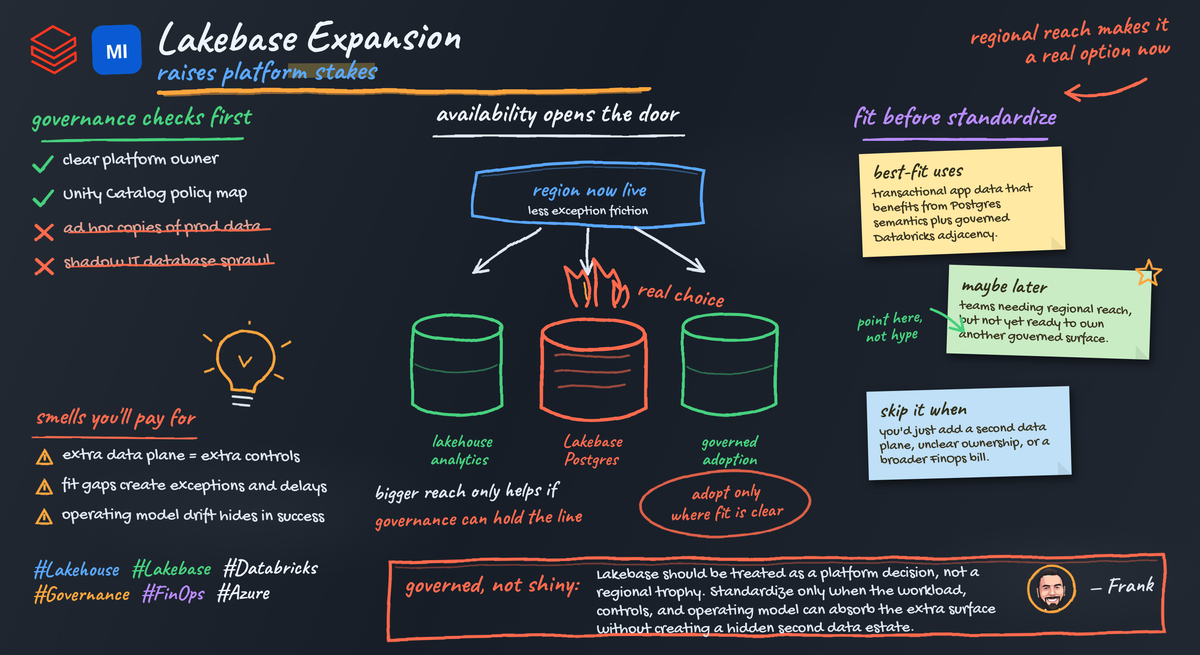
Lakebase getting more regional reach is the least interesting part of the story.
On this page
- Regional reach changes the shortlist, not the strategy
- What Lakebase actually adds to the Databricks decision surface
- The workload-placement test leaders should require
- Standardization is a governance design problem
- The operating-model trade-off behind the product decision
- A practical evaluation path for CDOs and platform leads
- The measured conclusion: standardize the control plane first
- Sources & References
The real question is whether your governance model can absorb one more operational surface without turning “platform standardization” into a branding exercise.
I’m bullish on Lakebase. I’m also allergic to fake consolidation.
If you run Azure Databricks seriously, Lakebase deserves a real evaluation. Microsoft positions Azure Databricks as a unified, open analytics platform for enterprise-grade data, analytics, and AI at scale in the product overview. And now the Databricks docs place OLTP databases under the Lakebase category right alongside the rest of the platform surface in the main documentation tree. That matters.
But regional availability does not create a business case by itself. It just gets Lakebase onto the shortlist without an exception memo.
Regional reach changes the shortlist, not the strategy
This is where architecture discussions often go off the rails.
A service lands in more regions, somebody says “great, now we can standardize on it,” and six months later you’ve got another half-governed platform with unclear support boundaries and a cost model nobody can explain.
Regional expansion matters because it removes real blockers:
- data residency
- legal review friction
- procurement objections
- enterprise support concerns
- architecture review pushback on location constraints
That is a viability unlock. It is not a strategy.
The senior-leader constraint is simpler than people admit: how many platforms can one governance model actually operate well? Not in PowerPoint. In production. With access reviews done on time, audit evidence available, cost allocation visible, incident ownership clear, and delivery still moving.
If the answer is “we barely govern the three we already have,” then adding Lakebase broadly is not platform standardization. It’s platform sprawl wearing a Databricks badge.
I’ve seen this firsthand: a “strategic” data service got approved because it reduced integration steps for two app teams. Within months, the central platform team had inherited backup expectations, access review evidence, and production escalation for a service nobody had staffed. The architecture was fine. The operating model was nonsense.
What Lakebase actually adds to the Databricks decision surface
Let’s keep this precise.
Lakebase is a fully managed Postgres database integrated into the Databricks platform for real-time transactional applications alongside lakehouse data, with capabilities including automatic scaling, instant branching, and native Unity Catalog integration per the Lakebase docs.
That’s the value proposition.
Not “all databases are now Databricks.” Not “your warehouse is obsolete.” Not “every app team should move tomorrow.”
The strategic piece is Unity Catalog integration. That creates the possibility of bringing transactional application data into the same governance conversation as your analytical estate. Possibility, not victory.
Automatic scaling and instant branching are useful. Developers will like them. Platform teams will like them when used correctly. But those features do not solve:
- ownership
- privileged access control
- production support
- cost accountability
- retention policy enforcement
- recovery expectations
- workload placement discipline
Platform adjacency is not the same as platform consolidation.
A product can sit neatly inside Databricks and still require different operational expertise. Postgres-backed transactional behavior is not the same discipline as batch curation, BI serving, or lakehouse optimization. If your team knows Delta cold but has no muscle memory around transactional database operations, you have not standardized. You have expanded scope.
The part people miss is that Lakebase changes the Databricks decision surface. It makes Databricks more credible for application-adjacent data patterns, not just engineering, analytics, and AI. That’s a meaningful shift. I wrote about the broader platform gravity in Databricks to OneLake Just Rewrote Azure Platform Strategy, and Lakebase pushes further in that same direction: control planes are converging faster than operating models are.
The workload-placement test leaders should require
Here’s the test I’d put in front of every architecture board.
Use Lakebase when all three of these are true:
- The workload genuinely needs a managed Postgres transactional system.
- It supports real-time application behavior, not just convenient SQL access.
- There is material benefit from operating it alongside Databricks lakehouse data.
That third point is where the nonsense gets filtered out.
If a team just wants a new database endpoint because it sits in a familiar portal, that’s not a reason. If the workload has no meaningful adjacency to your Databricks data products, don’t force it. That’s how platform standards become resented and bypassed.
By contrast, if you have an operational application pattern where transactional writes, governed access, and downstream analytical curation all need to move together, Lakebase gets interesting fast.
The lakehouse side still has its lane. Azure Databricks recommends the medallion architecture as a layered approach to build a single source of truth for enterprise data products in the medallion guidance:
- Bronze for raw ingestion
- Silver for validated and conformed data
- Gold for business-ready products
A simple architecture sketch makes the point better than another paragraph:
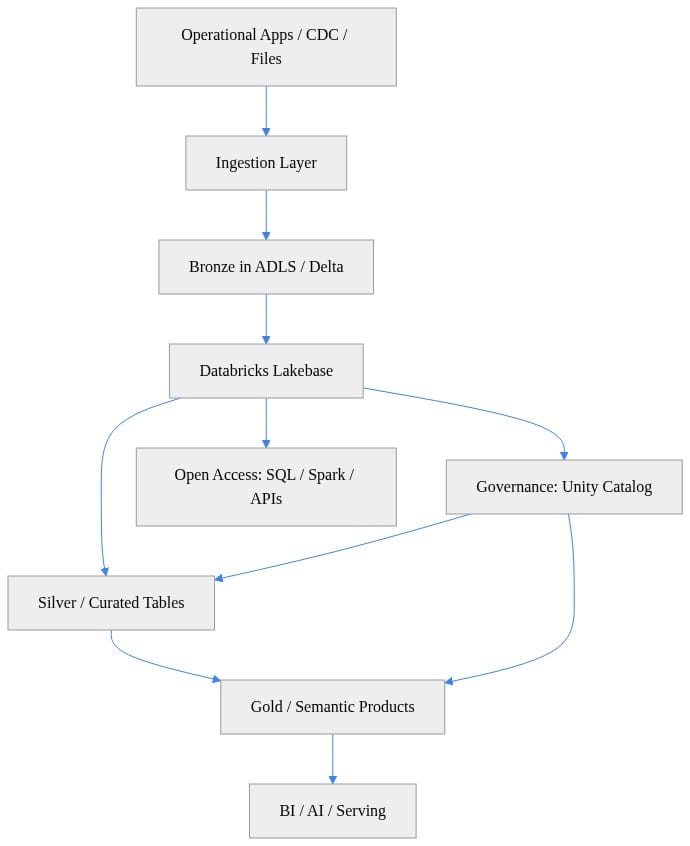
What to look for: Lakebase belongs in the governed flow, not beside it as a rogue operational island. If your diagram has separate ownership, separate controls, and duplicate copies of the same domain everywhere, stop there and fix the design.
Here’s the fragmentation risk I see constantly: one customer domain ends up copied into an app database, a lakehouse bronze layer, curated Delta tables, warehouse semantic models, and ad hoc extracts. Nobody owns synchronization rules. Nobody can say which copy drives policy. Everyone says they’re “standardized.”
That is not a platform. That is entropy with budget.
Standardization is a governance design problem
This is the blunt take: sharing a vendor and a console does not mean you have a standard.
Standardization exists when controls, evidence, cost allocation, and support responsibilities are repeatable.
So if you’re evaluating Lakebase, run a governance design review before you run a migration campaign.
Ask the hard questions:
- Who is the accountable service owner?
- How are access reviews performed for transactional and analytical access?
- How is data classified?
- What is the retention model?
- What audit evidence is produced and where is it stored?
- Who can perform privileged operations?
- How are break-glass scenarios handled?
- How do you separate application usage from analytics usage in FinOps reporting?
- Who owns backup, restore, and recovery testing?
- What are the production support hours and escalation paths?
If you can’t answer those cleanly, you’re not ready to standardize on anything.
A lightweight tagging and standards check is a good example of what “governed enough to scale” looks like. Not glamorous. Very effective.
# Validate that required platform standards are present before rollout
$requiredTags = @("owner", "domain", "environment", "costCenter")
$resourceTags = @{
    owner       = "data-platform"
    domain      = "lakehouse"
    environment = "prod"
    costCenter  = "FIN-042"
}

$missing = $requiredTags | Where-Object { -not $resourceTags.ContainsKey($_) }

if ($missing.Count -eq 0) {
    Write-Output "Platform standard check passed."
} else {
    Write-Output ("Missing required tags: " + ($missing -join ", "))
}
What to look for: this is the mindset, not the script. Before rollout, prove that ownership, domain, environment, and cost center metadata exist consistently. If you can’t do that for provisioning, you definitely can’t do it for audit or FinOps later.
This is also where existing platform patterns matter. The same discipline I pushed in Azure AI Landing Zones for Enterprise AI Governance applies here: standardize the control model first, then scale the product footprint.
The operating-model trade-off behind the product decision
Lakebase can absolutely reduce handoffs for teams already building in Databricks. That benefit is real.
A team that would otherwise stitch together app data, ingestion logic, governance mapping, and analytical publishing across separate tools may move faster if the transactional Postgres role sits closer to the rest of the Databricks estate.
But every reduction in developer friction creates a corresponding increase in platform responsibility.
That means you need maturity signals before broad adoption:
- a named database service owner
- published workload intake criteria
- reusable security patterns
- chargeback or showback
- production support boundaries
- performance and reliability expectations
- recovery testing discipline
Without those, “single platform” becomes a label slapped over separate teams, duplicated data, inconsistent controls, and incompatible service expectations.
If you want to make this operational, write the service contract down. Even an illustrative object model helps force clarity.
# Define a standardized medallion-style Lakebase table contract in Python
from dataclasses import dataclass, asdict
from typing import List

@dataclass
class TableContract:
    catalog: str
    schema: str
    name: str
    owner: str
    primary_key: str
    quality_tier: str
    tags: List[str]

contract = TableContract(
    catalog="main",
    schema="sales_curated",
    name="customer_orders",
    owner="data-platform",
    primary_key="order_id",
    quality_tier="gold",
    tags=["pii:none", "domain:sales", "sla:hourly"]
)

print(asdict(contract))
What to look for: owner, quality tier, tags, and primary key are not paperwork. They are the minimum shape of a platform contract. If your first Lakebase workloads can’t meet a contract like this, they are not your lighthouse candidates.
A practical evaluation path for CDOs and platform leads
Here’s the framework I’d use.
Gate 1: Regional and commercial viability
Confirm the service now satisfies residency, procurement, and enterprise support requirements in the regions that matter to you. Regional reach gets Lakebase into the conversation. That’s its first job.
Gate 2: Workload fit
Require a transactional Postgres need plus a material reason for proximity to Databricks lakehouse data. No adjacency, no deal.
Gate 3: Governance fit
Prove how cataloging, access control, lifecycle policy, ownership, and auditability work in your enterprise model. Unity Catalog integration helps, but it does not absolve you from designing the rest.
Gate 4: FinOps fit
Define budget ownership, cost attribution, utilization reporting, and escalation paths before production use. If you’re weak here, read my piece on Azure MCP Server Cost Tools for FinOps Governance and apply the same discipline: observability before scale.
Gate 5: Operating fit
Confirm the accountable team can support this service without degrading reliability for your existing lakehouse, warehouse, and application platforms.
Then do one more thing most enterprises skip: make the first workloads exception-based, not default-based.
That gives you room to validate:
- governance evidence
- cost observability
- operational load
- ownership clarity
- delivery speed
- actual business value
If those hold, expand. If they don’t, you’ve learned cheaply.
To make the platform observable, I’d also insist on metadata-level checks early. You can’t govern what you can’t enumerate.
# Query metadata to show how standardization becomes observable
from pyspark.sql import SparkSession

spark = SparkSession.builder.getOrCreate()

tables = spark.sql("SHOW TABLES IN main.sales_curated")
filtered = tables.select("database", "tableName", "isTemporary")

for row in filtered.collect():
    print(f"{row['database']}.{row['tableName']} temporary={row['isTemporary']}")
What to look for: the point is not the command. The point is that standardization becomes visible when you can inspect what exists, where it lives, and whether it follows the expected structure.
The measured conclusion: standardize the control plane first
Lakebase deserves evaluation. Full stop.
As regional availability broadens, it moves from “special exception” to “credible platform option.” That is a serious change for architecture and procurement teams. And because it is a managed Postgres capability integrated into Databricks, it opens up a tighter pattern for transactional application behavior near governed lakehouse data.
But I would reject both lazy extremes.
Don’t dismiss it as just another database. That misses the strategic value of bringing more of the data lifecycle into one governed platform conversation.
And don’t treat availability expansion as a reason to shove every workload into Databricks. That’s how you create a badly governed data plane with a nice logo.
The right move is boring, disciplined, and effective:
- standardize decision rights
- standardize governance controls
- standardize FinOps evidence
- standardize service ownership
- then standardize product footprint where the workload fit is real
That’s how lakehouse grows up: not by collecting more services, but by reducing the number of control models the enterprise has to operate.
Which part of this would you reverse: the “transactional adjacency” gate, the governance-first rollout, or the exception path for early workloads?
#Azuredatabricks #Datagovernance #Lakehouse
Sources & References
- Azure Architecture Center - Azure Architecture Center
- What is Azure Databricks? - Azure Databricks
- Azure Databricks documentation
- What is the medallion lakehouse architecture? - Azure Databricks
- Lakehouse end-to-end scenario: overview and architecture - Microsoft Fabric
- Course DP-750T00-A: Implement data engineering solutions using Azure Databricks - Training
- What is a lakehouse? - Microsoft Fabric
- Study Guide for Exam DP-750: Implementing Data Engineering Solutions Using Azure Databricks
- Guided Technical Labs
- Lakebase Postgres - Azure Databricks
Try it yourself
Run this tutorial as a Jupyter notebook: Download runbook.ipynb (27 cells, 21 KB).