Copilot Studio Evaluation for Agent Governance
How Copilot Studio’s New Evaluation Experience Could Change Agent Governance

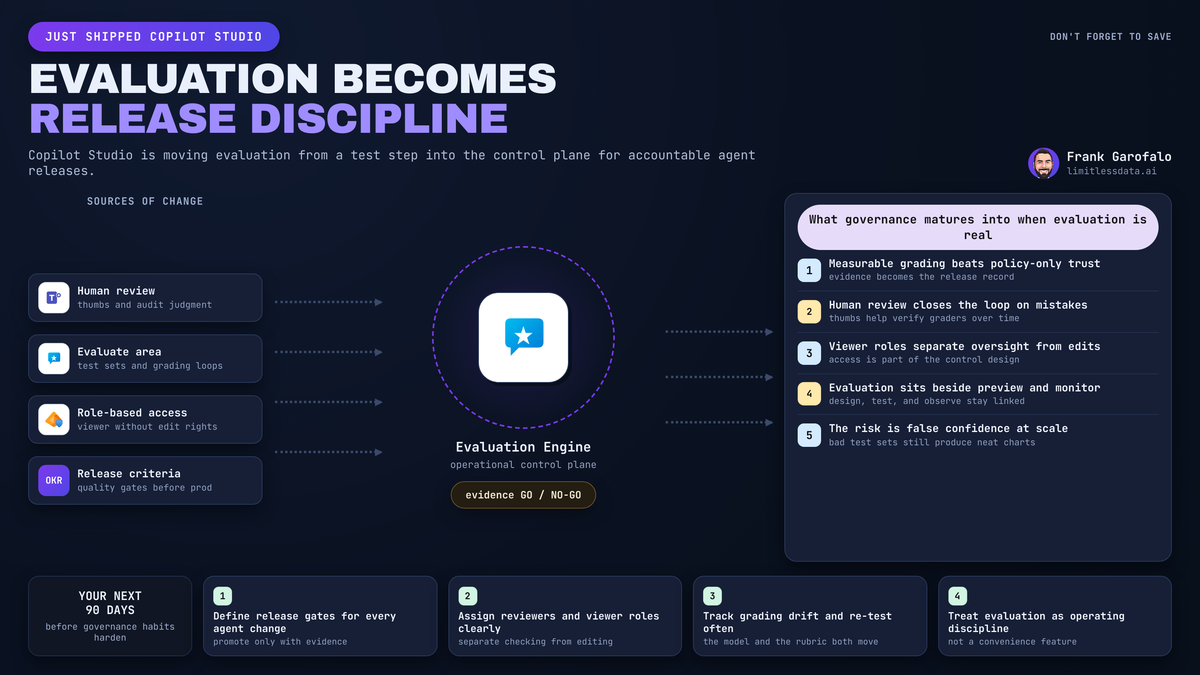
A green checkmark is a terrible governance model.
On this page
- The real problem starts after the demo
- Build measurable release gates
- Separate authors, evaluators, and approvers
- Watch for failure modes that fool leadership
I sat in a release review with an HR automation team whose agent looked great in demo, then failed three of eight escalation scenarios after a knowledge change and broader rollout. That’s the real governance problem: enterprise agents don’t fail at the policy layer first. They fail when nobody can prove a changed agent still meets the bar.
The real problem starts after the demo
Pilots survive on trust and “it looked good in preview.” Production agents do not.
Copilot Studio already gives authors a practical structure with Preview, Monitor, and Evaluate for running test sets against agent quality in the authoring experience. That matters because the release question is never “do we have a policy?” It’s “did this changed agent meet the bar for this use case, with evidence?”
That’s why I keep coming back to the same point in my own enterprise agent governance work: policy is foundation, not proof. Evaluation is the layer between agent design and accountable release.
Build measurable release gates
If you want governance that holds up, stop relying on confidence and start defining gates.
For any material change to instructions, knowledge, tools, topics, channels, or audience, I want a minimum release packet:
- named test scenarios
- expected outcomes
- results by scenario
- unresolved failures
- owner attestation
- approval decision
Those gates should map to business risk:
- task completion
- groundedness to approved knowledge
- escalation behavior
- unsafe or disallowed responses
- tool-use boundaries
- authorization-sensitive paths
Copilot Studio’s recent preview enhancements around evaluator feedback are a good step because they move evaluation closer to a governed review loop. But feedback is calibration evidence, not automatic truth. Human reviewers still own the decision.
A lightweight example of what this should look like operationally:
# PowerShell: fail a release gate when evaluation metrics drop below governance thresholds
$evaluation = @{
  Groundedness = 0.82
  Safety        = 0.97
  PolicyPass    = $true
}

if ($evaluation.Groundedness -lt 0.85 -or -not $evaluation.PolicyPass) {
  Write-Error "Release blocked: evaluation gate failed."
} else {
  Write-Host "Release approved: governance checks passed."
}
That’s the muscle most teams are missing: the release is blocked on threshold failure, not on somebody saying “it seems fine.”
Separate authors, evaluators, and approvers
This part is non-negotiable.
Copilot Studio’s role-based sharing, including the Agent Viewer role for evaluation access without edit rights, supports the right separation of duties. In practice, I want three lanes:
- authors improve the agent
- evaluators inspect evidence
- accountable owners accept or reject release risk
Security, DLP, compliance, and environment controls still matter. They just don’t answer whether version 27 of your agent should ship on Friday.
Watch for failure modes that fool leadership
The ugliest governance failures I’ve seen were all “passing” systems.
Common patterns:
- narrow test sets that create false confidence
- aggregate scores that hide critical scenario failures
- release boards that cannot actually block deployment
- exceptions with no expiry
- baselines that never get updated after incidents
And I’d strongly recommend a simple failure taxonomy:
- content gap
- instruction conflict
- tool failure
- authorization issue
- grader disagreement
That makes remediation assignable. Without it, every miss becomes a vague “AI quality problem.”
My take is simple: evaluation does not replace security or monitoring. It makes governance executable at the exact moment an agent changes and someone wants to promote it.
Rate your team’s current agent release discipline from 1 to 5: how often can you actually block production on failed evaluation evidence?
#Copilotstudio #EnterpriseAI #Datagovernance
Try it yourself
Run this tutorial as a Jupyter notebook: Download runbook.ipynb (14 cells, 13 KB).