Databricks and Microsoft Enterprise AI Architecture
How the Databricks and Microsoft partnership is reshaping enterprise AI architecture

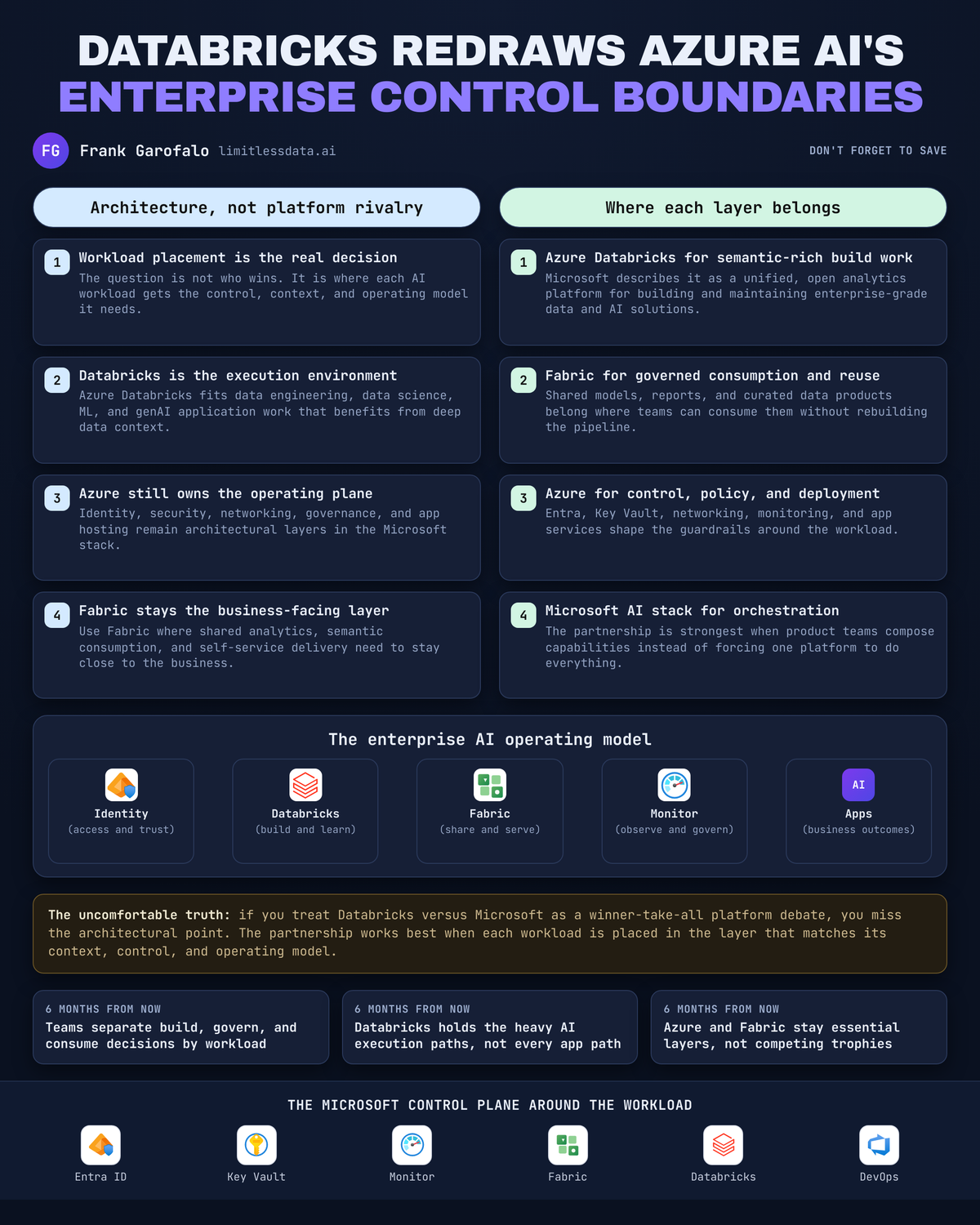
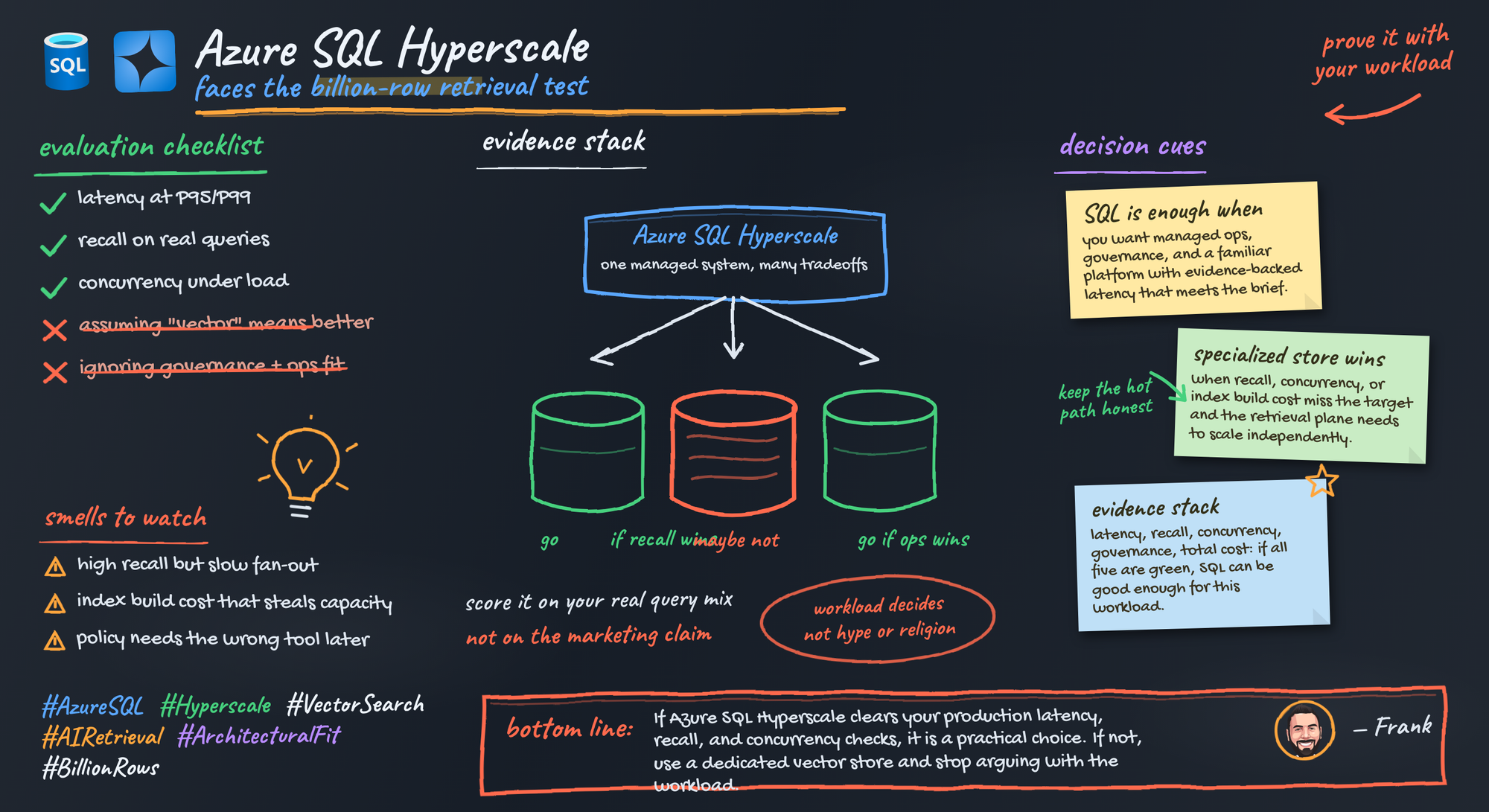
37 architecture reviews later, the wrong question still shows up: “Who wins, Databricks or Fabric?” The real decision is workload placement inside a Microsoft operating model, and teams that miss that spend the next 18 months duplicating pipelines, semantics, and support models.
On this page
- The false choice hiding inside the partnership debate
- Use one enterprise operating model, not one mandatory execution engine
- Place workloads by responsibility, not platform allegiance
- Why business context is the real Databricks value
- The governance and identity test executives should run first
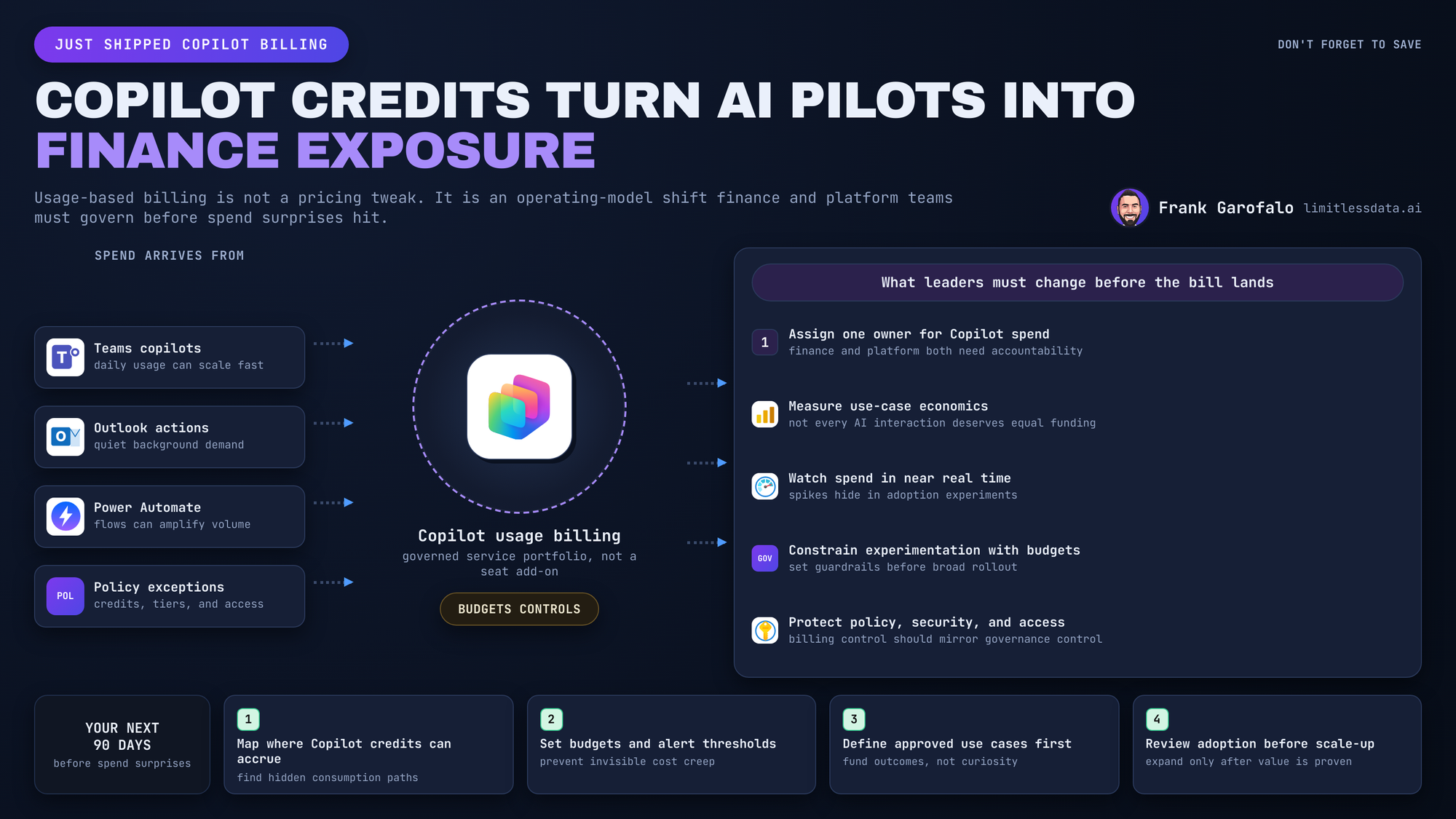
- Cost discipline means avoiding duplicate architecture
- A decision framework for the next architecture review
- The strategic conclusion: architecture pluralism with strict accountability
- Sources & References
I’m going to say this bluntly: if your enterprise AI strategy is framed as a platform cage match, your architecture team is already behind.
Microsoft describes Azure Databricks as a unified, open analytics platform for building, deploying, sharing, and maintaining enterprise-grade data, analytics, and AI solutions at scale in Azure Azure Databricks docs. That matters. So does the fact that Microsoft’s own modern analytics guidance places Azure Databricks alongside Fabric, Power BI, Azure Data Lake Storage, and other Azure services in the same architecture, not as mutually exclusive bets modern analytics architecture.
That’s the whole post in one line: Databricks belongs in the enterprise where its execution model fits, and Azure plus Fabric remain essential architectural layers you do not rip out just because Databricks is strong.
The false choice hiding inside the partnership debate
A lot of leadership conversations are still stuck at the product-logo level.
Should we standardize on Fabric? Should we move everything to Databricks? Should Power BI stay? Should we keep Azure-native ML patterns?
Those are downstream questions. The upstream question is simpler and more important:
Who owns the control plane, who owns the data products, who owns semantic access, and who owns AI application operations?
If you don’t separate those responsibilities first, every tooling decision becomes political. Then the platform team starts optimizing for procurement simplicity instead of delivery speed and operating clarity.
Back in Q1, I sat in a review with a 14-person data platform team that had rebuilt the same customer revenue prep logic in two engines, published three conflicting semantic definitions of “active customer,” and still couldn’t tell me which team owned model-serving incident response at 2:00 a.m. That’s not a tooling problem. That’s an operating model failure.
The Microsoft-Databricks partnership is consequential because it gives enterprises a serious data and AI execution environment inside a broader Microsoft estate. Azure Databricks is explicitly positioned by Microsoft as a Spark-based analytics platform for data engineering, data science, and machine learning Azure architecture guidance. Good. Use it for that. But stop pretending that means the rest of Azure or Fabric becomes irrelevant.
Use one enterprise operating model, not one mandatory execution engine
This is the distinction executives need to force into the room.
An enterprise operating model is not the same thing as an execution engine.
Your operating model covers identity, policy, networking, cost accountability, support ownership, lifecycle controls, and architecture standards. In a Microsoft shop, that almost always means Entra ID, Azure resource governance, shared monitoring patterns, security review gates, and a consistent ownership model across platforms.
Your execution environment is where a workload actually runs.
For Spark-heavy engineering, data science, ML pipelines, and integrated AI workflows, Azure Databricks is often the right execution environment. For Microsoft-native analytics consumption, Fabric and Power BI stay very relevant. For core cloud controls, Azure remains the foundation. The mistake is forcing all of those jobs into one service because “standardization” sounds tidy on a slide.
Standardization is policy consistency and accountable ownership. It is not mandatory workload uniformity.
A simple way to explain it to your architecture board is this:
- Azure is the enterprise control and cloud operating foundation
- Fabric is a strong Microsoft-native analytics and consumption layer
- Databricks is a powerful data and AI execution environment
- Power BI remains critical for BI consumption where it fits
- ADLS and related storage patterns still matter as durable data foundations
If you collapse those roles into one bucket, you will overbuild in some places and under-govern in others.
Place workloads by responsibility, not platform allegiance
Here’s the practical framework I use.
1) Control plane
Start with ownership, not code.
Who sets platform standards? Who approves network patterns? Who owns identity integration? Who defines lifecycle rules for dev, test, prod? Who is on the hook for audit evidence?
If nobody can answer those in 10 minutes, stop the architecture review right there.
Identity and governance boundaries are the first test. This is exactly why I want teams to sketch the control path before they sketch the data path.
Use a simple governance view like this to make the conversation concrete:
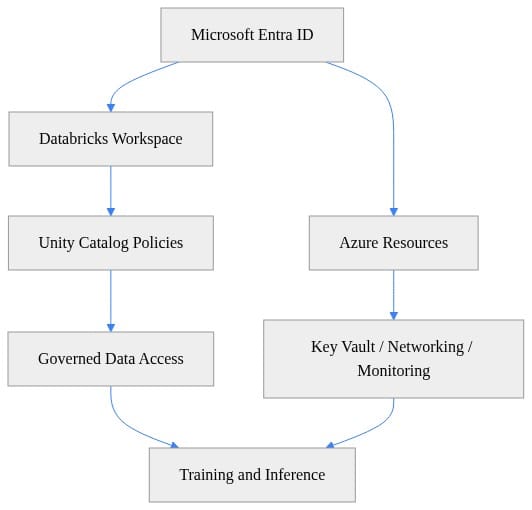
What you should notice: Entra ID, Azure resources, Databricks workspace controls, policy enforcement, and governed access all chain together. That’s the model. Cross-platform, one operating discipline.
2) Data engineering and ML execution
If the workload is Spark-oriented, requires serious data engineering, or needs tight coupling between engineering, feature creation, model work, and serving, Databricks deserves a hard look.
Microsoft’s own documentation is very clear that Azure Databricks spans data engineering, data science, and machine learning. So when a team is doing high-scale transformations, curated lakehouse patterns, feature pipelines, or model training close to governed data, I don’t waste time forcing that into an ill-fitting tool just to satisfy a purity test.
Here’s a tiny illustrative pattern: ingest data into Delta in Databricks first, because governed data products beat ad hoc file piles every single time.
# Ingest enterprise data into a Delta table in Databricks
from pyspark.sql import SparkSession

spark = SparkSession.builder.getOrCreate()

raw_df = spark.createDataFrame(
    [
        (1, "contoso", 1200.50, "2026-07-01"),
        (2, "fabrikam", 845.10, "2026-07-01"),
    ],
    ["invoice_id", "customer", "amount", "invoice_date"],
)

(raw_df.write
 .format("delta")
 .mode("overwrite")
 .saveAsTable("main.finance.raw_invoices"))

print("Created Delta table: main.finance.raw_invoices")
What to observe next: the point isn’t the toy invoice data. The point is the table-first habit. Enterprise AI gets better when the raw landing zone becomes a managed object, not a folder archaeology project.
Then curate and apply governed access:
# Apply governance with Unity Catalog-style table access in Databricks SQL
catalog = "main"
schema = "finance"
table = "curated_invoices"

spark.sql(f"CREATE SCHEMA IF NOT EXISTS {catalog}.{schema}")

spark.sql(f"""
CREATE OR REPLACE TABLE {catalog}.{schema}.{table} AS
SELECT invoice_id, customer, amount, to_date(invoice_date) AS invoice_date
FROM {catalog}.{schema}.raw_invoices
""")

spark.sql(f"GRANT SELECT ON TABLE {catalog}.{schema}.{table} TO `analysts`")
print(f"Governed table ready: {catalog}.{schema}.{table}")
Now you’ve got a better conversation with security, with analytics teams, and with downstream AI builders. Ownership and access are explicit.
3) Trusted data products and semantic reuse
This is where a lot of AI strategy decks fall apart.
The value of Databricks in the enterprise is not “it runs models.” Plenty of things run models. The real value is that it can sit in the middle of engineering, curation, governance, and AI execution when the workload benefits from that integrated lifecycle.
Microsoft’s Databricks guidance explicitly emphasizes curating data and offering trusted data-as-products as a guiding principle for a platform that supports present and future business needs guiding principles. That is the right framing.
If your AI app is built on duplicated extracts, undocumented joins, and five different definitions of margin, the model layer is just expensive theater.
Why business context is the real Databricks value
The enterprise AI conversation still gets hijacked by model access. That’s lazy architecture.
Model access is table stakes. Business context is the moat.
Microsoft’s guidance on Databricks AI/BI says the capability is designed to understand data semantics and enable self-service data analysis, built on a compound AI system using the data lifecycle AI/BI concepts. That’s exactly why I evaluate Databricks as a context-rich execution environment, not just another place to run notebooks.
When the workload needs all of this together, Databricks is a strong fit:
- governed data products
- engineering pipelines
- feature logic
- model development
- GenAI evaluation and deployment
- monitoring tied back to enterprise data
When it does not need that integrated responsibility stack, don’t force it.
That’s the part people miss. I’m not arguing every AI workload belongs in Databricks. I’m arguing that the ones which depend on enterprise data context, lifecycle continuity, and serious engineering discipline should be evaluated there first.
A compact architecture sketch helps teams see the shape fast:
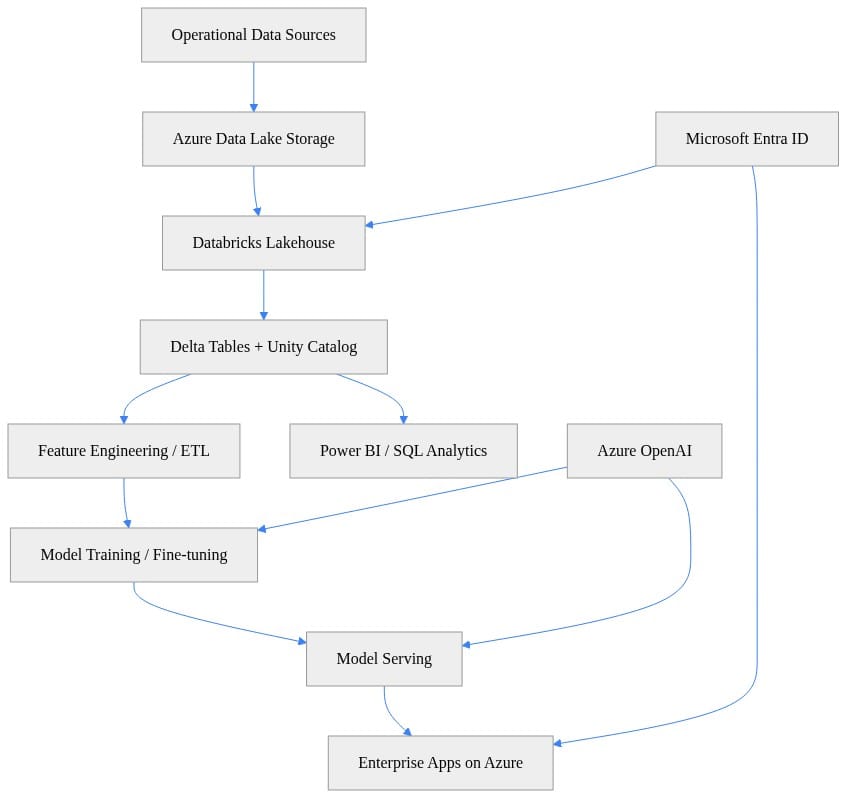
What to notice: the lakehouse, governed tables, model work, enterprise apps, Power BI consumption, Entra ID, and Azure OpenAI all sit in one coherent path. That’s a practical enterprise pattern, not a vendor beauty contest.
The governance and identity test executives should run first
Before you greenlight another AI workload, run five checks.
- Is there a named owner for identity and access?
- Is there a named steward for the data product behind the workload?
- Is there a named operator for model or app runtime support?
- Is there one policy path for audit, retention, and lifecycle?
- Is this architecture creating duplicate semantics or duplicate pipelines without a business reason?
That last one is where money disappears.
I’ve seen enterprises spend six figures in engineering time recreating the same transformations in parallel because one team wanted “full Databricks autonomy” and another wanted “pure Fabric alignment.” Both were wrong. Shared policy, clear boundaries, and deliberate placement would have cut the noise in half.
Microsoft notes that Azure Databricks includes tools for building, evaluating, deploying, and monitoring generative AI applications GenAI capabilities. Great. Use those capabilities where the team actually needs that end-to-end AI application lifecycle. But pair that with governance discipline. Microsoft also states Databricks AI assistive features are intended to improve data and AI productivity while maintaining governance Databricks AI guidance. Productivity without governance is just faster entropy.
Cost discipline means avoiding duplicate architecture
Direct service cost is the easy part. Duplicate architecture is the real tax.
Here’s what I want in every architecture review:
- system of record
- consuming audience
- execution environment
- semantic owner
- operational owner
- support model
- reason this workload belongs here and not somewhere else
If that business case is missing, the default answer should be no.
Redundancy is fine when it is intentional. Maybe one workload truly belongs in Databricks for engineering and model lifecycle reasons, while another belongs in Fabric for consumption-centric analytics. Good. Document the boundary and move on.
What I won’t approve is accidental duplication:
- same prep logic in two places
- same business metric defined three ways
- same dataset copied because nobody wants to negotiate ownership
- same model operations function split across teams with different alerting paths
That is how “partnership flexibility” turns into platform sprawl.
A lightweight feature engineering example makes the point. Once the curated table exists, feature logic can stay close to the governed data instead of getting exported into random side systems.
# Build a simple feature table for enterprise AI workloads
from pyspark.sql import SparkSession
from pyspark.sql.functions import col, month

spark = SparkSession.builder.getOrCreate()

features_df = (
    spark.table("main.finance.curated_invoices")
    .withColumn("invoice_month", month(col("invoice_date")))
    .withColumn("high_value_invoice", (col("amount") > 1000).cast("int"))
)

(features_df.write
 .format("delta")
 .mode("overwrite")
 .saveAsTable("main.ml.invoice_features"))

print("Feature table created: main.ml.invoice_features")
What to do next: inspect whether your real feature logic belongs near the governed lakehouse or whether you’re exporting context too early and creating drift between analytics and AI paths.
A decision framework for the next architecture review
If you’re a CIO, CDO, platform lead, or principal architect, use this sequence.
Step 1: classify the workload
Is it:
- data engineering
- data science / ML
- GenAI application delivery
- AI-assisted analytics
- BI consumption
Step 2: assess context needs
Does it require:
- curated trusted data products
- reusable semantics
- lifecycle-connected evaluation and monitoring
- close coupling between engineering and AI runtime
Step 3: assess operating constraints
What are the requirements for:
- identity model
- governance ownership
- support model
- cost accountability
- networking and security standards
Step 4: place the workload
Then make the call:
- retain a Microsoft-native path where it fits
- use Azure Databricks where its execution model fits
- document the boundary so teams stop rebuilding each other’s work
For AI application delivery, I like showing teams the runtime path end to end:
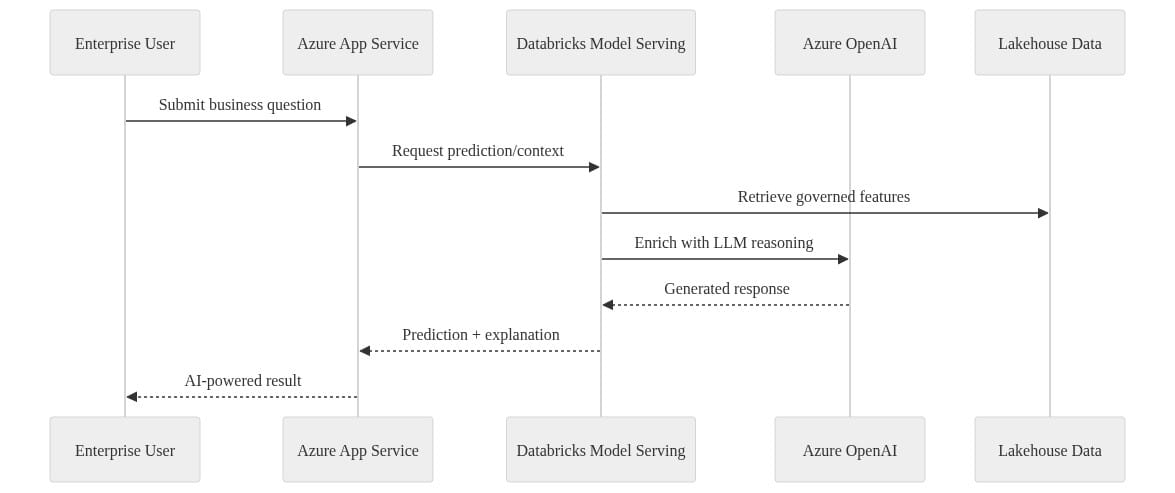
What to notice: the app, model serving, governed lakehouse retrieval, and Azure OpenAI interaction are separate responsibilities. That’s exactly why architecture placement matters.
The strategic conclusion: architecture pluralism with strict accountability
The Databricks-Microsoft partnership is reshaping enterprise AI architecture because it gives enterprises more legitimate choices inside one cloud operating model.
That is a good thing, if you have discipline.
The two bad extremes are obvious:
- declaring one universal winner and shoving every workload into it
- letting every team create its own unmanaged platform island
Both fail. One kills fit. The other kills control.
The right answer is a small number of explicit workload patterns, shared governance expectations, and hard ownership boundaries. Databricks should be evaluated as a context-rich data and AI execution environment within a Microsoft operating model. Azure and Fabric remain essential layers in that architecture. They are not placeholders waiting to be replaced.
That’s the call.
Rate your team’s current workload-placement discipline from 1 to 5: are you placing AI workloads by responsibility and operating model, or are you still arguing platform allegiance?
#EnterpriseAI #DataArchitecture #AzureDatabricks
Sources & References
- Get Started with AI Architecture Design - Azure Architecture Center
- Databricks well-architected framework - Azure Databricks
- Guiding principles - Azure Databricks
- Concepts: Data science and machine learning on Azure Databricks - Azure Databricks
- AI/BI concepts - Azure Databricks
- Databricks AI assistive features - Azure Databricks
- What is Azure Databricks? - Azure Databricks
- The scope of the Databricks platform - Azure Databricks
- Azure Databricks generative AI capabilities - Azure Databricks
- Create a Modern Analytics Architecture by Using Azure Databricks - Azure Architecture Center
Try it yourself
Run this tutorial as a Jupyter notebook: Download runbook.ipynb (21 cells, 19 KB).