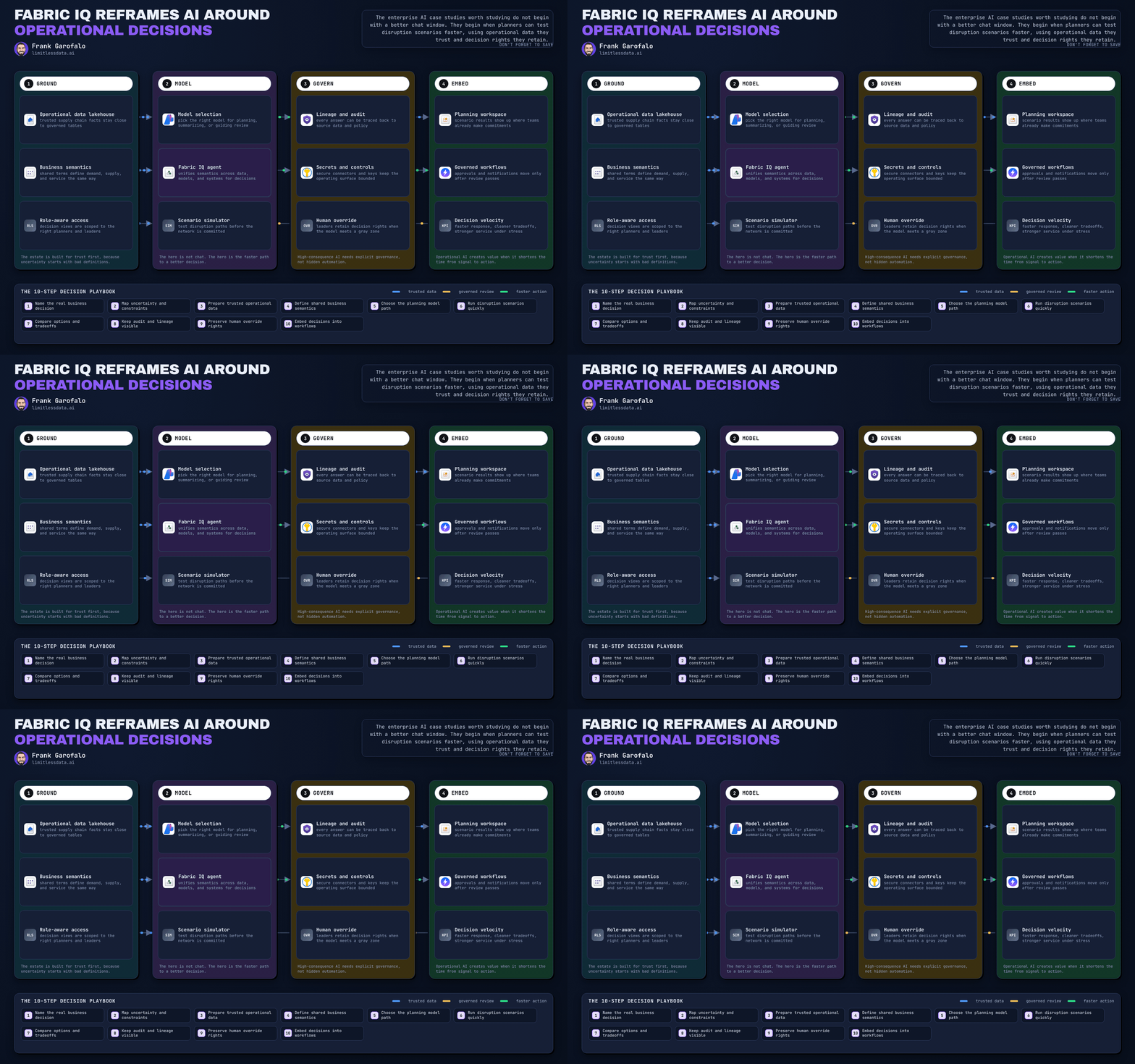
Databricks to OneLake Just Rewrote Azure Platform Strategy
Why Databricks-to-OneLake Interoperability Changes the Azure Data Platform Conversation


Databricks-to-OneLake interop is not an integration story. It is a power shift in how Azure data leaders should design platforms, sequence migrations, and negotiate lock-in.
Most teams will treat Databricks-to-OneLake interoperability as another integration checkbox. That misses the point: this is a governance and operating-model shift that changes how Azure data leaders should think about coexistence, migration timing, and switching costs.
Microsoft is explicit about the direction of travel. OneLake is positioned as a single, unified, logical data lake for the organization, and Microsoft references Azure Databricks integration in its OneLake documentation, including catalog federation scenarios involving Unity Catalog. Azure Databricks also remains a first-class analytics platform for engineering, analytics, data science, and ML workloads. Those are not accidental messages. They suggest the Azure data conversation is moving away from forced separation and toward governed interoperability.
The real story: bargaining power
The old Azure platform argument was framed as a hard choice:
- standardize on Fabric for an integrated Microsoft analytics experience
- standardize on Databricks for lakehouse engineering and ML-heavy workloads
- accept duplication if you wanted both
That framing gave too much power to product selection and not enough to architecture. If your estate had to be split by tool boundary, the platform you chose earliest often dictated your migration path, governance model, and future switching costs.
Interoperability changes that.
If OneLake can act as a logical organizational lake and Databricks can participate through open storage and metadata access patterns, the strategic question is no longer "Which product wins?" It becomes: "Where should control planes, governance boundaries, and workload placement sit?"
That matters because reduced lock-in is not just a side effect here. It is a strategic outcome.
A specific example from the field: in Q1, a 220-person retail analytics organization I advised had separate Fabric and Databricks teams maintaining the same finance-ready sales data in two storage estates, and one schema drift in the orders_curated table triggered three days of reconciliation across Power BI and ML reporting. That is the tax interoperability is trying to reduce.
Why this changes the Azure conversation now
This matters now for three reasons: AI readiness, migration sequencing, and budget pressure.
First, AI workloads are forcing consolidation pressure on the data estate. One enterprise data estate increasingly needs to serve BI, engineering, data science, and downstream AI use cases without multiplying copies of the same data.
Second, budget scrutiny is exposing the hidden cost of copy-based integration. Storage is cheap until you duplicate curated data across platforms, duplicate pipelines, duplicate quality checks, and duplicate governance reviews. Then the cost shows up in engineering time and slower change management.
Third, interoperability is becoming a platform selection criterion in its own right because it preserves future choices. Feature parity is not the only question anymore. Optionality is.
From copy-first to hybrid lakehouse
The old pattern was simple and expensive:
- land data in one platform
- copy it into another platform for consumption
- rebuild metadata, permissions, and quality controls
- explain why "single source of truth" still requires multiple copies
The new pattern is not "no copies ever." That would be sloppy architecture. The improvement is selective replication instead of default replication.
OneLake shortcuts are designed to unify data across domains, clouds, and accounts without requiring movement in every case. Fabric mirroring adds another option when synchronized copies are operationally justified. Different tools, different jobs.
The architecture pattern leaders should internalize is this: Databricks writes open Delta data, and OneLake/Fabric may consume through shared or virtualized access patterns rather than forcing a second full estate.

This is a conceptual architecture pattern, not an exact implementation blueprint. The center of gravity is no longer just the analytics engine. It is the open data representation, the access path, and the governance plane around it.
Databricks' medallion architecture still fits cleanly here. Bronze, silver, and gold layers can remain Databricks-engineered while selected curated layers are exposed for broader Fabric consumption.
Hybrid lakehouse operating model = shared data estate, multiple engines, explicit governance contracts, and replication only where it has a clear reason to exist.
What interoperability actually changes
If you are an architect or platform lead, there are four decisions worth revisiting immediately.
1. Storage strategy
You need a position on when OneLake is the logical enterprise lake and when Databricks-managed patterns still make sense.
If your priority is broad organizational access, business analytics, and unified discovery, OneLake's positioning is strategically attractive. If your priority is advanced engineering pipelines, ML feature preparation, and established Databricks operating patterns, keeping core Delta data engineered in Databricks may still be the cleaner path.
The point is not to force one answer. It is to stop assuming different compute engines require physically isolated data estates.
# Inventory Databricks and Fabric-related endpoints from a simple platform manifest
$estate = @(
    [pscustomobject]@{ Platform="Databricks"; Workspace="dbx-prod"; Endpoint="https://adb-123.azuredatabricks.net"; Storage="abfss://curated@acct.dfs.core.windows.net" },
    [pscustomobject]@{ Platform="Fabric"; Workspace="fabric-finance"; Endpoint="https://app.fabric.microsoft.com"; Storage="https://onelake.dfs.fabric.microsoft.com/finance" }
)

$estate |
    Sort-Object Platform, Workspace |
    ForEach-Object {
        "{0} | {1} | {2} | {3}" -f $_.Platform, $_.Workspace, $_.Endpoint, $_.Storage
    }
What to observe: you are mapping platforms to endpoints and storage paths, not debating brands.
2. Catalog and metadata strategy
Metadata is where many "interoperable" designs quietly fail.
Yes, Microsoft documents OneLake integration patterns involving Azure Databricks and Unity Catalog. But that should not be read as seamless, universal metadata convergence. Interoperability can reduce friction; it does not eliminate semantic mismatches, duplicated stewardship decisions, or cross-platform governance work.
You should test whether key table properties line up across your Databricks and OneLake-facing views of the same data product.
-- Databricks / Unity Catalog: inspect the authoritative Delta table definition
DESCRIBE DETAIL main.sales.orders;
-- Fabric-facing validation pattern: confirm the exposed object points to the expected path and format
-- Pseudo-example for architecture validation, not a copy-paste production script
SELECT
    table_name,
    data_source_format,
    data_location
FROM metadata_inventory
WHERE table_name = 'sales.orders';
If name, format, location, or partition semantics diverge, your interoperability story is weaker than your slide deck suggests.
3. Workload placement
Databricks remains strong for engineering-heavy pipelines, data science, and ML workflows. Fabric is compelling for integrated analytics, SQL-centric consumption, and business-facing experiences. The value of interoperability is that you do not have to create two disconnected estates to use both strengths.
The better architecture questions are:
- Where should transformation happen?
- Where should semantic serving happen?
- Where should business consumption happen?
- Where should ML experimentation happen?
- Which data products deserve replication, and which should be shared in place?
A simple heuristic helps:
# Show the strategic decision rule: prefer open Delta access over duplicate copies
datasets = [
    {"name": "orders", "format": "delta", "shared_path": True},
    {"name": "erp_extract", "format": "csv", "shared_path": False},
]

for ds in datasets:
    if ds["format"] == "delta" and ds["shared_path"]:
        action = "Reuse in Fabric/OneLake without copy"
    else:
        action = "Consider ingestion or conversion"
    print(f"{ds['name']}: {action}")
Open Delta plus a shared path is a strong signal to reuse rather than duplicate. Closed formats and brittle extracts are where ingestion or conversion still earns its keep.
4. Ownership and governance
Interoperability does not remove domain ownership. It makes ownership more important.
A central platform team might own storage patterns, catalog standards, and policy frameworks. Business-aligned teams might own data products, semantic definitions, and SLAs. If those contracts are not explicit, shared storage quickly becomes shared confusion.
Governance gets harder before it gets better
This is the part many teams underestimate.
Interoperability reduces technical lock-in while increasing governance complexity. Shared data does not mean shared accountability. In fact, the more engines you allow against a shared estate, the more important your governance discipline becomes.
You need clear answers to these questions:
- What is the authoritative catalog for discovery?
- What lineage standard is required across Databricks and Fabric workflows?
- What access model governs cross-platform consumption?
- Which team owns each data product SLA?
- When is a shortcut allowed, when is mirroring preferred, and when is a full copy mandatory?
If you do not answer those questions centrally, teams will invent local patterns. That is how you end up with a new form of sprawl: governance sprawl across two powerful ecosystems.

This is also a conceptual pattern, not an implementation blueprint. Interoperability does not eliminate architecture work. It moves the hard part from data copying to governance design.
The cost model is not just compute versus storage
Too many platform debates still collapse into a simplistic TCO argument:
- Fabric is cheaper for this
- Databricks is more expensive for that
- therefore standardize
That is not serious architecture.
The real cost model includes:
- duplicated storage for the same curated datasets
- duplicated pipelines and orchestration logic
- duplicated testing and reconciliation effort
- slower schema change management
- duplicated governance reviews
- delayed AI initiatives because data is fragmented
Interoperability can reduce those costs by lowering the need for brute-force duplication. But it also introduces new costs:
- dual governance overhead
- cross-team coordination
- skill overlap across Fabric and Databricks
- more demanding platform architecture reviews
That does not make interoperability a bad trade. It makes it an executive trade.
Migration strategy: sequenced coexistence
This is where I take the strongest position: Databricks-to-OneLake interoperability weakens the case for forced all-in migrations.
If your organization already has high-value Databricks engineering patterns, mature Delta assets, and ML workflows, a big-bang move into a single analytics stack is often architectural theater. It looks clean on a target-state slide and creates avoidable risk in the real estate.
A better sequence is:
- preserve high-value Databricks engineering and medallion patterns
- expose selected curated data through OneLake-oriented access patterns
- enable Fabric consumption where integrated analytics and business reach matter
- rationalize duplication over time based on usage, governance maturity, and actual economics
That is not indecision. It is disciplined sequencing.
And sometimes coexistence is not a transition state. It is the target state.
That is especially true where:
- data science and ML teams are deeply invested in Databricks workflows
- business analytics is consolidating around Fabric and Power BI
- governance maturity is high enough to support shared standards
- the cost of migration disruption exceeds the cost of platform coexistence
The bottom line
Databricks-to-OneLake interoperability is not a feature recap. It is a market signal.
It weakens the old assumption that choosing Fabric or Databricks requires hard architectural separation. It can lower switching costs and reduce copy-based integration, but it does not remove the need for deliberate catalog design, access control alignment, lineage standards, or ownership boundaries.
The winning posture is not picking one winner too early. It is designing for governed optionality:
- explicit storage rules
- explicit catalog strategy
- explicit shortcut vs mirror vs copy policies
- explicit workload placement decisions
- explicit ownership contracts across platform and domain teams
The most mature Azure data strategy may now look less standardized on paper and more resilient in practice.
For teams running both today, what breaks first in the real world: catalog authority, access control, lineage, or ownership boundaries?
#MicrosoftFabric #AzureDatabricks #DataArchitecture
Sources & References
- OneLake, the OneDrive for data - Microsoft Fabric
- Unify data sources with OneLake shortcuts - Microsoft Fabric
- Mirroring - Microsoft Fabric
- Azure Databricks documentation
- What is the medallion lakehouse architecture? - Azure Databricks
- Azure Architecture Center - Azure Architecture Center
Try it yourself
Run this tutorial as a Jupyter notebook: Download runbook.ipynb (24 cells, 17 KB).