DP-800 and AI-Ready Data Engineering Skills
The New Skills Bar for SQL Teams: What DP-800 Signals About AI-Ready Data Engineering

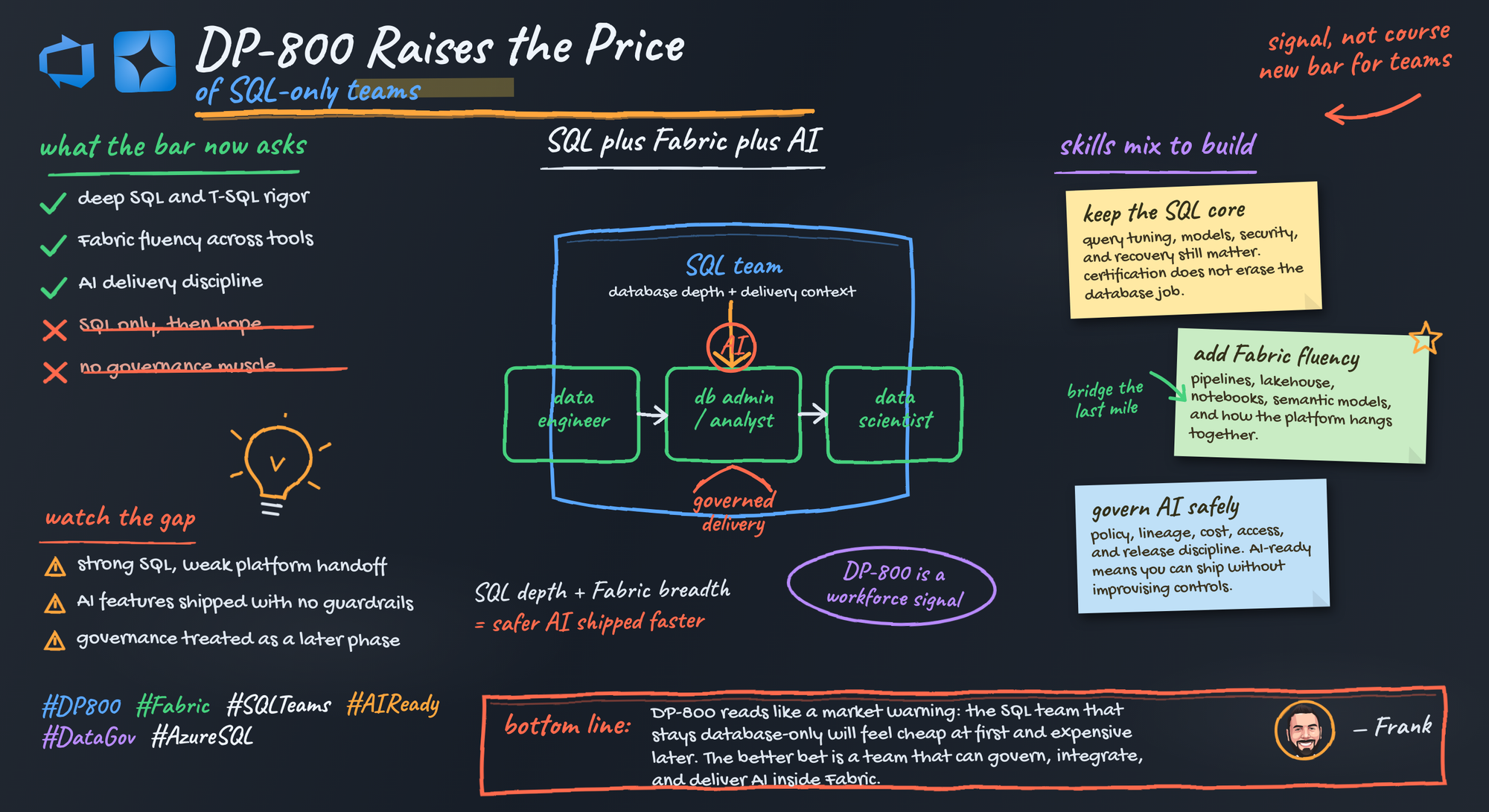
“Should I put my SQL team through DP-800?” Yes—but if your only takeaway is exam prep, you missed the signal completely.
On this page
- DP-800 Is a Market Signal, Not Exam Trivia
- The Old Warehouse Profile Is No Longer the Whole Job
- The New Skills Bar Has Four Layers
- Do Not Trade Modeling Discipline for Prompt Demos
- Fabric-Era Fluency Changes Team Boundaries
- Redesign the Workforce Before the Next AI Commitment
- The Leadership Takeaway
- Sources & References
Microsoft launched DP-800T00-A, “Develop AI-enabled database solutions,” as an intermediate course aimed at SQL Server work across data analyst, data engineer, data scientist, and DBA roles per the course page. That matters far more than the badge. It tells you where Microsoft thinks database work is headed: straight into AI delivery, with governance and platform decisions attached.
I’ll say it bluntly: the SQL team’s remit just got bigger. The winners are not the teams with the flashiest prompt demos. The winners are the ones that can still tune a bad query at 2:13 AM, fix a broken load, explain lineage to audit, and wire trusted data into AI-enabled apps without blowing up security, latency, or cost.
DP-800 Is a Market Signal, Not Exam Trivia
A lot of leaders will handle this the lazy way. They’ll buy a few training seats, ask who wants a certification, and declare the team “AI-ready” by the end of the quarter.
That is not workforce design. That is theater.
DP-800 matters because it puts AI-enabled database solutions directly inside the SQL conversation. Not off in a separate “innovation” lane. Not parked only with data science. Right in the middle of the people who own schemas, performance, pipelines, reliability, and access patterns.
That is exactly the right move.
When Microsoft frames this work across multiple data roles, it is telling you the boundary lines are shifting. Database engineering is still database engineering. But now the job includes understanding how data gets exposed to intelligent applications, how retrieval context is shaped, how operational controls travel with the workload, and where platform handoffs should happen.
If you lead a data organization, the action item is not “who wants to study.” The action item is:
- who owns semantics,
- who owns governed access for AI workloads,
- who owns evaluation,
- who owns the platform boundary between SQL, Fabric, and adjacent AI services,
- and who gets paged when the AI app starts hammering the same hot path your finance workload depends on.
I wrote about this earlier in DP-800 Reveals Fabric's New SQL Talent Bar, and the point has only gotten sharper: this is an org design signal disguised as a course launch.
The Old Warehouse Profile Is No Longer the Whole Job
Let’s give the classic SQL and warehouse team its due. The traditional profile is still valuable:
- relational modeling
- SQL development
- ETL or ELT design
- indexing and workload tuning
- backup, recovery, and reliability
- role-based access and operational discipline
None of that becomes optional because AI showed up. It becomes more important.
Bad models produce bad retrieval. Weak semantics produce misleading summaries. Slow queries become slow copilots. Loose access control becomes a security incident with a chat interface on top.
That is why I get impatient when people talk about AI as if it replaces data engineering. It amplifies data engineering. It punishes weak foundations faster and more publicly.
The platform story reinforces this. Microsoft describes Fabric as a unified platform for an organization’s data and analytics needs in the Fabric docs. Azure SQL documentation now explicitly includes intelligent applications, AI-related concepts, multi-model capabilities, SQL MCP Server, and connections to REST API endpoints in the Azure SQL docs. Read that for what it is: the walls between database, analytics, and AI delivery are thinner than they were two years ago.
The New Skills Bar Has Four Layers
Here’s the practical model I use with teams. Don’t turn this into a religious debate about titles. Treat it as a capability stack.
1) Database foundations
This is still the base layer.
You need people who can handle:
- data modeling
- indexing strategy
- query performance
- workload isolation
- backup and recovery
- security boundaries
- cost discipline
- change management
If your team can’t keep the transactional and analytical core healthy, your AI layer is built on wet cardboard.
2) AI literacy
I do not need every SQL engineer pretending to be a model researcher. I do need them to understand what AI-enabled solutions require from the data layer.
That includes:
- clean and stable retrieval context
- metadata enrichment
- chunking and searchability for documentation or text-heavy assets
- evaluation inputs and expected outputs
- operational constraints like latency, token pressure, and authorization paths
A simple way to explain the shift to a team is to map the old profile to the new one. This little example is intentionally lightweight, but it makes the point fast.
# DP-800-style skill map for an AI-ready SQL team
skills = {
    "sql_foundations": ["query tuning", "index strategy", "data modeling"],
    "engineering": ["pipelines", "orchestration", "incremental loads"],
    "governance": ["lineage", "security", "data quality"],
    "ai_readiness": ["vectorization", "metadata enrichment", "semantic search"],
}

for category, items in skills.items():
    print(f"{category.upper()}:")
    for item in items:
        print(f"  - {item}")
What to notice: the new work does not replace SQL foundations. It adds governance and AI-readiness concerns on top of them.
3) Platform fluency
Platform fluency is not product trivia. I do not care whether somebody can win a naming contest for every Fabric feature. I care whether they can make sound design decisions across SQL Server, Azure SQL, Fabric, and adjacent analytics platforms.
Microsoft’s own definition of a data engineer is someone who integrates, transforms, and consolidates structured and unstructured data into usable structures on the data engineer career path. That definition is still the center of gravity. The difference now is that the usable structure may feed BI, an app, a search layer, or an AI system in the same delivery chain.
And yes, Fabric is part of this conversation. So is Azure Databricks, which Microsoft positions as a unified, open analytics platform for enterprise-grade data, analytics, and AI solutions at scale in the Azure Databricks introduction. Mature leaders design for interoperable responsibilities, not one-product tribalism.
4) Governance and operations
This is where weak teams get exposed.
If you cannot answer these questions, you are not AI-ready:
- What source data is trusted?
- Who owns the meaning of each field?
- What lineage exists from source to AI-facing artifact?
- Which identities can access what?
- What happens when quality drops?
- How is cost observed?
- Who supports the workload in production?
That is why I keep pushing governance as architecture, not paperwork. I made that case directly in Fabric Data Agent API Just Turned Governance Into Architecture.
Do Not Trade Modeling Discipline for Prompt Demos
Here’s the trap I see constantly: a team gets a nice-looking AI demo working against semi-curated data, executives get excited, and nobody asks the ugly questions until production.
So ask them early.
Can the system explain where the answer came from? Can it enforce user-specific access? Can it survive a schema change? Can it handle load without starving core workloads? Can you measure whether the output is getting better or worse? Can you estimate the cost of running it every day instead of once in a workshop?
This is where agent and skill design become a data problem, not just an app problem. Microsoft’s Agent Skills documentation describes progressive disclosure, where skill names and descriptions are injected at the start of a run and more detail is disclosed later to minimize context usage in the Agent Skills docs. That pattern should sound familiar to any serious data person: selective exposure, controlled context, and clear boundaries.
That is database thinking.
If you want a simple visual for the team, this is the evolution I use in workshops.
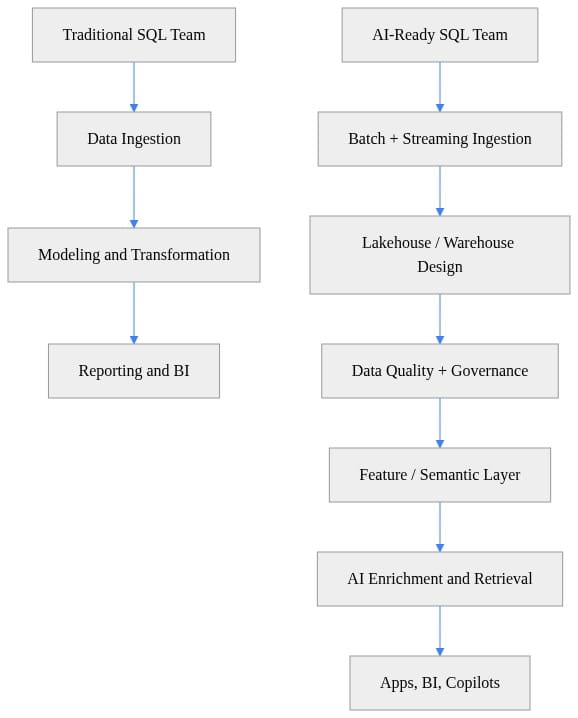
The thing to observe is the extra middle. AI-ready teams have more governed steps between ingestion and consumption. That middle layer is where quality, semantics, and control live.
Fabric-Era Fluency Changes Team Boundaries
A unified platform changes coordination, whether people like it or not.
In the old model, the SQL team could often stop at “the warehouse is loaded.” Someone else picked up BI. Someone else handled app integration. Somebody in a different building was called for machine learning.
Those clean handoffs are fading.
Now the database team needs enough platform fluency to know:
- when data belongs in a curated warehouse pattern,
- when lakehouse-style access is appropriate,
- when semantic shaping matters more than raw ingestion speed,
- when an AI app should hit a governed serving layer instead of ad hoc tables,
- and when to keep a hard boundary because the operational risk is too high.
That is one reason I’ve been writing so much about Fabric. The stack is forcing conversations that used to stay siloed. Fabric Data Factory Just Shrunk the Pipeline Stack gets at this from the pipeline angle, but the bigger story is organizational: fewer excuses for disconnected ownership.
A sequence view helps here. This is how I explain the responsibility chain to SQL-heavy teams moving into AI-enabled delivery.
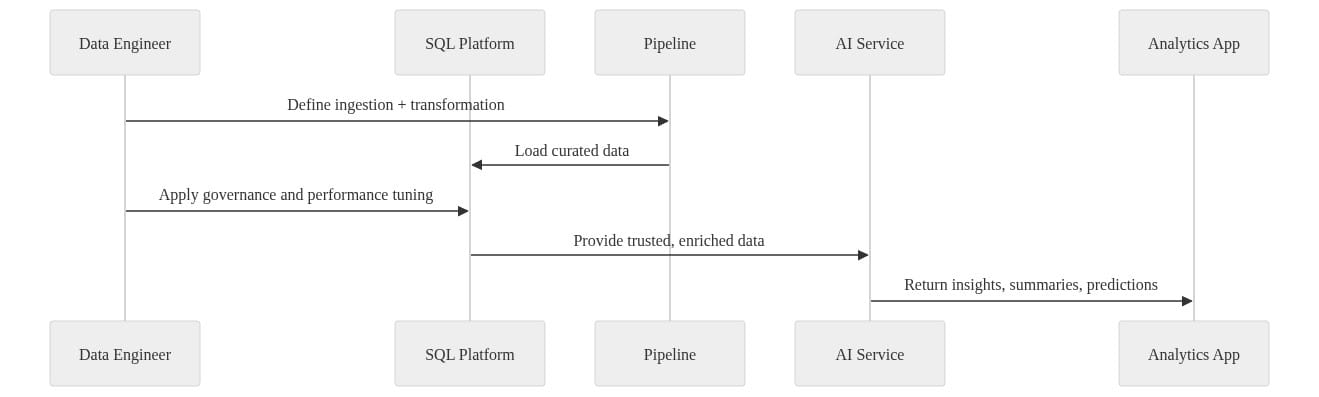
Read that as an operating model, not a toy diagram. The SQL platform is not just a storage destination anymore. It becomes a governed serving point for downstream AI behavior.
Redesign the Workforce Before the Next AI Commitment
If you are a leader, stop inventorying job titles and start inventorying capabilities.
I want to know:
- who owns data semantics,
- who owns performance engineering,
- who owns security and authorization paths,
- who owns lineage and metadata,
- who owns platform integration,
- who owns AI evaluation,
- and who owns production support.
Then I want a baseline that spans SQL teams, analytics teams, and AI practitioners. Not identical depth. Shared competence.
This is where curated learning matters. Microsoft Learn plans let organizations create structured learning experiences and track progress through Learn plans. Good. Use that. But don’t just assign generic AI content. Build role-relevant paths:
- DBAs: security, performance isolation, AI-facing access patterns
- data engineers: pipeline reliability, metadata, retrieval-ready shaping
- analytics engineers: semantic consistency, tests, governed serving layers
- AI practitioners: source quality, lineage, authorization, evaluation inputs
And put gates on the portfolio before the next executive AI commitment gets announced:
- named data owner
- trusted source list
- access policy
- measurable quality criteria
- expected workload profile
- support model
- cost review
If that sounds heavy, good. Production is heavy. The teams that skip this work always pay later.
A fast self-check can make the gap visible in about two minutes.
# Quick checklist to assess whether a SQL platform is AI-ready
$capabilities = @{
    "Structured SQL workloads" = $true
    "Automated data quality checks" = $true
    "Metadata and lineage capture" = $true
    "Embeddings or vector support" = $false
    "Secure access patterns for AI apps" = $true
}

$capabilities.GetEnumerator() |
    Sort-Object Name |
    ForEach-Object {
        "{0}: {1}" -f $_.Key, $(if ($_.Value) { "Ready" } else { "Gap" })
    }
The point is not whether every box says “Ready.” The point is whether your team can identify the gaps before an AI workload lands on top of them.
The Leadership Takeaway
SQL depth just became more strategic, not less.
That’s the part too many people still have backward. AI systems increase the blast radius of bad data design, weak governance, poor workload engineering, and fuzzy ownership. They do not make those concerns secondary. They make them board-level.
So yes, pay attention to DP-800. Read it as a signal that modern SQL teams need to evolve from warehouse delivery specialists into SQL-plus-AI-plus-platform operators.
Keep the modeling rigor. Keep the operational discipline. Add AI literacy, governance awareness, and platform fluency.
That is how you deliver AI safely, quickly, and cost-effectively.
Rate your SQL team’s current AI-readiness from 1 to 5—and be honest: are you strong on foundations, or just strong on demos?
#DataEngineering #MicrosoftFabric #EnterpriseAI
Sources & References
- Microsoft Fabric documentation - Microsoft Fabric
- Microsoft Learn for Organizations
- Agent Skills
- Course DP-800T00-A: Develop AI-enabled database solutions - Training
- AI for educators - Training
- Training for Data Engineers
- Azure SQL documentation - Azure SQL
- What is Azure Databricks? - Azure Databricks
- Design and develop database solutions - Training
- Microsoft Credentials AI Challenge
Try it yourself
Run this tutorial as a Jupyter notebook: Download runbook.ipynb (26 cells, 20 KB).