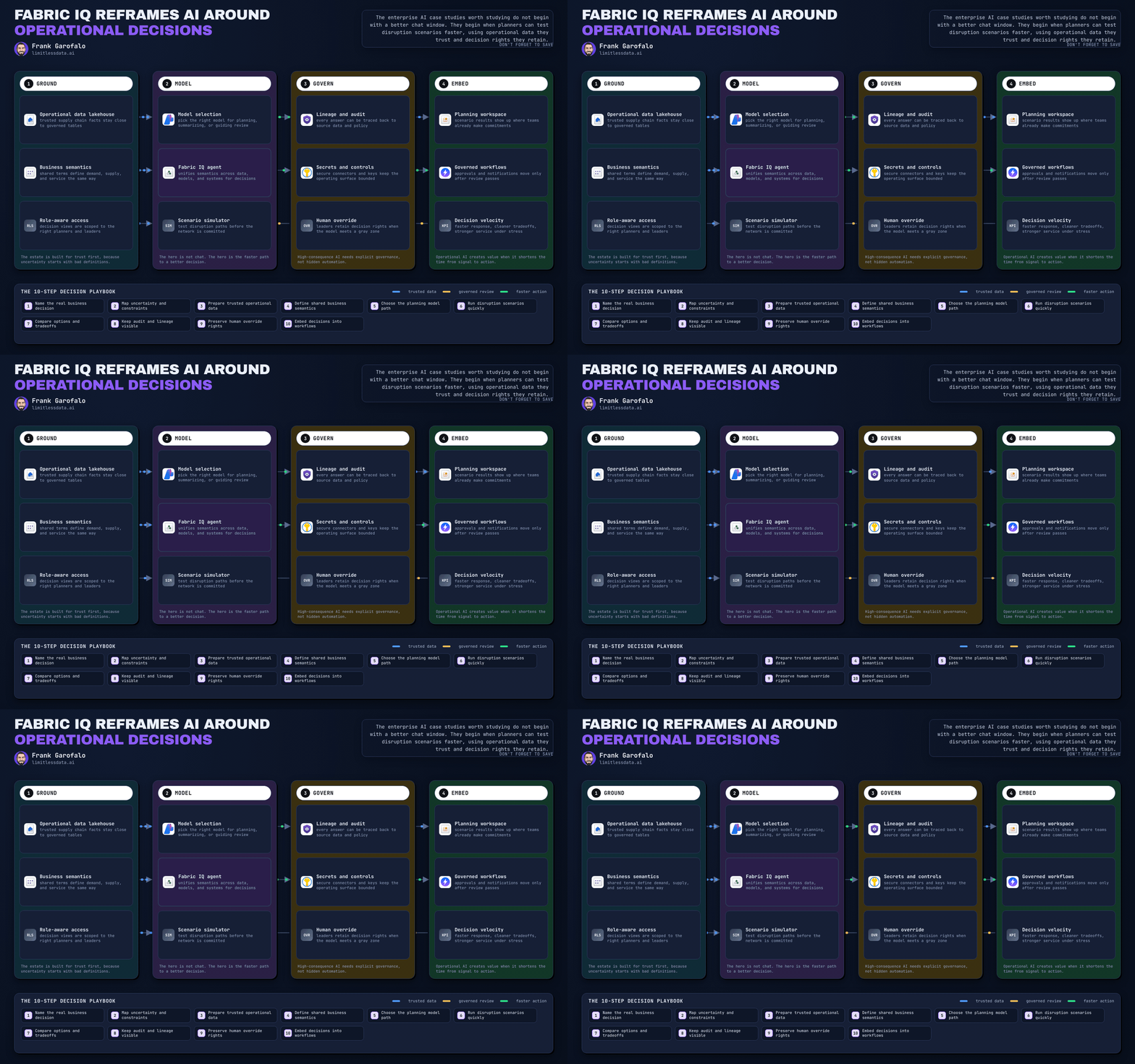
Fabric IQ Turns Data Products Into Business Answers
Fabric IQ as the Missing Layer Between Data Products and Business Questions


The smartest model is rarely the answer. The missing layer is meaning.
That is why so many enterprise talk-to-data efforts disappoint leaders. The demo works. The language is fluent. Then the CFO asks a basic question about revenue, margin, or customer health, and confidence collapses because the system has no reliable way to connect governed data products to business meaning.
My opinion: Fabric IQ matters because it is Microsoft’s clearest attempt to fill that missing layer inside the Fabric-centric data stack. Not with more chat polish, but with shared business context, ontology-driven meaning, and governance that can make natural-language answers more trustworthy than generic chat-over-data patterns.
Microsoft’s own framing supports that reading. Microsoft IQ is described as a unified intelligence layer for enterprise AI, with Fabric IQ providing the live state of the business so agents understand business entities and their relationships. Microsoft also presents the Fabric ontology item as a digital representation of enterprise vocabulary and a semantic layer that unifies meaning across domains and OneLake sources.
That is the real story here, not “chat with your dashboard.”
Why enterprise talk-to-data keeps failing
The conventional wisdom says the problem is model quality. It usually is not.
Enterprises already spent years building data products, semantic models, governed workspaces, warehouse layers, BI assets, and stewardship processes. Then many AI projects bypass all of that and ask an LLM to infer business meaning from schemas, column names, and a few prompts.
A retail analytics team I met in Q1 spent six weeks tuning prompts against a sales mart in Fabric, only to discover their “margin” answer was using revenue minus cost from one table while Finance’s certified gross margin logic lived somewhere else entirely.
That is the pattern. The failure happens between curated data and business questions.
If a user asks, “Why did margin drop in the West?” the system must know:
- what “margin” means in this company
- which metric definition is certified
- what “West” maps to in the enterprise geography hierarchy
- which data products are approved for use
- whether the user is allowed to ask at that level of detail
- what lineage and policy checks should apply before the answer is returned
A generic LLM-to-database pattern does not solve that. It guesses.
Fabric IQ is not another BI feature
This category confusion matters.
Fabric is Microsoft’s all-in-one SaaS analytics platform spanning data movement, data engineering, data science, real-time analytics, warehousing, and BI. Inside that strategy, Fabric IQ should be understood as the intelligence layer that helps agents and natural-language experiences use business-aware context over governed Fabric assets.
In plainer language: Fabric semantic models and Power BI semantics define measures, dimensions, and reporting logic. Fabric IQ sits above that layer and helps AI experiences interpret business questions using those governed definitions and relationships. It does not replace semantic models. It depends on them.
So Fabric IQ is not just:
- a chat box attached to a report
- a synonym list for BI search
- a thin natural-language interface over SQL
- a replacement for semantic modeling
It sits above raw storage and modeling, while depending on disciplined data products underneath.
The stack leaders should picture is simple:
- Fabric workloads produce governed data products
- semantic models and ontology define business meaning
- Fabric IQ operationalizes that meaning for agents and question answering
- downstream copilots, apps, and workflows consume the trusted layer
What to notice: the answer is not produced directly from a certified data product alone. The path runs through semantic definition, Fabric IQ, and governance guardrails.
That said, Fabric IQ is not a shortcut around hard data work. Its value depends on disciplined semantic modeling, clear ownership of business definitions, and governance maturity strong enough to support open-ended questioning. And because these capabilities are still emerging, most organizations should expect preview-stage constraints, uneven implementation maturity, and a need to start with narrow, well-governed domains.
The practical stack: from governed data product to trustworthy answer
If you are a CDO, analytics leader, or platform architect, the phrase to anchor on is this:
from governed data product to trustworthy answer
Fabric IQ is the connective tissue in that journey.
Microsoft describes Fabric IQ as part of Microsoft IQ and says it provides business context, while the ontology item provides a representation of enterprise vocabulary through entities, properties, and relationships. That matters because trustworthy question answering is not only about retrieving rows. It is about grounding a question in the enterprise’s approved concepts.
A practical trusted path looks like this:
- a business question is interpreted against governed entities and certified metrics
- the system resolves approved dimensions, filters, and relationships
- policy and lineage checks run before execution
- the answer returns with definition and provenance, not just numbers
The weak path is the opposite: jump straight to SQL generation, guess the schema, and hope the answer sounds plausible.
To make that concrete, a question like “Which regions had the highest revenue from enterprise customers last quarter?” should be resolved into approved entities, certified measures, and filters before any query is generated.
These snippets are conceptual patterns, not official Fabric IQ SDK examples.
# Map a business question to governed entities and certified metrics before any query generation.
from dataclasses import dataclass

@dataclass
class Intent:
    question: str
    entities: list[str]
    metrics: list[str]
    filters: dict

catalog = {
    "entities": {"customer": "dim_customer", "region": "dim_region", "order": "fact_sales"},
    "metrics": {"revenue": "certified.net_revenue", "margin": "certified.gross_margin"}
}

question = "Which regions had the highest revenue from enterprise customers last quarter?"
intent = Intent(
    question=question,
    entities=["customer", "region", "order"],
    metrics=["revenue"],
    filters={"customer.segment": "Enterprise", "date.period": "Last Quarter"}
)

resolved = {
    "tables": [catalog["entities"][e] for e in intent.entities],
    "measures": [catalog["metrics"][m] for m in intent.metrics],
    "filters": intent.filters
}
print(resolved)
What matters most here is not query generation. It is semantic resolution. “Revenue” becomes a certified metric. “Customer,” “region,” and “order” map to governed assets. “Enterprise” and “Last Quarter” become explicit filters.
Why ontology matters more than model cleverness
This is the part many executives skip because “ontology” sounds academic. It is not. It is operational.
Microsoft’s Fabric ontology documentation describes it as a digital representation of enterprise vocabulary and a semantic layer that unifies meaning across domains and OneLake sources. In business terms, that means the platform can represent what a customer, order, contract, region, policy, or active account actually means in your company.
Without shared meaning:
- “customer” may mean billing account in one domain and active subscriber in another
- “revenue” may mean booked, billed, recognized, or net of returns depending on the team
- “region” may map to sales territories, legal entities, or logistics zones
- “active” may mean 30-day, 90-day, or contract-status-based activity
An LLM can speak confidently through all of those ambiguities. That is exactly why leaders should be cautious.
# Contrast semantic grounding with naive SQL generation to show why trust depends on governed meaning.
question = "What was margin by region for strategic accounts?"

naive_sql = """
SELECT region, SUM(revenue - cost) AS margin
FROM sales
WHERE account_type = 'strategic'
GROUP BY region
""".strip()

semantic_plan = {
    "entity": "customer_account",
    "metric": "certified.gross_margin",
    "group_by": "dim_region.region_name",
    "filter": {"customer_account.segment": "Strategic"},
    "notes": "Uses certified metric logic, approved dimensions, and governed account segmentation."
}

print("Naive approach:\n", naive_sql)
print("\nSemantic approach:\n", semantic_plan)
The naive version looks plausible, which is why bad demos fool people. The semantic plan is stronger because it uses certified metric logic, approved dimensions, and governed segmentation.
What Fabric IQ fixes that generic chat-over-data does not
Generic chat-over-data architectures usually rely on one of three shortcuts:
- direct LLM-to-database access
- ad hoc copilots attached to isolated datasets
- fragmented semantic layers spread across tools and teams
All three fail in predictable ways.
They produce:
- inconsistent KPI definitions
- weak or missing lineage
- duplicated business logic
- access patterns that ignore governance boundaries
- answers that cannot be audited
- brittle prompts that break when schemas evolve
Fabric IQ matters because it points toward a different operating model: use the governed Fabric estate, unify business vocabulary, and ground natural-language interactions in shared semantics.
Foundry IQ documentation also helps clarify the role. It distinguishes Fabric IQ as the semantic intelligence layer among Microsoft’s IQ workloads, which is useful because it places Fabric IQ in the enterprise intelligence category, not the dashboard feature category.
Governance is not the tax. It is the product feature.
When users move from fixed dashboards to open-ended questions, governance becomes more important, not less.
That means:
- access control matters more
- stewardship matters more
- lineage matters more
- certification matters more
- sensitivity labeling matters more
The answer experience itself should carry semantic context and provenance, not just numbers.
# Build a trusted answer payload that includes metric definitions and lineage for business consumption.
answer = {
    "question": "How did revenue trend for enterprise customers this year?",
    "result": [
        {"month": "Jan", "revenue": 120000},
        {"month": "Feb", "revenue": 131500}
    ],
    "semantic_context": {
        "metric": "certified.net_revenue",
        "definition": "Revenue after returns and approved discounts.",
        "source_products": ["Sales Lakehouse", "Returns Warehouse"],
        "lineage_status": "Verified",
        "policy_status": "Compliant"
    }
}

for row in answer["result"]:
    print(f"{row['month']}: ${row['revenue']:,}")
print("Definition:", answer["semantic_context"]["definition"])
print("Lineage:", ", ".join(answer["semantic_context"]["source_products"]))
And before any AI experience consumes assets, teams should be ruthless about whether those assets are actually ready.
# Generate a simple governance report for Fabric assets that should be certified before AI answers use them.
$assets = @(
    [pscustomobject]@{ Name="Net Revenue"; Type="Metric"; Certified=$true; Owner="Finance"; Lineage="Verified" },
    [pscustomobject]@{ Name="Gross Margin"; Type="Metric"; Certified=$true; Owner="Finance"; Lineage="Verified" },
    [pscustomobject]@{ Name="AdHocSales"; Type="Dataset"; Certified=$false; Owner="Unknown"; Lineage="Missing" }
)

$report = $assets | Select-Object Name, Type, Certified, Owner, Lineage,
@{Name="AIReady"; Expression={ $_.Certified -and $_.Lineage -eq "Verified" -and $_.Owner -ne "Unknown" }}

$report | ConvertTo-Json -Depth 3
“AI-ready” should not be a vibe. It should be a governance state based on certification, verified lineage, and clear ownership.
A practical architecture pattern leaders can implement now
Here is the reference pattern I recommend:
- Curate high-value data products in Fabric.
- Define certified metrics and semantic models for the target domain.
- Represent shared business concepts and relationships through ontology.
- Use Fabric IQ as the contextual grounding layer for business-aware question answering.
- Expose that governed context through copilots, agents, or app experiences.
The handoff is clean:
- platform teams standardize controls, workspace baselines, lineage, and lifecycle
- business domains define concepts, metrics, and stewardship
- AI experiences consume the governed semantic layer instead of improvising logic
A simple readiness checklist:
- Do you have trusted data products for the domain?
- Are the critical business metrics certified?
- Are definitions explicit and shared across teams?
- Is lineage verified for the assets involved?
- Are access controls and sensitivity rules in place?
- Do you have 5 to 10 high-value business questions worth grounding properly?
If the answer is no to most of these, do not start with a broad copilot rollout. Start with semantic cleanup.
What leaders should do next
Start narrow. Pick one domain where the business pain is real and stewardship already exists:
- sales pipeline
- customer health
- supply chain exceptions
- finance variance analysis
Then do the unglamorous work:
- inventory where business definitions currently live
- count how many semantic layers exist across Fabric, BI, and app teams
- identify which metrics are certified versus merely popular
- define the ontology and semantic ownership model
- pilot natural-language access only on the governed subset
My opinionated takeaway is simple: the winners will not be the firms with the flashiest copilot demo. They will be the firms that connect governed data products to business questions through a shared intelligence layer.
That is why Fabric IQ matters. It gives Microsoft Fabric a clearer path from governed data products to trustworthy natural-language answers.
Where does this break for your environment: ontology ownership, metric certification, or governance at query time?
#MicrosoftFabric #EnterpriseAI #DataArchitecture
Sources & References
- What is Fabric IQ? - Microsoft Fabric
- What Is Ontology (Preview)? - Microsoft Fabric
- Microsoft IQ documentation
- What is Foundry IQ? - Microsoft Foundry
- Introduction to end-to-end analytics using Microsoft Fabric - Training
Try it yourself
Run this tutorial as a Jupyter notebook: Download runbook.ipynb (26 cells, 21 KB).