Fabric June 2026 Redefined the Data Platform Playbook
Building an AI-ready analytics operating model with Fabric June 2026 updates


Fabric’s June 2026 wave is not a feature story. It is a control story.
The real leadership question is not what to turn on, but what to standardize, what to pilot, and what to deliberately leave alone.
Why the June 2026 Fabric wave is really an operating model story
The conventional reaction to a major Microsoft release is predictable: scan the announcements, pick the eye-catching features, and ask teams to “explore.” That is exactly the wrong leadership behavior now.
Microsoft has been explicit about Fabric’s strategic position as a unified platform for an organization’s data and analytics needs, which strengthens the case for consolidation over fragmented analytics estates rather than adding yet another tool to the stack (Microsoft Learn: Fabric overview, https://learn.microsoft.com/en-us/fabric/). In the June 2026 wave, that positioning matters more because the updates push Fabric further into AI-facing operating patterns, not just traditional BI delivery.
Fabric is no longer just a BI and lakehouse conversation. It now sits in the path of app workloads, agent workloads, and conversational access patterns.
So I would force every June 2026 update into three buckets:
- Standardize
- Pilot
- Monitor
If you do not bucket the release this way, you will drift into feature collection instead of operating model design.
A specific scene from the field: in Q1, a 14-person data team at a regional insurer showed me three separate “AI analytics copilots” hitting different semantic definitions for loss ratio, and the executive sponsor thought the problem was prompt quality.
Standardize now on the June 2026 capabilities that reduce platform sprawl
My opinion is simple: the best June 2026 Fabric decisions are the boring ones.
Microsoft’s training continues to emphasize end-to-end analytics in one platform and explicitly includes how Fabric supports AI, which is not accidental messaging; it is a blueprint for platform consolidation (https://learn.microsoft.com/en-us/training/modules/introduction-end-analytics-use-microsoft-fabric/). In this release wave, that matters because consolidation is no longer just a cost or tooling decision. It is becoming the prerequisite for governed AI access.
The first thing to standardize is not an agent. It is the semantic layer and governed access pattern around it.
That means:
- Shared semantic models for core business metrics
- Curated data products in OneLake
- Workspace standards
- Identity and RBAC patterns
- Audit and telemetry requirements for any AI-facing endpoint
This is where Fabric data agents matter right now. Microsoft documents Fabric data agent as a generally available capability for building conversational Q&A systems with generative AI, designed to make insights more accessible and actionable (https://learn.microsoft.com/en-us/fabric/data-science/concept-data-agent). GA status changes the operating-model decision in June 2026: this is no longer just something to experiment with in isolation. It can be standardized for controlled enterprise use cases where the data is curated and ownership is clear.
That does not mean “roll them out everywhere.” It means standardize the pattern for where conversational access is allowed:
- Curated domains only
- Approved semantic definitions only
- Named owners for each exposed data product
- Logged interactions
- Clear access boundaries
Before any rollout, validate basic guardrails such as naming, region, and tag compliance. This is mundane work, and that is exactly why it matters.
# Check governance guardrails such as naming, region, and tag compliance before deployment
param(
    [string]$WorkspaceName = "fabric-finance-prod",
    [string]$Region = "eastus",
    [hashtable]$Tags = @{ Owner = "data-platform"; Classification = "Confidential" }
)

if ($WorkspaceName -notmatch "^fabric-[a-z]+-(dev|test|prod)$") {
    throw "Workspace name does not match operating model standard."
}

if ($Region -notin @("eastus", "westeurope")) {
    throw "Region $Region is not in the approved deployment list."
}

foreach ($requiredTag in @("Owner", "Classification")) {
    if (-not $Tags.ContainsKey($requiredTag)) {
        throw "Missing required tag: $requiredTag"
    }
}

"Guardrail validation passed."
What to observe: governance starts with standards that are easy to check automatically. If your workspace and deployment conventions are inconsistent, every downstream control becomes harder.
Pilot selectively where June 2026 expands AI interaction with the semantic layer
This is the category where leaders are most likely to make mistakes.
Power BI MCP servers are strategically important, but they are still preview. Microsoft states that Power BI MCP servers enable AI agents to interact with Power BI through natural language using the Model Context Protocol (https://learn.microsoft.com/en-us/power-bi/developer/mcp/mcp-servers-overview). That is a big June 2026 signal because it turns semantic models into machine-consumable interfaces for agents, not just dashboards for humans.
But preview means pilot, not standardize.
The right pilot design is narrow and disciplined:
- One domain with strong data stewardship
- One or two high-value workflows
- Explicit audit expectations
- Known approved callers
- Measurable business outcomes
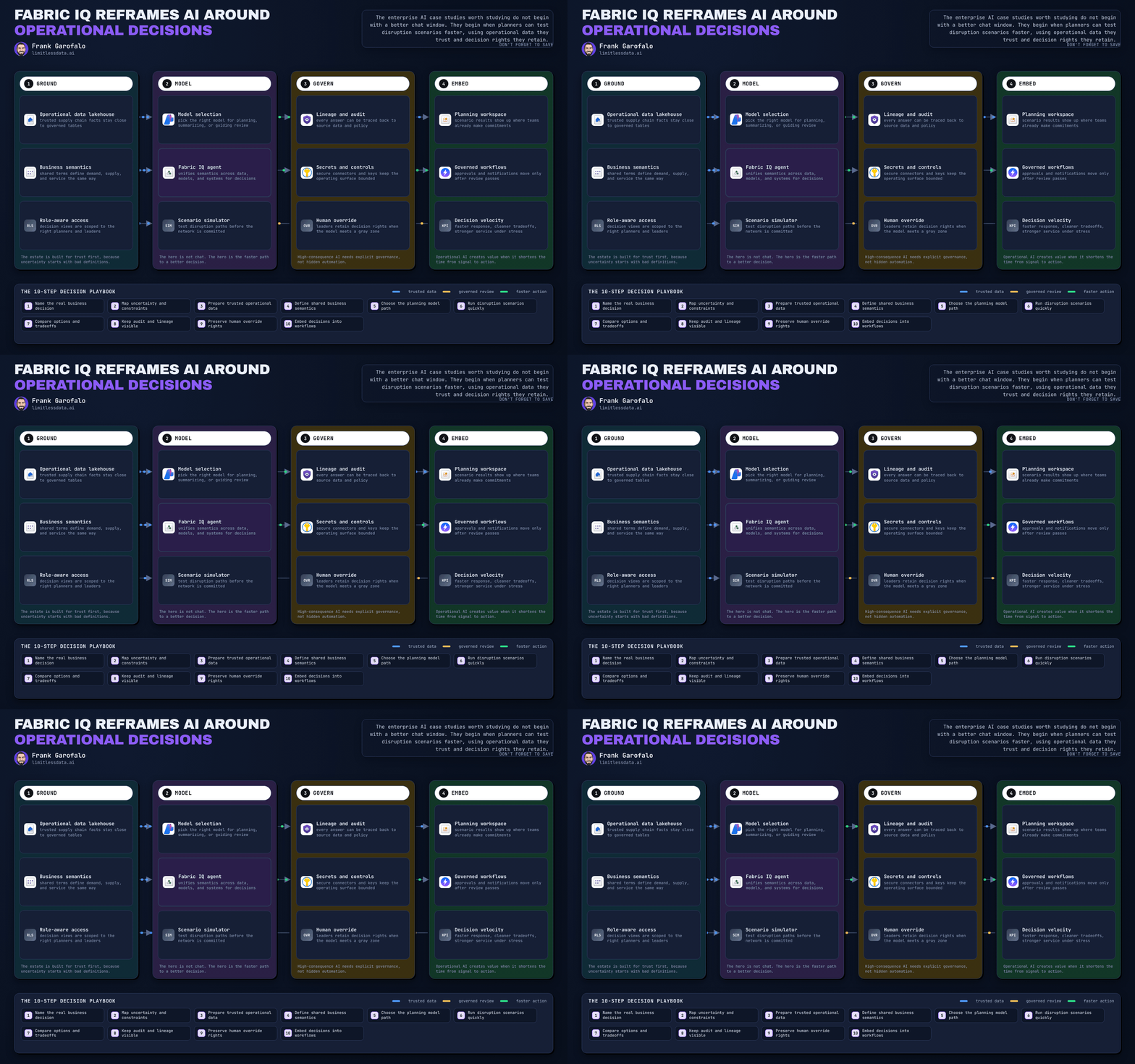
Fabric IQ belongs in the same pilot bucket. Microsoft describes Fabric IQ as part of Microsoft IQ and an enterprise intelligence layer that works with other IQ components to provide organizational context (https://learn.microsoft.com/en-us/fabric/iq/overview). In the June 2026 context, that is important because it points to a richer enterprise context layer for AI experiences. But it only improves decisions if your metadata, ownership, and business definitions are already mature.
If your metadata is weak, an intelligence layer will amplify confusion faster than it creates value.
Monitor the rest until governance and skills catch up
Not every promising June 2026 update deserves immediate action.
The updates I would monitor are the ones that expand AI surface area faster than the organization can govern it. That includes anything that creates new agent access paths, new semantic exposure paths, or overlapping tooling that recreates platform sprawl under an “AI innovation” banner.
Why so strict? Because production AI is now an architecture discipline, not a feature scavenger hunt.
Azure Well-Architected explicitly calls out Well-Architected AI workloads, raising the bar for governance, reliability, and operational review before scale-out (https://learn.microsoft.com/en-us/azure/well-architected/). Azure developer guidance also increasingly centers AI app development and generative AI integration, which means analytics platforms are now expected to serve application and agent workloads, not just BI users (https://learn.microsoft.com/en-us/azure/developer/). That is why the June 2026 Fabric wave changes operating-model decisions now: the platform is moving closer to production AI architecture, so weak controls become more expensive.
And skills are now a gating factor, not a side note. Microsoft has introduced a SQL AI Developer certification path, which is one more signal that AI-enabled data platform skills are becoming operational requirements rather than niche specialties (https://learn.microsoft.com/en-us/credentials/certifications/developing-ai-enabled-database-solutions/).
If your data engineers, BI modelers, and application developers are still working from separate mental models, broad AI rollout is premature.
The four design decisions that separate AI-ready leaders from feature collectors
This is the real tutorial: not how to click through a release, but how to design the operating model.
1) Governance
Define who can expose data to agents, who can approve semantic assets, and how policy is enforced across conversational and BI access. Governance is not just labels and RBAC. It is decision rights.
2) Real-time data readiness
Do not treat real-time as a blanket modernization goal. Use it where fresher data materially changes decisions. Many AI analytics scenarios are not blocked by latency; they are blocked by poor semantic consistency and weak ownership.
3) Semantic modeling
The semantic layer is the control plane for AI-ready analytics. Humans can sometimes work around inconsistent definitions. Agents will scale those inconsistencies instantly.
That is why Power BI MCP matters so much strategically even in preview: it makes semantic assets available as interfaces for machines. If the semantic layer is weak, agentic analytics will fail in a more automated way.
4) Production observability
Require telemetry for agent interactions, semantic query behavior, and operational drift before scaling AI access. Logging is not enough; you need correlation across caller, policy, workspace, and data product.
To make the sequence tangible, here is the pattern I would use for a controlled request into an AI-ready analytics endpoint using managed identity and trace context.
# Acquire a token with managed identity and call a governed analytics endpoint with trace context
import os
import uuid
import requests
from azure.identity import DefaultAzureCredential

endpoint = os.environ["GOVERNED_ANALYTICS_ENDPOINT"]
scope = os.getenv("AZURE_SCOPE", "api://governed-analytics/.default")
correlation_id = str(uuid.uuid4())

credential = DefaultAzureCredential()
token = credential.get_token(scope).token

headers = {
    "Authorization": f"Bearer {token}",
    "Content-Type": "application/json",
    "x-correlation-id": correlation_id,
    "x-data-boundary": "finance-curated"
}
payload = {"question": "Summarize Q2 margin variance by region", "workspace": "fabric-finance-prod"}

response = requests.post(endpoint, json=payload, headers=headers, timeout=30)
print({"status": response.status_code, "correlation_id": correlation_id, "body": response.json()})
What to observe: the important part is not the HTTP call itself. It is that identity, correlation, and data boundary are first-class parts of the interaction, and the token audience matches the governed analytics endpoint pattern rather than implying Azure management as the default.
A practical executive decision matrix for the next two quarters
If I were advising a CIO or CDO on Fabric June 2026, this is the matrix I would use.
Standardize
- Unified Fabric platform patterns for analytics domains, consistent with Microsoft’s platform consolidation direction (https://learn.microsoft.com/en-us/fabric/)
- Governed semantic models for core metrics
- Curated conversational access with Fabric data agents in approved domains, leveraging their GA status (https://learn.microsoft.com/en-us/fabric/data-science/concept-data-agent)
- Well-Architected review checkpoints for AI-facing analytics workloads (https://learn.microsoft.com/en-us/azure/well-architected/)
Pilot
- Power BI MCP server scenarios because they are strategically important but still preview (https://learn.microsoft.com/en-us/power-bi/developer/mcp/mcp-servers-overview)
- Fabric IQ use cases where enterprise context quality is already strong (https://learn.microsoft.com/en-us/fabric/iq/overview)
- Narrow agentic analytics workflows with explicit audit and ROI measures
Monitor
- Broader AI surface expansion without clear controls
- Overlapping tools that recreate platform sprawl
- Use cases with no measurable business value
- Anything the organization cannot yet support with shared skills, telemetry, and operating procedures
The winning move is simplification, not maximal adoption
Here is the opinionated bottom line: the most important Fabric June 2026 updates are the ones that tighten the analytics operating model for AI.
That means:
- Standardize the capabilities that reduce sprawl and improve governance
- Pilot the features that expand AI interaction with trusted semantic models
- Monitor everything else until skills, observability, and ROI evidence catch up
Microsoft’s direction is clear. Fabric is being aligned more tightly with enterprise AI architecture, governed conversational access, machine-consumable semantic interfaces, and broader Azure production guidance. Leaders who read that as a signal to simplify and standardize will get leverage. Leaders who read it as permission to enable everything will get entropy.
So here is the better question: in your organization today, which June 2026 capability belongs in standardize versus pilot—and what governance control is still missing before you would trust it in production?
#MicrosoftFabric #EnterpriseAI #DataArchitecture
Sources & References
- Microsoft Fabric documentation - Microsoft Fabric
- Azure developer documentation
- Azure Well-Architected Framework - Microsoft Azure Well-Architected Framework
- Microsoft Certified: SQL AI Developer Associate - Certifications
- Fabric data agent creation - Microsoft Fabric
- What are the Power BI MCP servers? - Power BI
- Introduction to end-to-end analytics using Microsoft Fabric - Training
- What is Fabric IQ? - Microsoft Fabric
Try it yourself
Run this tutorial as a Jupyter notebook: Download runbook.ipynb (27 cells, 25 KB).