GPT-5.6 on Azure Databricks economics and governance
GPT-5.6 on Azure Databricks: What Frontier Models Mean for Data Platform Economics

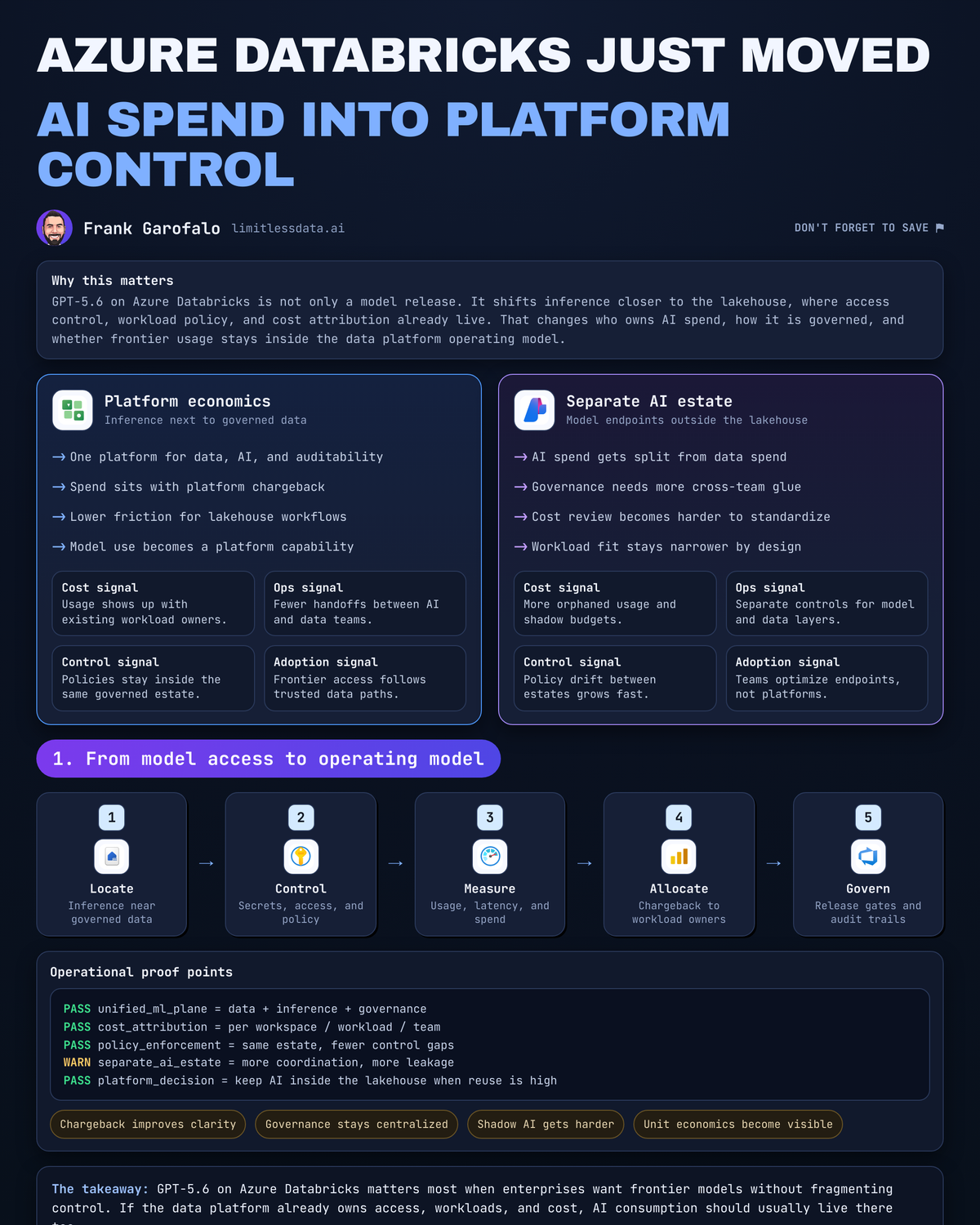
“What happens when a frontier model lands on Azure Databricks?”
That’s the more useful question.
The real story isn’t a specific model announcement. It’s that as frontier inference moves closer to the governed data platform, enterprises have to decide who owns it: the data platform team, the app team, or a separate AI estate.
Why this is really a platform economics story
Azure Databricks already positions itself as a unified platform for data, analytics, and AI, not just a place to experiment with models. Once inference sits inside that same control plane, the ownership conversation changes fast.
Now the CDO, platform engineering lead, and FinOps team have to answer a harder question: is AI usage a platform capability with shared controls and chargeback, or a separate stack with its own budgets, telemetry, and governance?
In practice, that decision matters more than model benchmarks.
The shift is from model choice to inference placement
Databricks now gives teams multiple ways to consume models: pay-per-token APIs, batch-oriented AI functions, and provisioned serving patterns. So the key design choice is no longer just “which model?” but “where should inference live?”
Workload shape should drive that answer:
- Interactive copilots: optimize for latency, concurrency, and guardrails
- Batch enrichment: optimize for throughput and repeatability
- Evaluation runs: optimize for observability and spend control
- Production APIs: optimize for quotas, ownership, and predictable behavior
My blunt take: the cheapest model is often not the cheapest production path. The winning path is usually the one with the lowest governance friction and the clearest chargeback story.
Make costs legible on day one
If I were setting this up today, I’d log usage metadata with every inference call before letting any app team scale.
This is the minimum viable pattern: call the serving endpoint, capture latency and token usage, and stamp the event with workload class and cost center.
# Python: Minimal Databricks Foundation Model API call with usage metadata for chargeback
import os, time, json, requests

host = os.environ["DATABRICKS_HOST"]          # https://adb-<workspace>.azuredatabricks.net
token = os.environ["DATABRICKS_TOKEN"]
url = f"{host}/serving-endpoints/databricks-frontier-model-endpoint/invocations"

payload = {"messages": [{"role": "user", "content": "Summarize yesterday's sales anomalies in 3 bullets."}]}
t0 = time.time()
r = requests.post(url, headers={"Authorization": f"Bearer {token}"}, json=payload, timeout=60)
latency_ms = int((time.time() - t0) * 1000)

usage = (r.json().get("usage") or {})
event = {
    "endpoint": "databricks-frontier-model-endpoint",
    "workload_class": "bi-copilot",
    "cost_center": "finance-analytics",
    "latency_ms": latency_ms,
    "prompt_tokens": usage.get("prompt_tokens"),
    "completion_tokens": usage.get("completion_tokens"),
    "total_tokens": usage.get("total_tokens"),
}
print(json.dumps(event, indent=2))
The model call is only half the story. The useful artifact is the usage event. Persist that to a platform table and you can route spend by team, compare batch vs. interactive economics, and stop arguing from screenshots.
Databricks-native path vs. separate AI estate
A Databricks-native route makes the most sense when the enterprise already runs serious data and ML workloads there, especially for governed internal apps, retrieval-heavy use cases, and batch inference tied to existing pipelines.
A separate Azure OpenAI-centric estate can still be the right call for isolated product teams or app platforms that already own the full API lifecycle outside the data org.
The failure mode is trying to do both without standards. That’s when you get duplicated secrets, duplicated access reviews, duplicated telemetry, and no shared unit economics.
What leaders should do now
The hidden bill is rarely just the model rate. It’s the extras around it: evaluation jobs nobody shut off, the wrong serving mode for the workload, duplicated retrieval pipelines, and “temporary” prompt logic that becomes permanent architecture.
My recommendation:
- Decide where inference belongs before teams benchmark models
- Define workload classes before approving endpoints
- Make token, latency, and endpoint ownership visible in one chargeback view
- Treat pilots older than 90 days as production until proven otherwise
If your platform already lives in Databricks, frontier models there could become a serious economic lever because spend, access, and compliance get more legible in one place.
Where does this break first in your environment: latency, governance, or chargeback?
#AzureDatabricks #EnterpriseAI #DataArchitecture
Try it yourself
Run this tutorial as a Jupyter notebook: Download runbook.ipynb (16 cells, 15 KB).