Microsoft Copilot Just Changed Your Knowledge Work Stack
How Microsoft’s redesigned Copilot changes the operating model for knowledge workers


Microsoft’s Copilot redesign is not the main story. The real story is whether your company is ready to run knowledge work through AI-native workflows instead of bolting AI onto old habits.
The easy take is that Microsoft cleaned up Copilot, reduced friction, and made the experience easier to understand. True, but strategically incomplete.
The important shift is where work starts.
Microsoft’s own Microsoft 365 Copilot guidance frames Copilot as something that must be planned, secured, governed, and managed across Microsoft 365, not as a standalone feature you simply switch on and admire: https://learn.microsoft.com/en-us/microsoft-365/copilot/
That matters because the redesign pushes Copilot closer to an ambient layer inside daily work rather than a destination tool people visit occasionally. For knowledge workers, that means:
- less context switching
- faster task initiation
- more AI use at the point of decision
- more work beginning with synthesis, not search
If work still begins with “open five apps, search three mail threads, scan two decks, then draft manually,” Copilot will remain a nice demo.
If work begins with “generate the brief, pull the context, propose the next action, then let the human approve,” the operating model changes.
A CDO I advised had 12 internal agents shared across two business units before anyone had defined owner names, access scopes, or retirement rules. The interface was smooth. The operating model was chaos.
Why Microsoft is simplifying Copilot now
This redesign is a response to adoption friction, not just a design refresh.
Microsoft now distinguishes among different Copilot experiences, which means enterprises need portfolio decisions about which Copilot surface fits which user group and use case, not blanket assumptions that “Copilot is Copilot”: https://learn.microsoft.com/en-us/microsoft-365/copilot/which-copilot-for-your-organization
Microsoft also states that Microsoft 365 Copilot Chat is grounded in the web and large language models, while Microsoft 365 Copilot adds work-context grounding and broader Microsoft 365 integration: https://learn.microsoft.com/en-us/copilot/faq
In plain English: user expectations, rollout design, and value realization should be different.
Ignore that and you create three predictable failures:
- Users expect enterprise-specific answers from experiences that are not grounded in their work context.
- Leaders overbuy licenses without redesigning workflows.
- Security and compliance teams are forced to explain nuances after rollout has already shaped behavior.
So yes, Microsoft is simplifying. But the bigger signal is that Copilot is becoming habitual infrastructure, not an experimental sidecar.
The real shift: from app navigation to AI-mediated orchestration
The old knowledge-work model is app-centric.
A worker opens Outlook, Teams, Word, Excel, SharePoint, maybe a CRM or service app, then manually stitches together the task. Search is the glue. Human memory is the router. Meetings become the integration layer.
The new model is orchestration-centric.
Copilot increasingly sits between the user and the stack, retrieving context, summarizing, drafting, routing, and in some cases invoking agents that extend built-in capabilities using enterprise data from Microsoft Graph: https://learn.microsoft.com/en-us/microsoft-365/copilot/extensibility/agents-overview
That makes Copilot more than a chat interface. It becomes a work orchestration layer.

What executives should notice:
- the prompt is now the trigger for retrieval, grounding, app interaction, and action
- human review still matters, but manual orchestration decreases
- telemetry and governance have to sit inside the flow, not outside it
This is also why Dynamics 365 matters in the conversation. Microsoft’s Dynamics 365 Customer Service documentation shows Copilot-adjacent AI embedded inside operational applications, reinforcing the broader trend: AI is becoming part of process execution, not just personal productivity. https://learn.microsoft.com/en-us/dynamics365/customer-service/
Simpler UX only pays off if you redesign workflows
The redesign creates potential, not value.
If you want measurable returns, pick a small set of high-frequency workflows and make Copilot the default starting point. Not optional. Default.
Good candidates:
- meeting prep for managers and sellers
- document first drafts for strategy, HR, and legal ops
- email triage for executives and support leads
- recurring analysis narratives for finance and operations
- service case summarization and response drafting
Bad strategy: broad license deployment with no workflow redesign.
That path produces shallow usage: a few summaries, a few rewrites, a lot of curiosity, and weak ROI. The problem is not the model. The problem is that the workflow still assumes the human is manually orchestrating everything.
Prompting belongs here too. As Copilot gets easier to access, prompt inconsistency becomes a workflow problem, not a user quirk.
Leaders should standardize prompt behavior the same way they standardize templates, approval paths, and reporting definitions. That means:
- role-based prompt libraries
- embedded instructions for recurring tasks
- examples of good inputs and acceptable outputs
- escalation rules for low-confidence or sensitive outputs
Microsoft’s Power BI guidance makes the broader point well: better AI outcomes come from structured context, semantic models, and verified answers, not magical prompting. https://learn.microsoft.com/en-us/power-bi/create-reports/copilot-prepare-data-ai
[ BODY_IMAGE_1 ]
A practical business question here is: are people merely trying Copilot, or is it changing how work gets done?
This Microsoft-oriented pseudocode shows one way to detect adoption depth by role, frequency, and agent use:
# Analyze Copilot adoption telemetry by role, frequency, and depth of use
from collections import defaultdict

events = [
    {"user": "ana", "role": "Sales", "actions": 18, "apps": 4, "agent_calls": 3},
    {"user": "ben", "role": "Finance", "actions": 6, "apps": 2, "agent_calls": 0},
    {"user": "cara", "role": "Sales", "actions": 11, "apps": 3, "agent_calls": 1},
    {"user": "drew", "role": "HR", "actions": 3, "apps": 1, "agent_calls": 0},
]

summary = defaultdict(lambda: {"users": 0, "actions": 0, "deep_users": 0})
for e in events:
    freq = "high" if e["actions"] >= 10 else "medium" if e["actions"] >= 5 else "low"
    depth = "deep" if e["apps"] >= 3 or e["agent_calls"] > 0 else "basic"
    key = (e["role"], freq, depth)
    summary[key]["users"] += 1
    summary[key]["actions"] += e["actions"]
    summary[key]["deep_users"] += int(depth == "deep")

for (role, freq, depth), s in sorted(summary.items()):
    print(f"{role:8} | {freq:6} | {depth:5} | users={s['users']} actions={s['actions']}")
What matters is not monthly active users alone. It is whether target roles are moving from one-off assistance into repeatable, cross-app, governed usage.
Control has to move into the flow of work
Microsoft states that Microsoft 365 Copilot Chat prompts and responses are processed within the Microsoft 365 service boundary with enterprise data protection: https://learn.microsoft.com/en-us/copilot/privacy-and-protections
Necessary, but not sufficient.
The real governance questions are operational:
- Who can access what data through Copilot?
- How do identity and permissions propagate into grounded responses?
- Where can sensitive content be surfaced, summarized, or acted on?
- Which users can create, share, or invoke agents?
- What telemetry is reviewed, by whom, and how often?
This is where agent sprawl becomes the next shadow IT problem.
As Copilot becomes easier to use, teams will create narrow agents for research, board prep, onboarding, service triage, contract review, and internal reporting. Microsoft’s extensibility and sharing model makes that possible: https://learn.microsoft.com/en-us/microsoft-365/copilot/extensibility/agent-builder-share-manage-agents
Copilot Studio’s release cadence shows how quickly the agent layer is evolving: https://learn.microsoft.com/en-us/microsoft-copilot-studio/whats-new
Without standards, you get:
- duplicate agents with overlapping purposes
- unclear ownership
- inconsistent naming
- risky sharing patterns
- no retirement process
- no approved path from prototype to production
Power Platform documentation is useful here because it places copilots, connectors, Dataverse, administration, and ALM in one platform context: https://learn.microsoft.com/en-us/power-platform/
That is the right lens. Administration and lifecycle management are not cleanup after innovation. They are part of the product.
Reset your ROI model before rollout gets ahead of the evidence
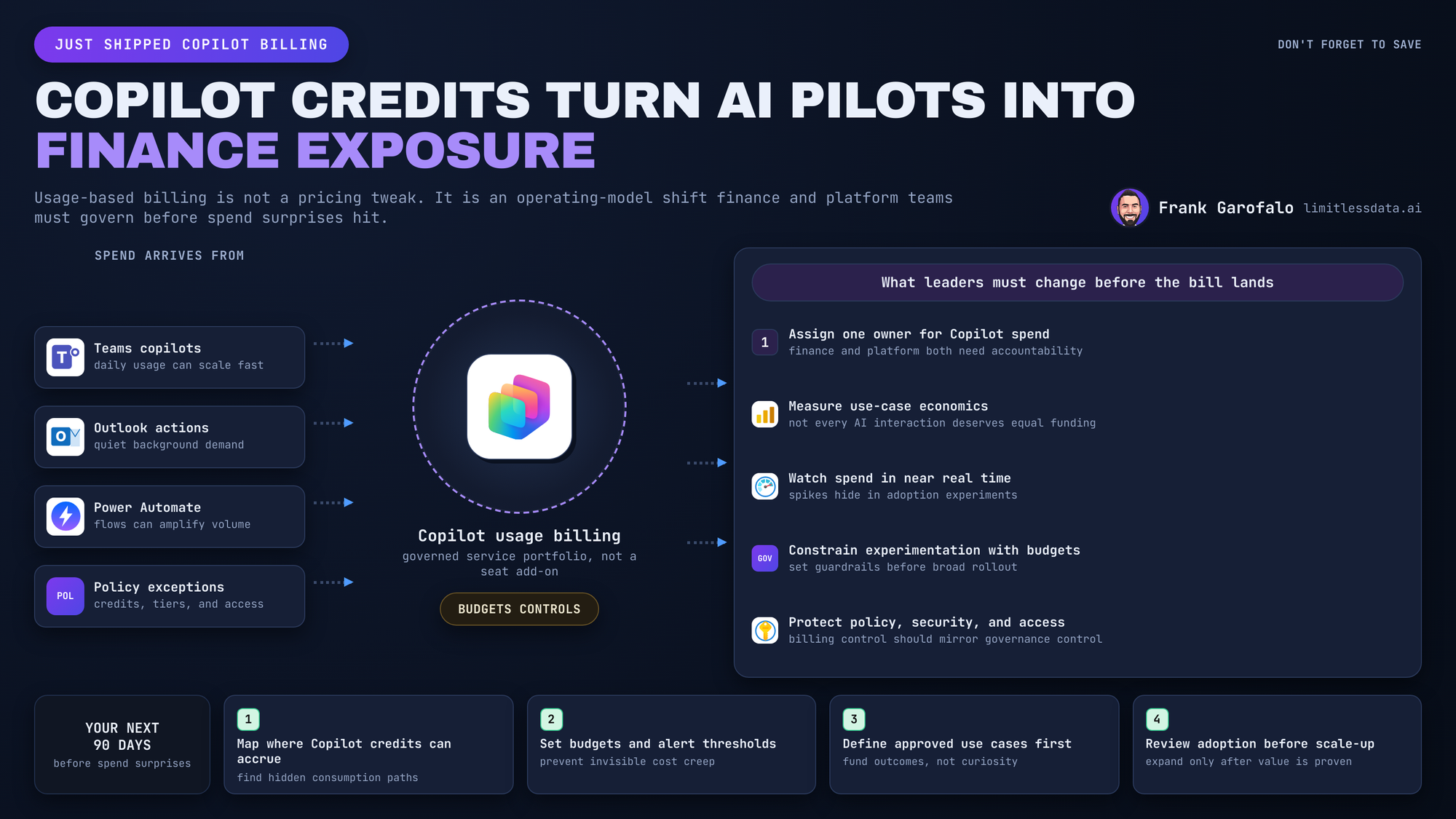
The worst Copilot ROI models are still built on licenses, monthly active users, and anecdotal “saved me 20 minutes” stories.
That is not executive-grade measurement.
A better scorecard tracks:
- workflow completion time
- rework reduction
- decision latency
- approval or acceptance rates
- quality improvements in priority processes
- adoption depth in target roles
- agent utilization in governed scenarios
- risk incidents avoided or contained
[ BODY_IMAGE_2 ]
A useful business question is: how do you report value to executives without reducing Copilot to vanity metrics?
This pseudocode scorecard keeps efficiency, quality, and autonomy together:
# Build an executive-ready operating model scorecard from Copilot workflow signals
records = [
    {"team": "Sales", "hours_saved": 42, "approval_rate": 0.91, "agent_runs": 28},
    {"team": "Finance", "hours_saved": 18, "approval_rate": 0.84, "agent_runs": 9},
    {"team": "HR", "hours_saved": 11, "approval_rate": 0.88, "agent_runs": 4},
]

for r in records:
    autonomy = "scaled" if r["agent_runs"] >= 20 else "emerging" if r["agent_runs"] >= 5 else "assisted"
    quality = "strong" if r["approval_rate"] >= 0.90 else "watch"
    print(
        f"{r['team']}: hours_saved={r['hours_saved']}, "
        f"quality={quality}, autonomy={autonomy}"
    )
Hours saved without approval quality or controlled agent usage is not transformation. It is noise.
What leaders should do in the next 90 days
1. Segment users by work pattern, not org chart alone
Use Microsoft’s own Copilot experience distinctions to decide which groups need which surface and capability set.
2. Pick 3 to 5 workflows where Copilot becomes the default starting point
Do not start with “everyone gets AI.” Start with recurring workflows where speed, synthesis, and grounded drafting matter.
3. Stand up one operating group across security, data, workplace, and business process owners
Copilot value crosses boundaries. Your operating model has to as well.
4. Standardize prompting and instructions inside the workflow
Create role-based prompt patterns, approved examples, and embedded instructions for common tasks. Treat prompt quality as process design.
5. Put agent governance in place before agent volume rises
Define naming standards, ownership rules, sharing restrictions, approval paths, telemetry review, and retirement criteria.
6. Measure depth, not just activity
Track whether users are staying in one-off assistance or moving into repeatable workflow execution and governed agent use.
[ BODY_IMAGE_3 ]
My bottom line: Microsoft’s redesigned Copilot matters because it can move knowledge work from app navigation toward AI-mediated orchestration. But that shift only creates enterprise value if leaders redesign workflows, standardize how work is prompted and approved, tighten governance over data access and identity, and actively manage agent sprawl with better adoption and ROI metrics.
If you treat this as a cosmetic product update, you will get cosmetic results.
Rate your organization from 1 to 5 on this question: is Copilot still a tool your people visit, or has it become the default starting point for real workflows?
#Microsoft365Copilot #EnterpriseAI #PowerPlatform
Try it yourself
Run this tutorial as a Jupyter notebook: Download runbook.ipynb (21 cells, 23 KB).