Microsoft Fabric IQ for Governed Semantic Analytics
Fabric IQ and the next wave of semantic analytics in Microsoft Fabric

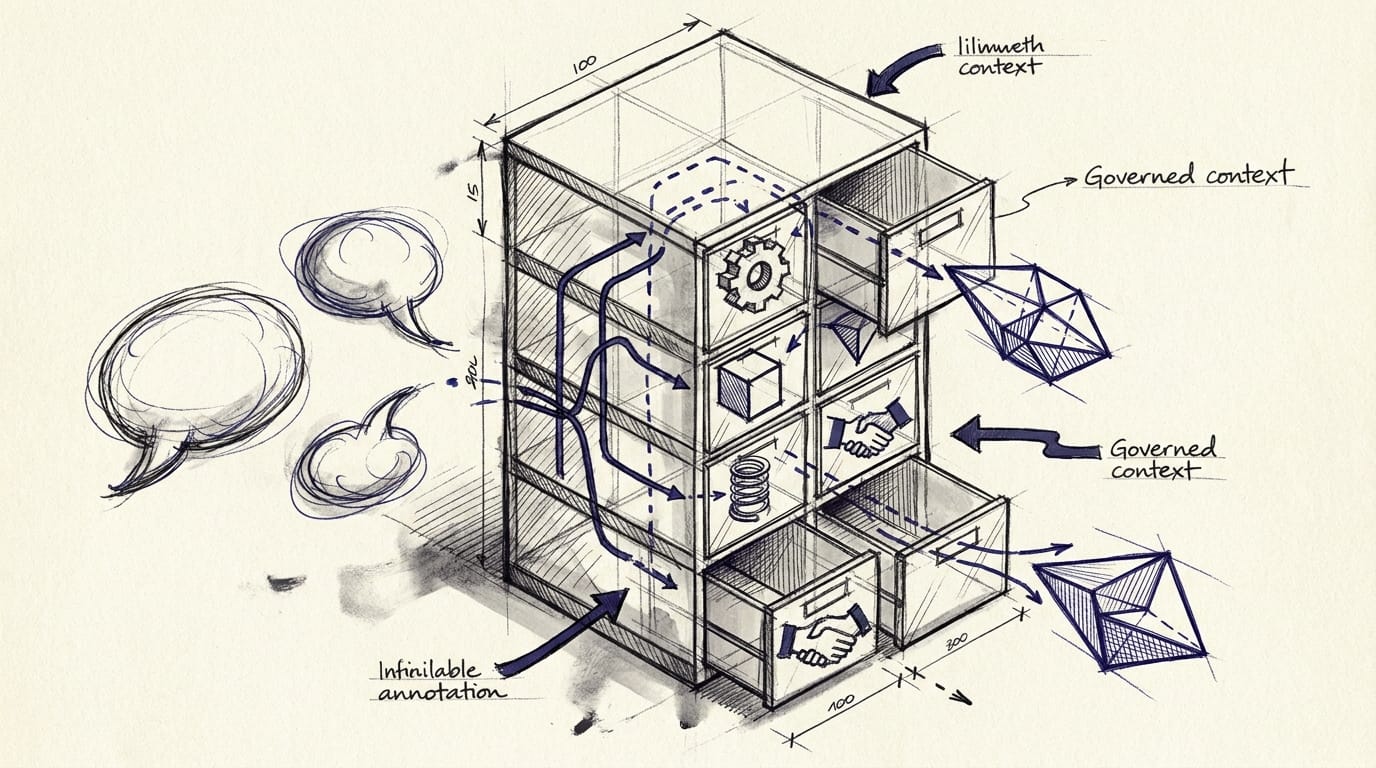
Part 1 of 3: Fabric IQ and the Semantic Bet
On this page
- Fabric IQ is a semantic-platform bet, not a chat feature
- Why Fabric momentum makes the semantic question urgent
- Ontology is the signal worth watching
- The real test is governed business context
- Agents amplify both trust and ambiguity
- A CDO agenda for evaluating Fabric IQ
- The next wave is semantic accountability
Last quarter I watched a leadership team celebrate a beautiful natural-language demo, then spend 45 minutes arguing about what “active customer” meant.
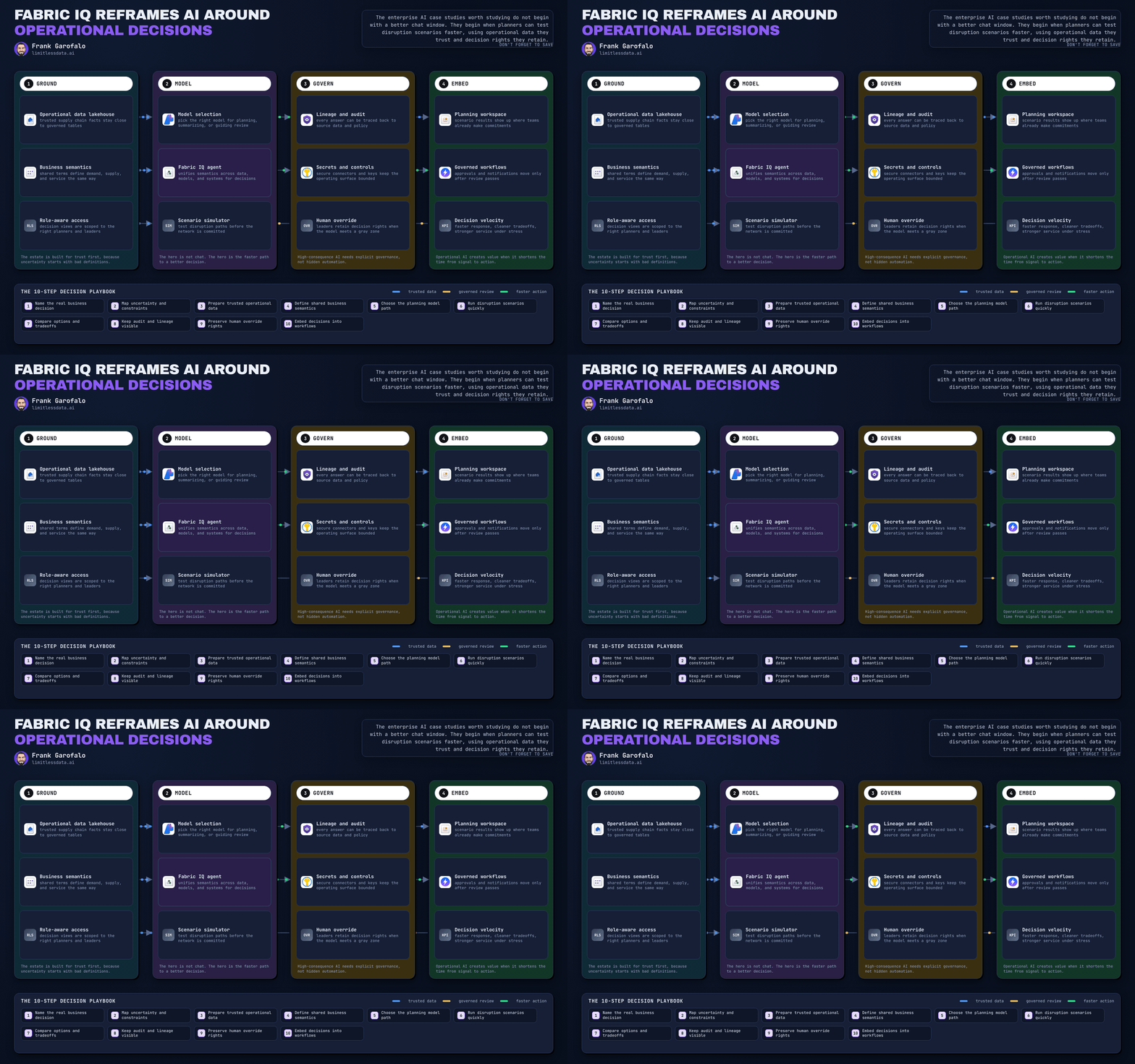
That is why Fabric IQ matters: not because it can chat about data, but because it could force business meaning into something governable, inspectable, and reusable across the platform.
Fabric IQ is a semantic-platform bet, not a chat feature
A slick prompt experience is easy to love in a demo. It is also a great way to hide unresolved ownership, weak definitions, and semantic drift.
Microsoft is framing Fabric as a unified platform for data and analytics, and Fabric IQ as the layer that unifies business semantics across data, models, and systems to support intelligent agents and decisions, per the Fabric documentation and Fabric IQ overview.
That positioning matters more than the UI.
My blunt take: if your team treats Fabric IQ as “Copilot for analytics, but better,” you are already undershooting it.
The enterprise test is simple:
- Can I define a business concept once?
- Can I bind it to approved sources and models?
- Can I inspect how that concept informed an answer?
- Can I reuse it across reports, agents, and decisions without re-litigating the definition every quarter?
If the answer is no, then the chat layer is just a prettier way to produce inconsistent answers faster.
To make this concrete, here is the architecture pattern people should be thinking about. The important part is not the natural-language box. The important part is the grounding path from OneLake and semantic models into governed answers.
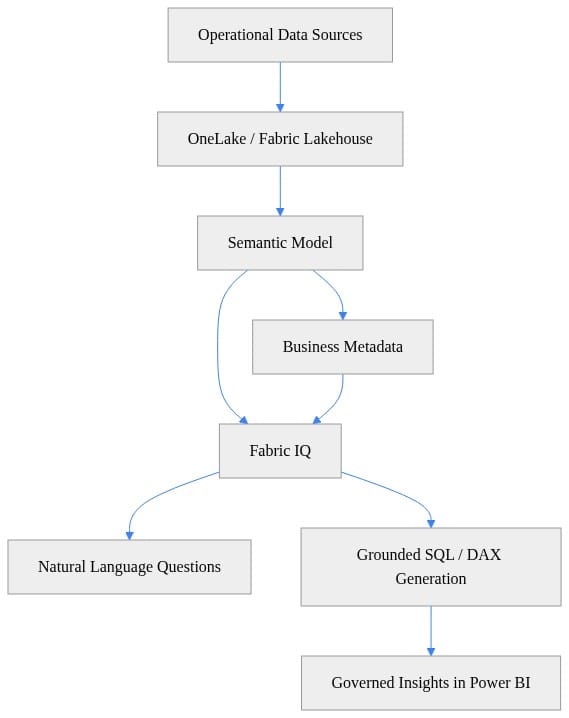
What to observe: the value chain runs through semantic metadata and business definitions. If that middle layer is weak, the answer quality is weak, no matter how polished the prompt experience looks.
Why Fabric momentum makes the semantic question urgent
Fabric’s unified-platform story raises the stakes on shared meaning. When you centralize more analytics work on OneLake and standardize around lakehouses, warehouses, eventhouses, and semantic models, inconsistent business definitions stop being a reporting annoyance and become a platform tax, as reflected in Microsoft’s OneLake-centered training path on analytics data stores in Fabric training.
I’ve seen this movie before in every “single pane of glass” era:
- centralize the storage
- standardize the tooling
- speed up access
- then discover your business vocabulary is fragmented across domains
That fragmentation gets expensive fast. Not just cloud-expensive. Organization-expensive.
A retail client I worked with in Q3 had 14 Power BI models, three “gross margin” formulas, and one executive scorecard that changed week to week depending on which analyst refreshed first. Nobody needed a better chatbot. They needed one governed margin definition and a review process with teeth.
That is why I keep pushing teams toward semantic accountability before conversational scale. If Fabric adoption is accelerating in your shop, the right leadership question is not “Can users ask questions in natural language?”
The right question is: “What business meaning is the platform enforcing when they do?”
If that answer is still fuzzy, Fabric IQ is not a UX project. It is a governance project.
#MicrosoftFabric #DataGovernance #EnterpriseAI
Part 2 of 3: Fabric IQ and the Governance Engine
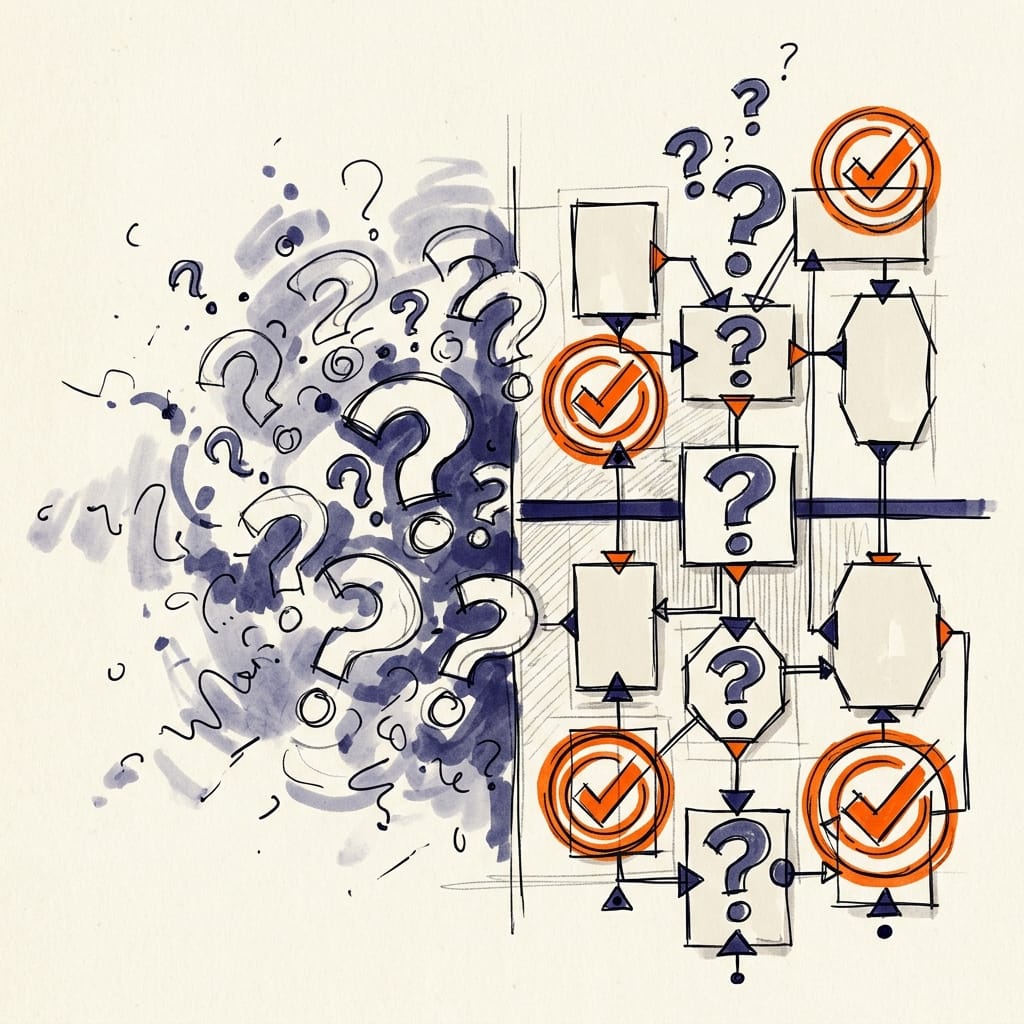
If Fabric IQ is going to matter, it will not be because of chat.
It will matter because of ontology, metadata, and the operating discipline required to turn business language into governed analytics.
Ontology is the signal worth watching
The most important Fabric IQ signal right now is not the prompt experience. It is the ontology item.
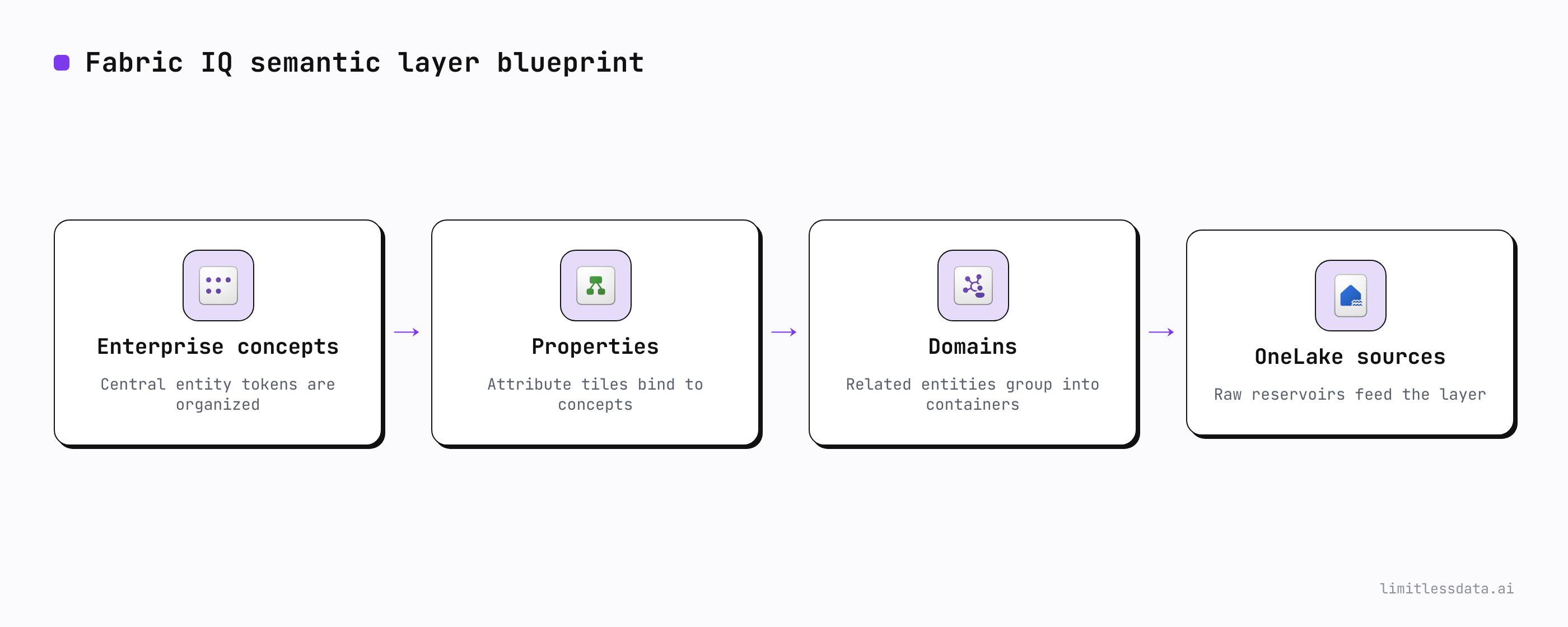
Microsoft’s ontology documentation describes it as a preview capability that digitally represents an enterprise vocabulary and semantic layer across domains and OneLake sources, per the ontology overview.
That is the serious part.
This is the difference between:
- a prompt interpreting “customer” based on whatever tables happen to be nearby
- a platform resolving “Customer” as a governed entity with known properties, relationships, and approved representations
That distinction is everything.
Here is a lightweight example of what semantic grounding should look like before any agent starts inventing SQL or DAX on your behalf.
# Map a natural-language question to governed business terms
question = "Show gross margin by region for the last quarter"

business_glossary = {
    "gross margin": "Gross Margin %",
    "region": "Customer[Region]",
    "last quarter": "relative_date_filter"
}

resolved_terms = {}
for phrase, semantic_ref in business_glossary.items():
    if phrase in question.lower():
        resolved_terms[phrase] = semantic_ref

print("Question:", question)
print("Resolved semantic references:")
for phrase, semantic_ref in resolved_terms.items():
    print(f"  {phrase} -> {semantic_ref}")
What to observe: the question gets mapped to governed business terms, not guessed from raw schema names.
That is the minimum standard:
- “Gross margin” should resolve to a certified measure
- “Region” should resolve to an approved dimension
- “Last quarter” should resolve through a known time filter pattern
Now the hard truth: ontology is in preview. That means this is an architectural direction, not a finished governance outcome. You should validate it aggressively in a narrow, high-value slice of the business instead of pretending the existence of an ontology object magically solves stewardship.
If you want the adjacent governance layer, this is exactly why I wrote about OneLake Catalog for governed Microsoft Fabric adoption. Shared storage without shared meaning just centralizes confusion.
The real test is governed business context
Here’s the operating standard I’d put in front of any CDO, BI leader, or Fabric platform owner.
Every important business concept should have:
- a plain-language definition
- an accountable owner
- approved source assets
- explicit relationships to the models and measures that implement it
- a visible review path when it changes
That is semantic analytics. Everything else is interface design.
If an agent answers “Why did margin drop in the West?” I need to know:
- which metric definition it used
- which semantic model it resolved against
- which dimensions and relationships were applied
- whether the answer stayed inside approved assets and security boundaries
This is where metadata and lineage stop being documentation hobbies and become delivery controls.
The interaction should look like this:
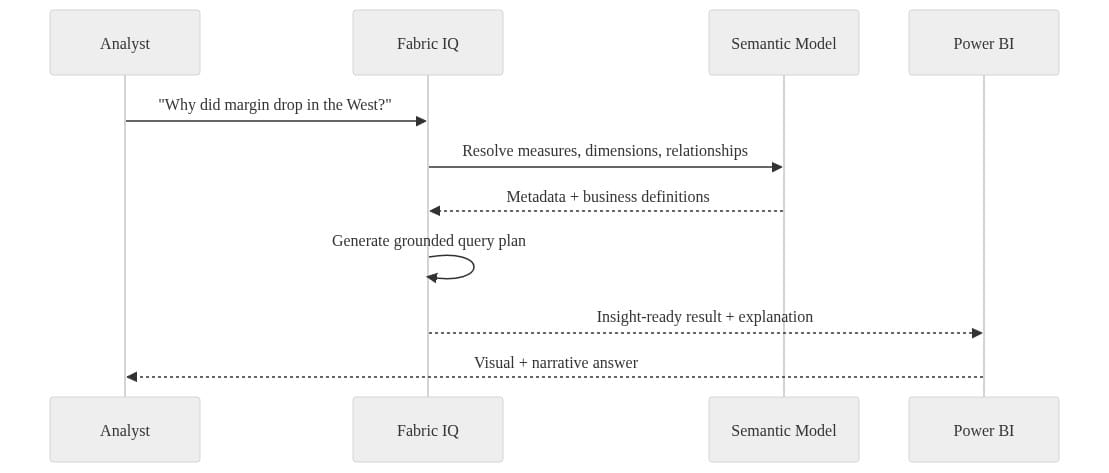

What to observe: the agent is not improvising business meaning at question time. It is resolving against metadata and business definitions already established in the semantic layer.
And if you are enabling Fabric data agents, remember that these are already generally available as conversational Q&A systems built with generative AI, per the Fabric data agent documentation. Once users can ask questions this easily, your semantic sloppiness gets exposed at scale.
I’ve written before on Fabric data agent governance for query language choice because this is where teams get burned: they obsess over prompt quality and ignore the governance path that determines whether the generated query should have existed in the first place.
If Fabric IQ succeeds, it will be because it makes business context operational, not because it makes analytics more conversational.
#MicrosoftFabric #SemanticLayer #DataGovernance
Part 3 of 3: Fabric IQ, Agents, and the CDO Agenda
Agents are about to make semantic discipline impossible to fake.
That is why Fabric IQ is interesting to me.
Not as a demo surface, but as a test of whether an enterprise can operationalize trusted business meaning before AI scales confusion.
Agents amplify both trust and ambiguity
This is where a lot of teams get lazy.
They hear “agents” and assume the problem is user productivity. It isn’t. The real problem is whether the agent is consuming established business context or fabricating a plausible interpretation from incomplete metadata.
Microsoft’s broader IQ framing is useful here. Fabric IQ is about business entities and relationships, the live business context that helps agents understand the organization, per the Microsoft IQ documentation. That means Fabric IQ should be judged on semantic grounding, not on generic agent sizzle.
Here is the practical control I want teams to implement before broad rollout: validate that the semantic assets exist and are certified before turning on AI-heavy user experiences.
# Validate that required Fabric semantic assets exist before enabling AI experiences
$requiredAssets = @(
    "Lakehouse: SalesLakehouse",
    "SemanticModel: SalesAnalytics",
    "Report: ExecutiveMarginDashboard"
)

foreach ($asset in $requiredAssets) {
    Write-Host "Checking $asset ..."
}

$allPresent = $true
if ($allPresent) {
    Write-Host "Fabric IQ prerequisites look ready."
} else {
    Write-Host "Missing one or more required assets."
}
What to observe: this is operational discipline, not glamour. Check the lakehouse, semantic model, and downstream report path first. If those assets are missing, immature, or disputed, your agent rollout is premature.
A CDO agenda for evaluating Fabric IQ
If I were assessing Fabric IQ in a real enterprise rollout, I would use a short, brutal checklist.
1. Start with concepts that already create pain
Pick 5 to 10 business concepts that regularly trigger reporting disputes:
- active customer
- net revenue
- gross margin
- fulfilled order
- churned account
Do not start with a broad ontology exercise across the whole company. Start where semantic friction is already measurable.
2. Force a visible mapping path
For each concept, require a visible path from:
- ontology or business vocabulary
- to approved OneLake data sources
- to semantic models and measures
- to reports and agent-facing experiences
If that chain is invisible, the answer is ungoverned.
3. Assign ownership before scale
Every concept needs a business owner and a technical steward. If nobody owns the definition, the platform owner becomes the referee by default, and that is a terrible use of platform time.
4. Review changes like production changes
If “net revenue” changes, the review should be handled like a production-impacting change, because that is exactly what it is. Semantic changes are system changes with business blast radius.
5. Measure delivery outcomes, not demo fluency
Track:
- reduction in definition disputes
- time to approve analytics changes
- number of reusable concepts across domains
- consistency of answers across reports and agents
If those numbers do not improve, do not call it semantic transformation. Call it a chatbot rollout and move on.
The next wave is semantic accountability
Fabric IQ has real strategic potential because Microsoft is putting business context at the center of the enterprise intelligence conversation.
But the market is going to get this wrong if it rewards conversational polish over semantic control.
Natural-language access is the easy part. Trusted semantic context is the platform test.
My buying posture is simple:
- reward traceability
- reward inspectability
- reward reusable business meaning
- ignore demos that cannot show the semantic chain
Rate your team’s current semantic discipline from 1 to 5: can your agents explain which governed business definitions they used, or are they still freelancing on prompts?
#MicrosoftFabric #EnterpriseAI #CDO
Try it yourself
Run this tutorial as a Jupyter notebook: Download runbook.ipynb (28 cells, 21 KB).