OneLake Catalog for Governed Microsoft Fabric Adoption
Why OneLake Catalog Matters More Than Another Fabric Feature Demo

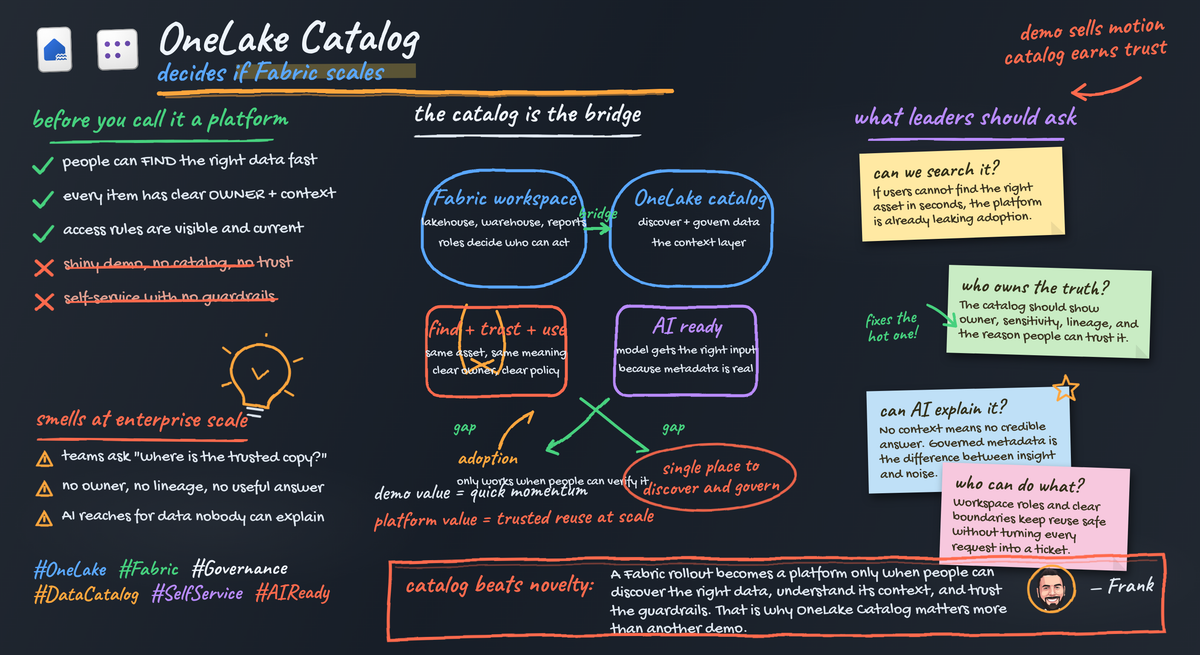
A polished Fabric demo can win the room by 3 PM. The platform decision gets made later, when someone asks a simpler question:
On this page
- The demo is not the platform
- Why catalog context is the real self-service experience
- The operational failure modes behind feature excitement
- AI readiness starts with trusted data context
- OneLake Catalog makes the rest of Fabric credible
- What CDOs and Fabric architects should measure
- The bottom line
Can people actually find the right data, trust it, and use it without starting a governance incident?
That is why OneLake Catalog matters more than the next flashy Fabric feature.
I like good demos. I build them. I run a Proxmox and Azure lab at home specifically so I can break things before customers do. But enterprise adoption does not hinge on whether a PM can show a smooth Copilot flow or a clean mirroring walkthrough. It hinges on whether the finance analyst, the data engineer, the BI lead, and the security team are all looking at the same asset with the same meaning and the same accountability trail.
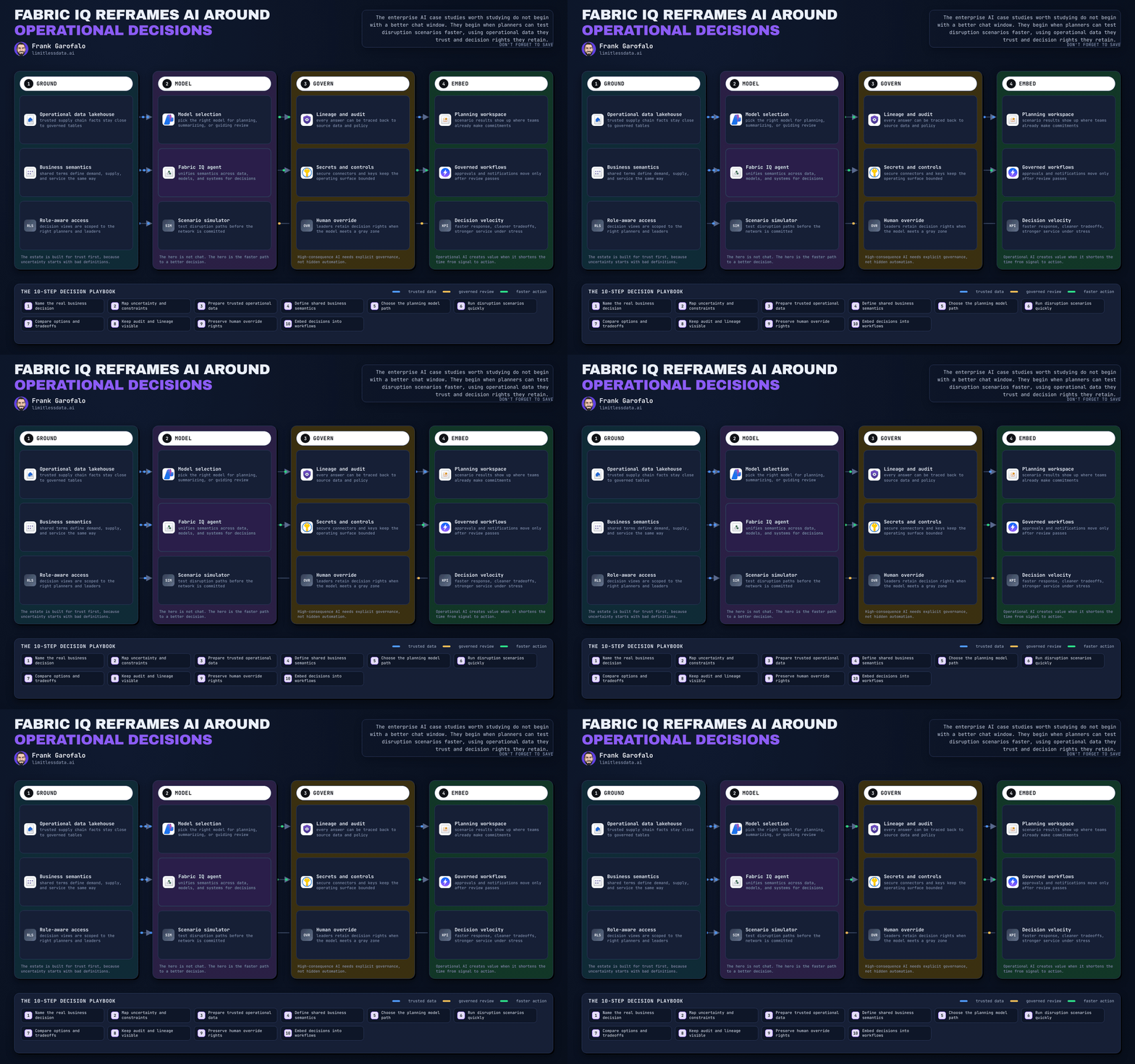
Microsoft’s own positioning makes the point: OneLake is the unified analytics data lake for Fabric, and the catalog is where discovery and governance become usable in practice. That is not background plumbing. That is the adoption multiplier.
The demo is not the platform
Feature demos compress value into five minutes:
- click a button
- ask a question
- get a chart
- land a table in the lake
- see an agent answer in natural language
Everyone nods because the value is visible.
But none of that proves you have an enterprise data platform. It proves you have a feature that works under controlled conditions.
My executive test is intentionally boring:
- Can a user find the approved data asset without pinging three people on Teams?
- Can they tell what it means in business terms, not just schema?
- Can they identify who owns it?
- Can they tell whether they are allowed to use it?
- Can they see enough lineage and policy context to trust the answer?
If the answer is no, then your self-service story is still tribal knowledge wrapped in a nice UI.
Why catalog context is the real self-service experience
Search alone is not self-service.
Typing “sales” and getting 47 tables back is not self-service. That is a scavenger hunt with compliance risk attached.
The real value of a catalog is context:
- owner
- business description
- tags
- sensitivity
- lineage
- downstream relationships
That is how teams distinguish an enterprise asset from a one-off workspace artifact someone built at 11:40 PM before a steering committee.
A healthcare customer I worked with had 14 Fabric workspaces, three separate “gold” patient encounter datasets, and one of them was still fed by a deprecated HL7 transform that should have been retired weeks earlier. The dashboard looked great. The trust model was garbage.
That is the heart of governed self-service: reducing dependence on hallway conversations, Slack archaeology, and “ask Priya, she knows which table is right.” If reuse depends on remembering who the local expert is, you do not have a platform. You have institutional memory with a cloud bill.
Here is the simplest way I explain catalog-first thinking: the asset is not valuable because it sits in OneLake. It becomes valuable when the metadata around it makes it reusable.
# Minimal metadata model that explains why OneLake Catalog scales value
from dataclasses import dataclass

@dataclass
class CatalogEntry:
    name: str
    path: str
    owner: str
    sensitivity: str

entry = CatalogEntry(
    name="sales_orders",
    path="onelake://contoso/lakehouse/Tables/sales_orders",
    owner="data-eng",
    sensitivity="internal",
)

print(entry)
print(f"Discoverable asset: {entry.name} owned by {entry.owner}")
What matters here is simple: the path tells you where the asset lives, but the owner and sensitivity tell you whether another team can safely use it. Storage without context is just a bigger place to hide confusion.
The operational failure modes behind feature excitement
This is where polished demos hit enterprise reality.
The common failure modes are predictable:
- Duplication — a team cannot find a trusted asset, so they create a new one.
- Semantic drift — two groups use the same term, but one means booked revenue and the other means recognized revenue.
- Orphaned ownership — nobody knows who approves changes or who gets paged when upstream data changes shape.
- False confidence — a beautiful Fabric experience sits on top of a dataset with no stewardship discipline behind it.
Weak metadata hygiene turns a shared lake into a larger place to lose data.
Fabric workspaces matter because they are independently securable containers on top of OneLake, and workspace roles define who can do what. That is good platform design. It is also why catalog discipline has to extend beyond a single workspace boundary. Local control is necessary. Shared understanding is mandatory.
A quick gut check: score your important assets on three things—owner, tags, lineage. Most organizations discover they have a lot of “production” data products that are basically anonymous.
# Score assets by catalog readiness to illustrate business impact
$assets = @(
    @{ Name = "sales_orders"; HasOwner = $true; HasTags = $true; HasLineage = $true },
    @{ Name = "inventory_snapshot"; HasOwner = $true; HasTags = $false; HasLineage = $true },
    @{ Name = "ad_hoc_extract"; HasOwner = $false; HasTags = $false; HasLineage = $false }
)

foreach ($asset in $assets) {
    $score = 0
    if ($asset.HasOwner) { $score += 1 }
    if ($asset.HasTags) { $score += 1 }
    if ($asset.HasLineage) { $score += 1 }
    Write-Output "$($asset.Name): catalog-readiness=$score/3"
}
The ad hoc extract is usually the one that creates the most downstream chaos, and it almost always exists because the trusted asset was hard to find or hard to understand.
I wrote about the security side of this in Fabric Data Protection Decides Who Survives AI Scale. Protection and discovery are joined at the hip. If users cannot identify the right governed thing, they will route around your controls.
AI readiness starts with trusted data context
This is the part too many teams get backward.
They see Fabric IQ, data agents, conversational analytics, and ontology work, then jump straight to the interface. The interface is the easy part. The hard part is whether the AI is grounded in data that is unified, governed, and understandable.
Microsoft is explicit that OneLake is foundational for Fabric IQ, serving as the governed source that unifies enterprise data across cloud and on-premises environments. That should end the debate. If the AI layer depends on governed data context, then catalog quality is not optional prep work. It is the substrate.
The same pattern shows up with Fabric data agents, which enable conversational Q&A experiences. Great. I want that capability. I also want to know the agent is steering users toward trusted assets instead of the loudest or newest dataset in a workspace.
And the ontology preview matters for the same reason. Microsoft describes it as an enterprise vocabulary and semantic layer across domains and OneLake sources. Translation: the platform is moving toward shared meaning, not just shared storage.
That is exactly the right direction.
If your business definitions are fragmented, agent-style access just accelerates the blast radius. You do not solve trust with a chat box. You expose trust failures faster.
If this topic is on your roadmap, read my take on Fabric Data Agent Query Governance and Control and How AI agent observability should influence Fabric data product design. The shorter the interface path becomes, the less tolerance you have for weak metadata and unclear ownership.
OneLake Catalog makes the rest of Fabric credible
Here is the platform argument in plain English:
Every new Fabric capability becomes more useful when teams can locate governed assets and understand the business context around them.
That includes:
- ingestion
- lakehouse and warehouse patterns
- semantic models
- AI experiences
Mirroring is a perfect example. Fabric can continuously replicate data from Azure databases and external sources into OneLake. That is powerful. It also increases the number of assets entering the estate, which raises the bar for discoverability, stewardship, and policy context.
More ingestion without stronger catalog discipline just creates more well-landed confusion.
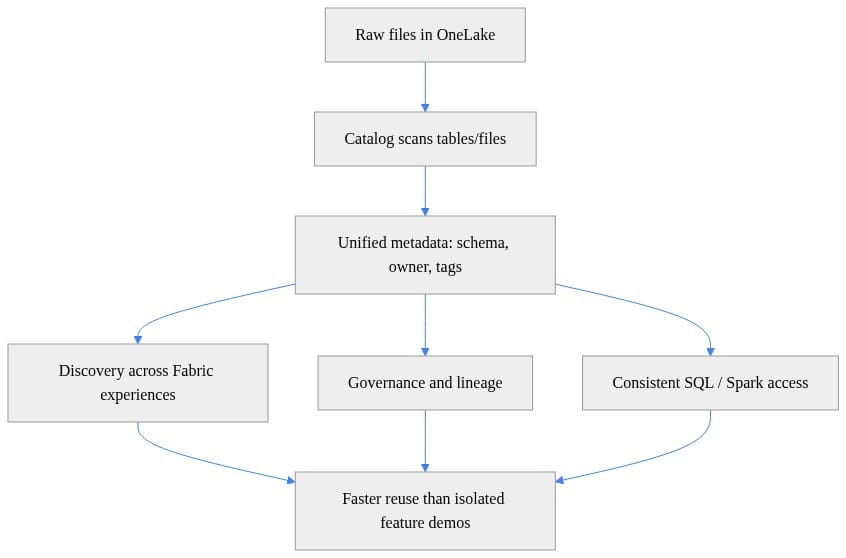
What matters in that pattern is that the catalog sits in the middle of reuse, governance, and access. That is why it compounds value over time while the single feature demo has a short half-life.
What CDOs and Fabric architects should measure
If you are steering Fabric adoption with a feature checklist, you are measuring the wrong thing.
Measure evidence of trusted reuse.
Start with these questions:
- Do critical assets have a named accountable owner?
- Do they have business descriptions a non-engineer can understand?
- Can users identify approved assets before creating new copies?
- Is lineage visible enough to assess upstream change impact?
- Are workspace boundaries complemented by cross-domain governance signals?
- Can AI-facing experiences be constrained toward trusted sources?
Then get blunt about the operating model.
Metadata stewardship is not a one-time documentation sprint. It is an operating capability. Somebody has to own standards, curation, review, and lifecycle hygiene. If you skip that, your catalog becomes decorative.
A simple search example makes the point. Teams do not think in storage paths. They think in business concepts like finance, gold, customer, regulated, approved.
# Search and filter assets by business meaning instead of storage location
catalog = [
    {"name": "sales_orders", "tags": {"gold", "finance", "pii"}},
    {"name": "sales_returns", "tags": {"silver", "finance"}},
    {"name": "web_events", "tags": {"bronze", "marketing"}},
]

query_tag = "finance"
matches = [item["name"] for item in catalog if query_tag in item["tags"]]

print(f"Assets tagged '{query_tag}':")
for name in matches:
    print("-", name)
Filtering by business meaning is what drives reuse. If discovery is still organized around where data landed instead of what it means, your platform is optimized for engineers and hostile to everyone else.
I also like using a basic owner check in governance workshops because it cuts through the nonsense immediately.
# Simulate governance checks that matter more than a flashy isolated demo
$assets = @(
    @{ Name = "sales_orders"; Owner = "data-eng"; Sensitivity = "Internal" },
    @{ Name = "customer_dim"; Owner = ""; Sensitivity = "Confidential" },
    @{ Name = "web_events"; Owner = "marketing-bi"; Sensitivity = "Public" }
)

foreach ($asset in $assets) {
    if ([string]::IsNullOrWhiteSpace($asset.Owner)) {
        Write-Output "FAIL: $($asset.Name) has no owner"
    } else {
        Write-Output "PASS: $($asset.Name) owned by $($asset.Owner)"
    }
}
Run that logic mentally against your top 20 assets. The ones without owners are the ones that will hurt you during an audit, a migration, or an AI rollout.
The bottom line
OneLake Catalog matters more than another Fabric feature demo because it is the thing that makes the demo survivable in production.
OneLake gives Fabric a unified analytics data foundation. The catalog gives that foundation discoverability, governance context, and accountability. Without that, self-service turns into duplication, cross-domain reuse stalls, and AI experiences amplify uncertainty.
With it, Fabric starts to behave like a real enterprise platform:
- data can be found
- meaning can be understood
- ownership is visible
- controls are clearer
- reuse compounds
That is the game.
The next time somebody shows you a polished Fabric feature, ask one follow-up question:
Can a new team find the trusted asset behind that experience without a private tour from the people who built it?
If this topic resonates, I may turn it into a short series:
- Part 1: why demos win attention but catalogs win adoption
- Part 2: how catalog discipline enables governance and AI readiness
Rate your team’s current state from 1 to 5: how reliably can users find an approved Fabric asset with clear ownership, meaning, and governance context before they create a duplicate?
#MicrosoftFabric #Datagovernance #DataArchitecture
Try it yourself
Run this tutorial as a Jupyter notebook: Download runbook.ipynb (26 cells, 17 KB).