Microsoft Mistral Partnership for Regulated AI Buyers
What Microsoft and Mistral’s Expanded Partnership Means for Regulated AI Buyers

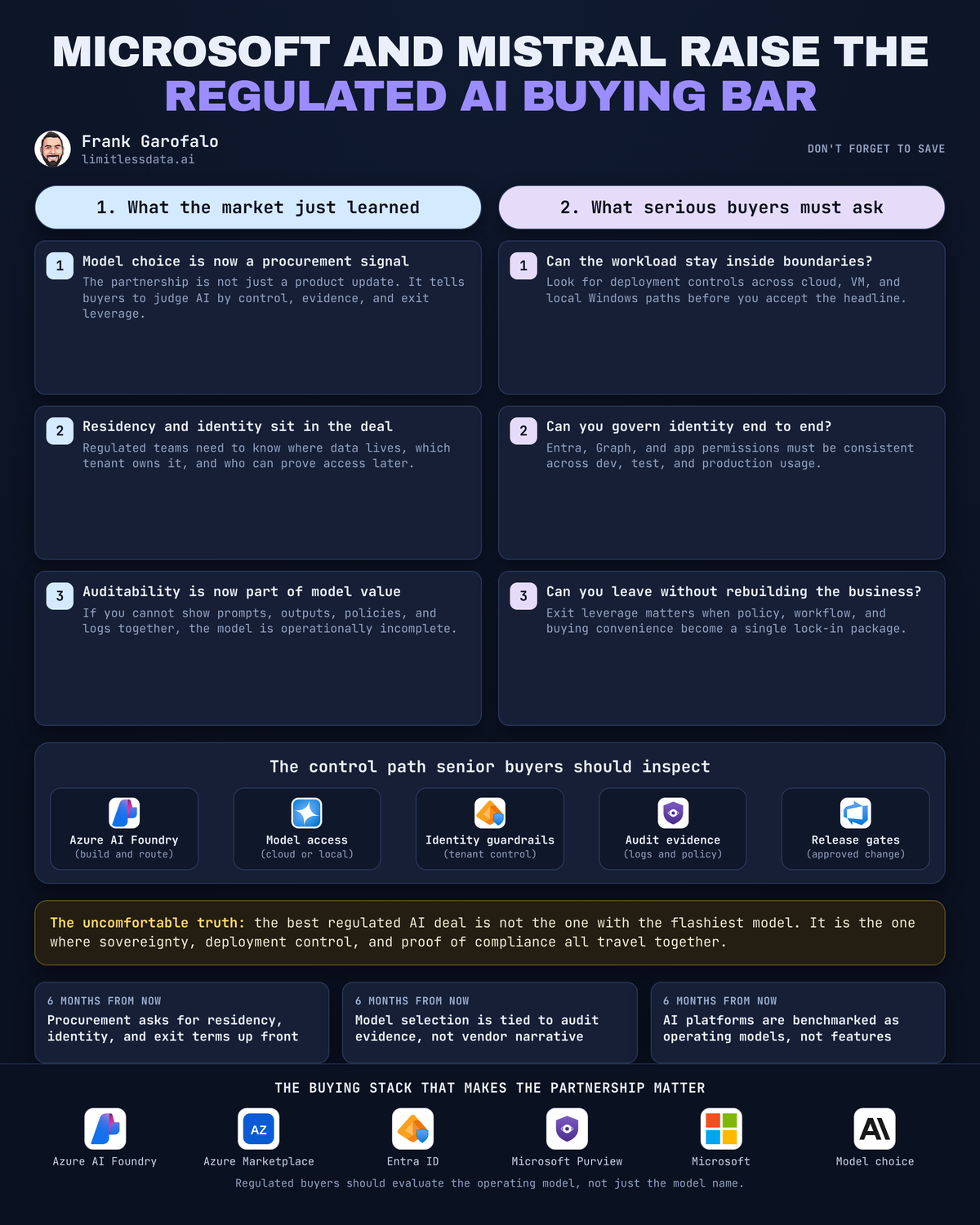
Model quality is now the easy part.
On this page
- The signal is bigger than a catalog update
- Model choice now sits inside an operating model
- Governance has to become production evidence
- The real trade-off is flexibility versus fragmentation
- Buy for leverage, not just access
- The executive decision is not whether to adopt
- Sources & References
For regulated buyers, the hard part is proving who controls the operating environment, what evidence exists at runtime, and how fast you can switch when a vendor, regulator, or risk committee changes the rules.
That’s why the expanded Microsoft and Mistral partnership matters.
Not because the market needed one more model choice, but because AI procurement has shifted from “which model scored best?” to “which operating model survives audit, supports residency, integrates identity, and preserves exit leverage?”
If your team is still comparing benchmarks before control planes, it is behind.
The signal is bigger than a catalog update
Boards want the same thing right now: move faster on generative AI without damaging a compliance posture that took years to build.
That tension is the story.
An expanded Microsoft + Mistral relationship is a market signal that model diversity is being pulled into a larger enterprise operating stack: identity, deployment options, procurement, and governance all have to line up. Microsoft’s commercial marketplace helps with discovery and buying motion, but regulated production still comes down to harder questions:
- Where do prompts, embeddings, logs, and backups live?
- Which tenant and identities govern access?
- What is the logging design?
- Who can support the service, from where, and under what approval path?
- How do you swap the model if the risk profile changes?
That is usually the bottleneck. Not model IQ. Operating discipline.
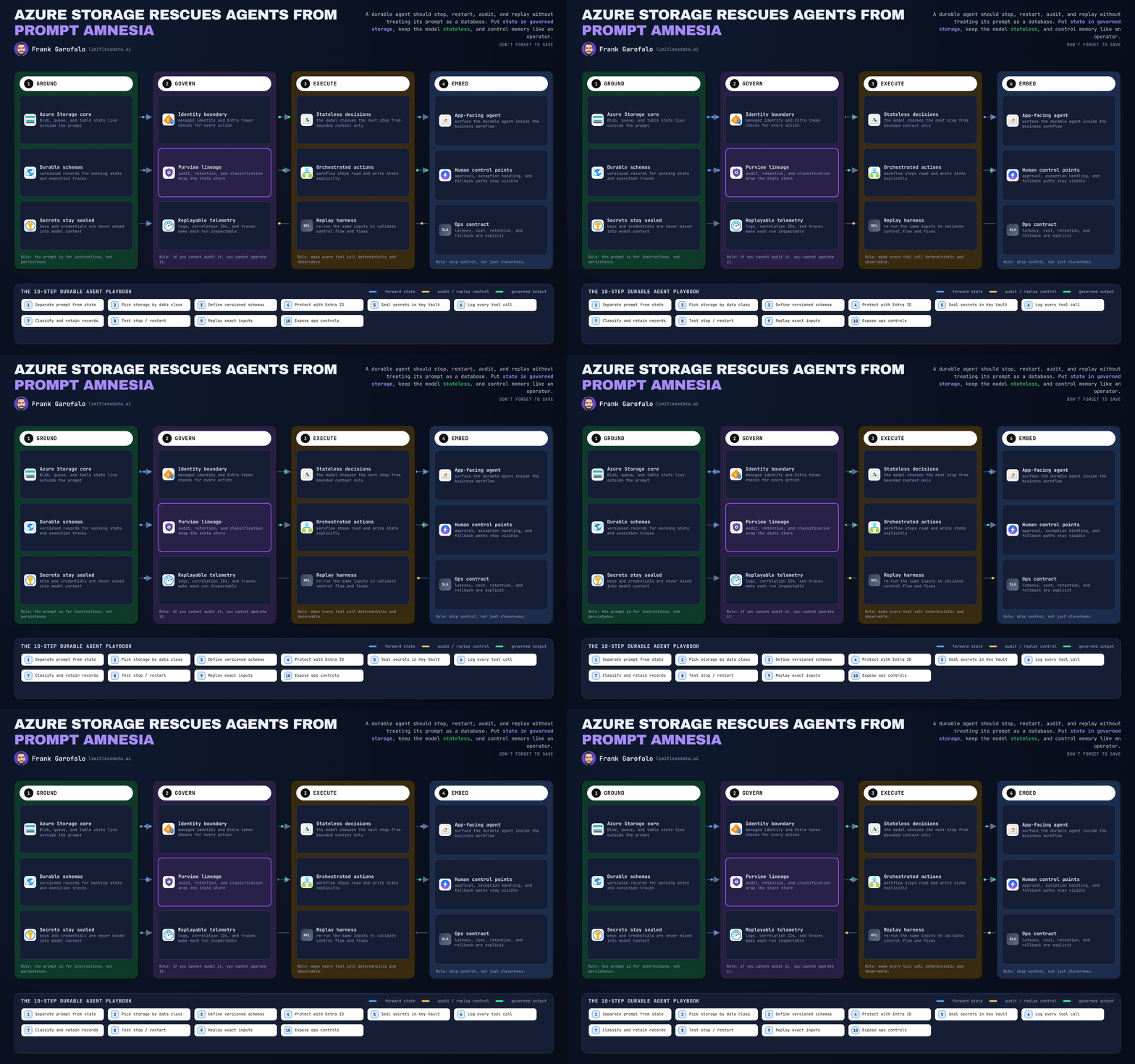
A simple architecture lens:
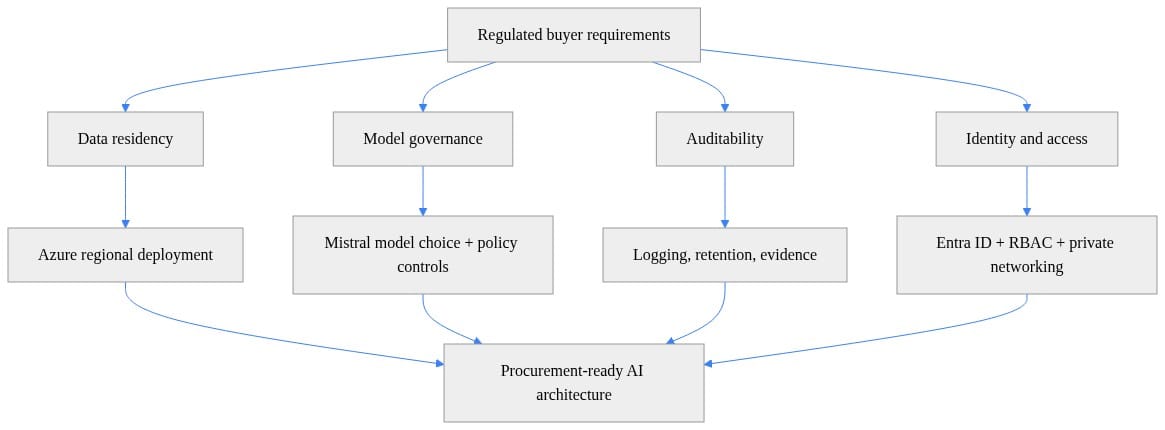
The key point: “Mistral on Microsoft” only becomes valuable when residency, governance, auditability, and identity converge into one procurement-ready architecture.
Model choice now sits inside an operating model
A lot of teams still collapse two different decisions into one:
- Which model do I want?
- Where and how will I operate it?
Those are not the same decision.
The same model can have very different risk characteristics depending on whether it runs through a tightly controlled enterprise endpoint, a local execution path, or a loosely governed integration hidden inside an app backlog.
That’s why deployment pattern matters more than benchmark screenshots.
Microsoft has been explicit that local and cloud-adjacent AI patterns are part of the stack conversation through offerings like Microsoft Foundry on Windows. That matters because regulated buyers now have practical choices across local, edge-adjacent, and cloud environments inside one ecosystem.
It’s also why the control plane matters so much. Model access without control-plane standardization creates exceptions. Exceptions are where regulated programs fail.
So if I were scoring this partnership for a regulated environment, I’d weight these first:
- Residency and support boundaries
- Identity integration and RBAC
- Logging and evidence generation
- Network isolation and private access
- Lifecycle ownership for model changes
- Integration boundaries to enterprise data
- Exit options and substitutability
- Then quality, latency, and price
A simple weighted matrix forces the right conversation:
# Compare regulated-AI procurement criteria in a simple scoring matrix
criteria = {
    "data_residency": 5,
    "private_networking": 5,
    "audit_logs": 4,
    "rbac_integration": 4,
    "model_choice": 3,
    "content_filtering": 4,
}

options = {
    "Azure_OpenAI_only": {"data_residency": 5, "private_networking": 5, "audit_logs": 4, "rbac_integration": 4, "model_choice": 2, "content_filtering": 4},
    "Mistral_on_Azure": {"data_residency": 5, "private_networking": 5, "audit_logs": 4, "rbac_integration": 4, "model_choice": 5, "content_filtering": 4},
}

for name, scores in options.items():
    total = sum(criteria[k] * scores[k] for k in criteria)
    print(f"{name}: weighted score = {total}")
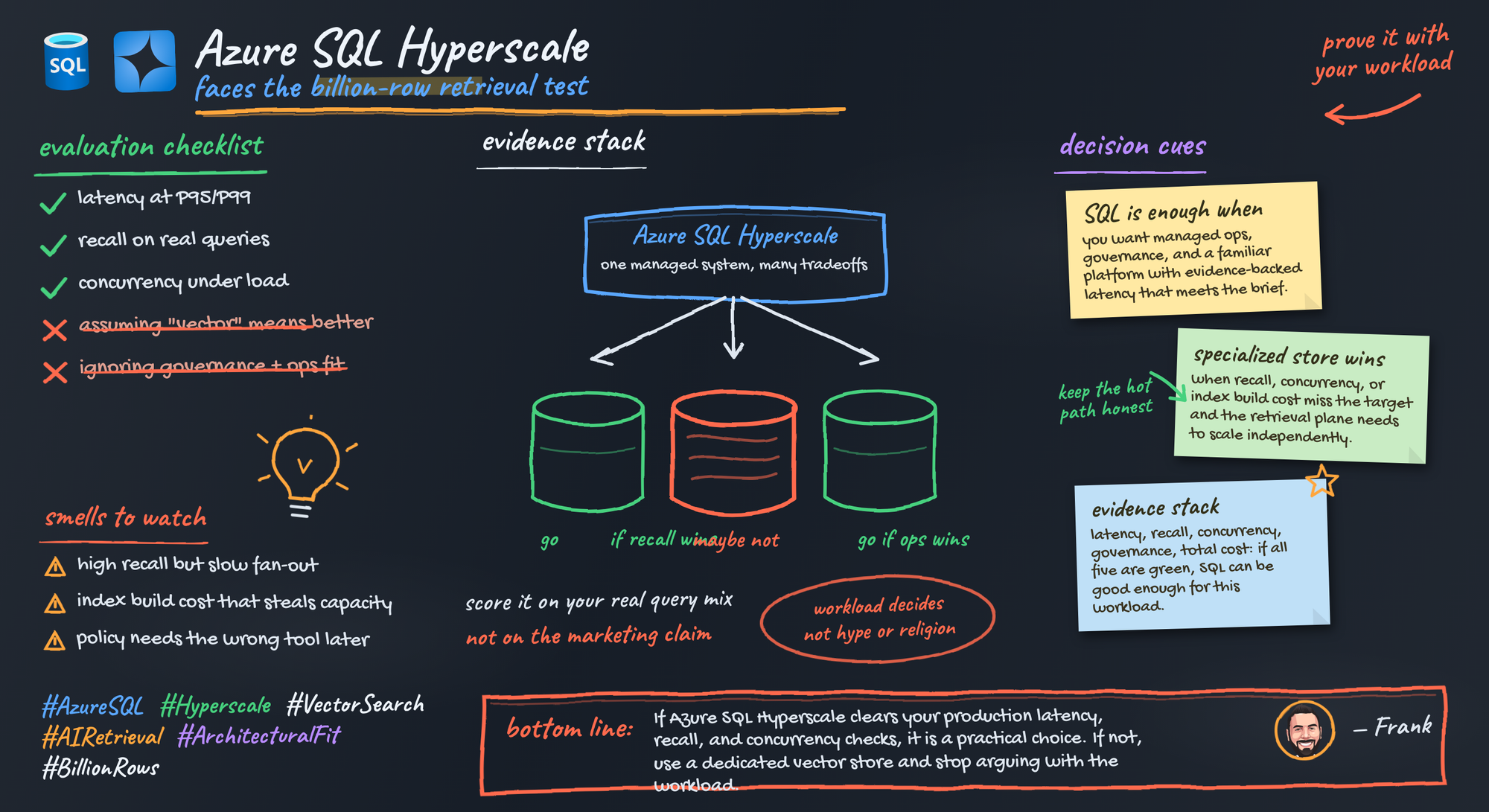
If “model choice” is your highest-weighted criterion, you are optimizing for demo day.
Governance has to become production evidence
I get twitchy when people call a workload “sovereign” because a model is available in-region or because a vendor added a compliance slide.
Sovereignty is not a sticker. It is a stack property, and governance has to show up as runtime evidence.
For regulated buyers, that means validating three things together:
- Data boundary: prompts, retrieved content, embeddings, logs, backups, and support artifacts stay inside approved handling boundaries.
- Identity boundary: tenant controls, privileged access workflows, service principals, role mapping, and audit trails are inherited from the enterprise estate.
- Operations boundary: incident handling, model updates, telemetry, subprocessors, support access, and control-plane authority are clearly defined.
That’s why Microsoft’s positioning around Confidential AI, ISO/IEC 42001, and Microsoft 365 Copilot’s orchestration model is relevant. The real issue is not whether a policy exists. It’s whether you can prove approved controls were active for this use case, in this environment, on this date, with this model version, under this access path.
For every material AI use case, I want an evidence pack that includes:
- business owner
- approved purpose
- data-flow record
- model and version record
- access model
- logging design
- evaluation results
- change process
- incident route
- retention and deletion treatment
Governance should fail closed, not live in a wiki nobody reads.
The real trade-off is flexibility versus fragmentation
More model choice is good for buyers.
It improves fit, negotiation leverage, and resilience against monoculture risk. But every new model endpoint also adds hidden cost:
- more integration paths
- more policy mappings
- more evaluation baselines
- more logging questions
- more audit scope
- more change-management burden
That is why I do not treat a marketplace path or cloud integration as proof of production readiness.
My rule is simple: standardize the control plane and approval process before you expand the model portfolio.
If you cannot answer, “How does a new model inherit identity, logging, evaluation, and incident handling?” then you are not adding optionality. You are adding entropy.
A governed request path should look something like this:
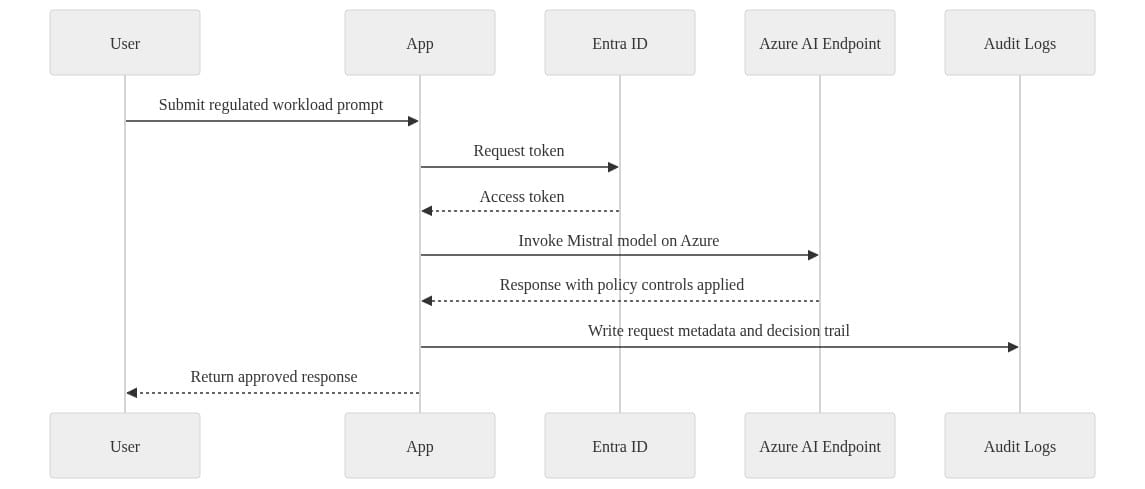
The model call is only one step. Identity issuance, policy application, and decision-trail logging are equally important.
Buy for leverage, not just access
This is the part too many enterprise deals still miss.
AI services should be negotiated like critical data platforms: for substitutability, operational assurance, and exit mechanics.
That means asking for clarity on:
- data handling commitments
- support access conditions
- service-change notification paths
- regional operations
- exportability of logs and evaluation artifacts
- migration paths if the model or service no longer fits policy
It also means making integration cost visible. The real total cost is not just tokens or endpoint pricing. It includes IAM integration, observability, evaluation harnesses, response controls, red-teaming, release management, and evidence generation.
If you ignore those, the cheapest model becomes the most expensive program.
The executive decision is not whether to adopt
That decision is already made. Serious enterprises are adopting AI.
The real executive decision is whether AI will be governed as a portfolio of controlled production services or accumulated as disconnected model exceptions that become impossible to defend, audit, or unwind later.
That is the signal I take from Microsoft and Mistral:
- More optionality? Good.
- More procurement leverage? Good.
- Better fit for certain workloads? Also good.
But none of that reduces the buyer’s obligation to verify residency, identity, audit evidence, deployment boundaries, and exit paths inside its own environment.
If I were advising a board this quarter, I would not ask, “Should we use this model?”
I would ask:
- What is our approved AI operating model?
- Who owns decision rights for new model adoption?
- What evidence is mandatory before production use?
- Where are our leverage thresholds if a vendor relationship changes?
That is the conversation worth having now.
Rate your organization from 1 to 5 on this question:
Can you swap a regulated AI model without rebuilding identity, logging, and evidence from scratch?
#AzureAI #EnterpriseAI #Compliance
Sources & References
- Use local AI with Microsoft Foundry on Windows
- Microsoft Marketplace overview - Marketplace customer documentation
- Startups guide to Building AI Agents for Microsoft Marketplace
- Data, Privacy, and Security for Microsoft 365 Copilot
- ISO/IEC 42001:2023 Artificial Intelligence Management System Standards - Microsoft Compliance
- What is Microsoft for Manufacturing? - Microsoft for Manufacturing
- Confidential AI - Azure Confidential Computing
- Artificial Intelligence overview - Microsoft Service Assurance
- Certified partner solutions for Microsoft for Manufacturing - Microsoft for Manufacturing
- What is Microsoft's Competitive Advantage in AI - Microsoft Q&A
Try it yourself
Run this tutorial as a Jupyter notebook: Download runbook.ipynb (25 cells, 21 KB).