Azure Content Understanding Agentic Mode for Documents
Why Azure Content Understanding’s Agentic Mode Matters for Document Automation at Scale

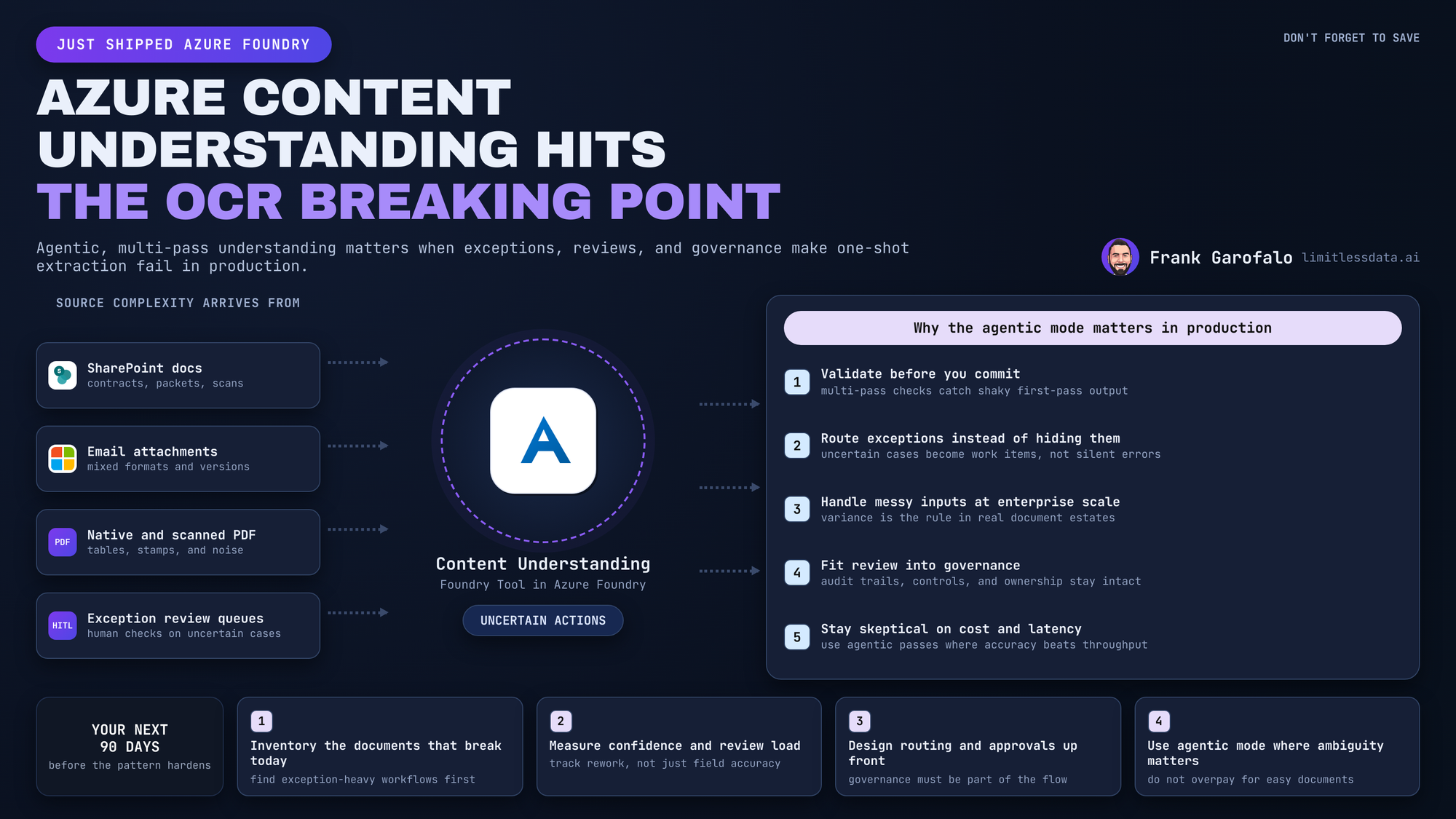
72 hours into a document rollout, the field extraction demo is usually still alive. The operating model is what catches fire.
On this page
- The real problem is operational, not OCR
- Why multi-pass agentic processing changes the architecture
- Where this pattern earns its keep
- Build validation loops before chasing autonomy
- Human review should be a control surface, not a failure dump
- The scale test is governance, cost, and latency
- Do not replace a brittle pipeline with an opaque agent
- My opinion, plainly
- Sources & References
Enterprise document automation fails when messy inputs, ambiguous exceptions, and disconnected review workflows turn a one-pass result into an operational liability. That is exactly why Azure Content Understanding’s agentic direction matters: not because “agents” are fashionable, but because the architecture finally has room for uncertainty, validation, and controlled escalation instead of pretending every document deserves a single yes/no decision.
Azure positions Content Understanding as a Foundry Tool in the Microsoft Foundry Resource and describes it as a way to reason over large amounts of unstructured data rather than just scrape text off a page, per the Content Understanding overview. That distinction matters a lot more than the branding.
The real problem is operational, not OCR
Teams love to argue about extraction accuracy because it is easy to measure and easy to demo.
The production problem shows up somewhere else:
- invoices with handwritten notes in the margin
- intake packets where page 3 belongs to a different customer
- claims correspondence that references an attachment that never arrived
- supplier docs where the “total” appears three times and only one is payable
- review teams getting a CSV with no evidence, no reason code, and no clue why the machine hesitated
That is the gap. Text extraction is first mile plumbing. Enterprise failure happens in the handoff between “I found a field” and “I can safely act on this result.”
Back in Q3, I watched a 14-person operations team pause an AP automation rollout after 1,800 supplier invoices produced just a 6% exception rate on paper but still created enough silent total mismatches and missing vendor IDs to force a full weekend reconciliation in SAP. That is what brittle automation looks like in the real world: the dashboard says green, finance says absolutely not.
The old pipeline pattern is familiar:
- ingest
- extract
- map
- export
That creates a false binary. Either the machine result is accepted automatically, or humans clean up the wreckage afterward. There is no disciplined middle state where uncertainty is surfaced, tested, retried, and routed with evidence.
My point here is architectural, not promotional. The question is not whether a service can return fields. The question is whether your system can reason through uncertainty without hiding it.
Why multi-pass agentic processing changes the architecture
The right pattern is straightforward:
- classify the document or packet
- extract candidate values
- attach evidence for those values
- validate against business rules and context
- decide whether to accept, retry, enrich, or escalate
That is the shift.
A one-pass extractor assumes the first answer is the answer. A multi-pass agentic workflow treats the first answer as a candidate state. That sounds subtle. It is not. It changes reliability, review design, and scale economics.
Here is the architecture I want teams building toward:
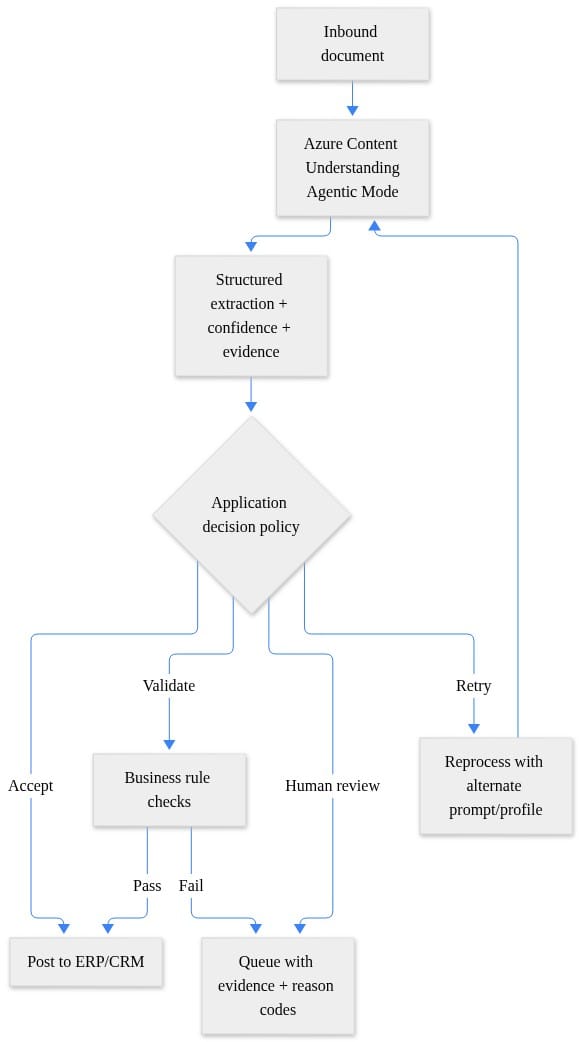
What to notice: the policy layer is separate from extraction. That separation is the whole game. If you bury acceptance logic inside a black-box workflow, you lose control of thresholds, auditability, and rollback.
Three things improve immediately when you adopt this pattern.
First, accuracy improves through verification, not wishful thinking. You stop trusting a raw field because a model emitted it and start checking whether the value is supported by source evidence and downstream rules.
Second, exception handling becomes explicit. “Low confidence,” “missing required field,” and “total mismatch” are operational states, not vague human complaints in a queue.
Third, scale gets more manageable because workflow decisions become repeatable. The system knows when to retry with a different profile, when to route to validation, and when to send a reviewer a bounded task.
And let me be disciplined with the language: “agentic mode” only matters if it results in observable workflow behavior you can govern. Fancy autonomy with no evidence trail is just a more expensive blind spot.
Where this pattern earns its keep
If your workload is clean, stable, and deterministic, keep it simple. A fixed form with consistent layouts and low business consequence does not need a multi-step reasoning loop.
This pattern earns its keep in the ugly middle of enterprise reality:
- mixed document estates
- variable layouts
- scans, photos, screenshots, and generated PDFs in the same process
- packets that require cross-page or cross-document checks
- high exception costs when bad data enters ERP, CRM, claims, or compliance systems
Microsoft’s training path on extracting insights from visual data is the right frame for these messy workloads, as it covers the broader Azure ecosystem for extracting insights from visual data, including generative AI and computer vision, per the Microsoft Learn training path.
Think about the common enterprise scenarios where this matters:
Intake packets
You are not processing one file. You are processing a set: forms, IDs, proofs, signatures, maybe correspondence. The hard part is not reading page 1. The hard part is deciding whether the packet is complete and whether the evidence supports the disposition.
Supplier documentation
Invoices, remittance details, W-9s, banking letters, and email attachments all arrive in different formats. The business risk is not “did I extract text.” It is “did I pay the right entity the right amount with the right controls.”
Claims and case correspondence
These are noisy, narrative-heavy, and often contradictory. Reliability means traceable evidence, a clear uncertainty state, and a safe path to a human reviewer.
Compliance evidence
Auditors do not want a confidence score. They want the source, the reason, the check, and the disposition.
That is why I keep tying this back to governance. If you care about enterprise scale, the extraction endpoint is the least interesting part of the design. The control plane is where the success or failure lives. I made that same argument in my post on Microsoft Fabric governance strategy for enterprise scale, and it applies just as hard here.
Build validation loops before chasing autonomy
A decent document automation system needs a decision policy before it needs swagger.
Start with simple routing states:
- accept
- validate
- retry
- human-review
Then make the rules boring and explicit. Missing required fields? Route it. Confidence below threshold? Route it. Arithmetic mismatch? Validate or escalate. Transient processing issue? Retry once with a bounded alternate profile.
Here is a small Python example that shows the shape of that routing layer:
# Decision policy for routing extracted document results with evidence and reason codes
from typing import Dict, Any

def route_document(result: Dict[str, Any]) -> Dict[str, Any]:
    conf = result.get("confidence", 0.0)
    fields = result.get("fields", {})
    evidence = result.get("evidence", [])
    missing = [k for k in ("invoice_id", "vendor", "total") if not fields.get(k)]
    reasons = []

    if missing:
        reasons.append(f"MISSING_FIELDS:{','.join(missing)}")
    if conf < 0.60:
        state = "human-review"; reasons.append("LOW_CONFIDENCE")
    elif missing:
        state = "validate" if conf >= 0.85 else "human-review"
    elif result.get("attempt", 1) < 2 and result.get("transient_error"):
        state = "retry"; reasons.append("TRANSIENT_EXTRACTION_ERROR")
    else:
        state = "accept"

    return {"state": state, "reason_codes": reasons, "evidence": evidence[:3], "document_id": result["document_id"]}
What to notice: the output is not just a state. It carries reason codes and evidence. That is what makes downstream review and audit workable.
Next, add business validation. This is where most teams get lazy. They celebrate extraction and skip the checks that actually protect the process.
# Business validation step that turns extracted fields into pass/fail evidence
from decimal import Decimal

def validate_invoice(fields: dict) -> dict:
    subtotal = Decimal(str(fields.get("subtotal", "0")))
    tax = Decimal(str(fields.get("tax", "0")))
    total = Decimal(str(fields.get("total", "0")))
    expected = subtotal + tax
    delta = abs(expected - total)

    passed = delta <= Decimal("0.01") and bool(fields.get("invoice_date"))
    return {
        "passed": passed,
        "reason_codes": [] if passed else ["TOTAL_MISMATCH_OR_DATE_MISSING"],
        "evidence": [
            {"check": "math", "expected_total": str(expected), "actual_total": str(total)},
            {"check": "invoice_date_present", "value": bool(fields.get("invoice_date"))},
        ],
    }
What to notice: this turns “the model said total = 104.92” into a pass/fail control with evidence. That is a production move. It is also the difference between automation and rework.
If a case fails validation or arrives with weak confidence, you do not always need to dump it on a human immediately. Sometimes a targeted retry is the right move, especially when the failure mode is recognizable.
# Retry profile selection for agentic reprocessing based on failure patterns
def choose_retry_profile(route: dict, fields: dict) -> dict:
    reasons = set(route.get("reason_codes", []))
    if "LOW_CONFIDENCE" in reasons:
        return {"profile": "high-accuracy", "max_pages": 10, "ocr_hint": "dense-text"}
    if any(code.startswith("MISSING_FIELDS") for code in reasons):
        return {"profile": "targeted-fields", "focus_fields": ["invoice_id", "vendor", "total"]}
    if fields.get("document_type") == "receipt":
        return {"profile": "receipt-layout", "currency_normalization": True}
    return {"profile": "default", "max_pages": 5}
What to notice: retries are bounded and intentional. You are not creating an infinite loop. You are selecting an alternate profile based on the failure pattern.
This is also where cost discipline matters. Every extra pass has a price in latency, compute, and operational complexity. If you are building agentic workflows on Azure, the same budgeting mindset I laid out in my AI agent cost optimization for Azure platform teams guide applies here too: cap retries, define review thresholds, and know your per-document economics before success in the pilot turns into pain in production.
Human review should be a control surface, not a failure dump
The worst review queues I see all share the same design flaw: the human gets a document and a vague instruction to “fix it.”
That is amateur hour.
A reviewer should receive:
- the document or relevant page context
- the proposed extraction
- the evidence snippets that support it
- the exact reason code for escalation
- the validation failures, if any
- the expected action and SLA
If you do that well, human review becomes a designed control surface. If you do it badly, it becomes a hidden labor pool cleaning up after a model no one can explain.
This sequence is the practical operating loop:
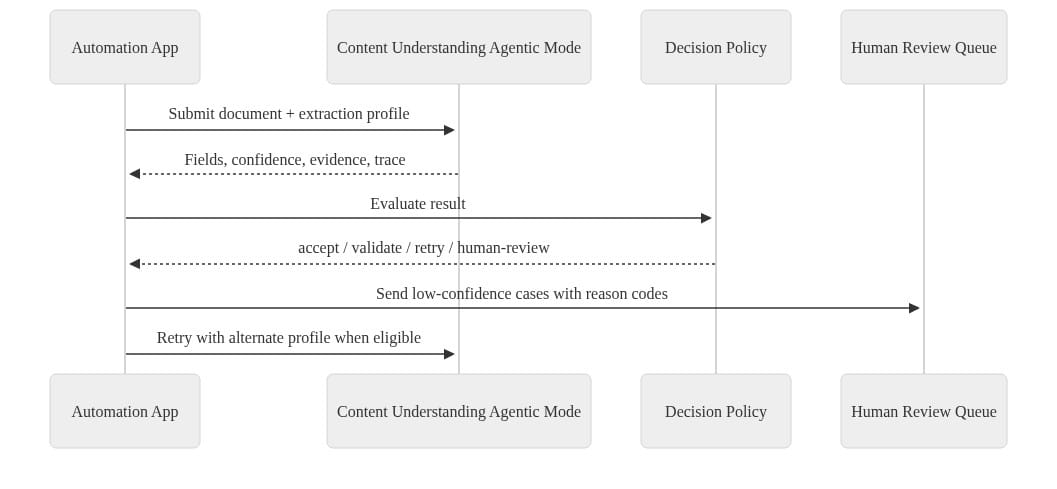
What to notice: the app owns orchestration, the policy owns decisioning, and the review queue only sees exceptions with context. That separation keeps the system governable.
I also want an audit event for every non-trivial decision. Not because compliance asked nicely. Because six months later, when someone asks why a payment posted or a packet was held, you need an answer that is better than “the AI thought so.”
The scale test is governance, cost, and latency
Once teams see better exception handling, they immediately try to expand to every document class in the enterprise. Slow down.
The scale test is not whether the model can parse more files. The scale test is whether your operating model survives:
- identity and access boundaries
- retention and data handling
- retry budgets
- reviewer staffing
- latency targets
- audit record volume
- rollback behavior
- incident response when a classification or routing rule goes sideways
Microsoft’s broader agents guidance is organized around planning for business value, implementing foundations, managing agents at scale, and improving outcomes over time, per the Agents hub. That is the right lens here. Document understanding belongs inside the enterprise control plane, not off to the side as a clever extraction microservice.
And if your document estate spans branches, plants, edge locations, or multicloud environments, the deployment story matters too. Azure Arc exists precisely because distributed environments are messy and need consistent control across on-prem, edge, and multicloud, per the Azure Arc documentation. Document automation at scale lives in that same messy reality.
My blunt take: if you have not defined bounded retries, review thresholds, audit records, and SLAs, you are not building agentic automation. You are building a future incident.
Do not replace a brittle pipeline with an opaque agent
There is a very real failure mode here.
Teams get excited about agentic workflows and accidentally swap one brittle system for another one that is harder to inspect. The extractor was simplistic; now the orchestrator is mysterious. Nothing improved except the slide deck.
Do not do that.
Start narrow:
- one document class
- one exception taxonomy
- one review workflow
- one measurable downstream outcome
Require a production readiness review that covers:
- data boundaries
- reviewer roles
- failure handling
- observability
- rollback
- cost controls
Then prove the pattern on a bounded workload. If validation loops reduce bad downstream actions, reduce manual touches, or shorten turnaround time, expand. If they do not, fix the design before you add more document types.
That is why Azure Content Understanding’s agentic direction matters right now. Microsoft is clearly positioning Content Understanding inside the Foundry-era stack, and Microsoft’s broader architecture story around agents and organizational grounding is converging in the same place. Microsoft IQ, for example, is framed as a shared intelligence layer grounding agent and Copilot interactions in organizational understanding, per Microsoft IQ documentation. The opportunity is bigger than extraction. It is about modernizing the decision loop around unstructured enterprise content.
My opinion, plainly
Enterprise architects should adopt multi-pass document reasoning where uncertainty is expensive. They should keep simpler one-pass extraction where inputs are predictable and the consequences of error are low.
That is the right split.
Do not buy the fantasy that every document flow needs autonomy. Do not accept the older fantasy that one-pass extraction is enough for high-consequence workflows either. The winning architecture sits in the middle: extract, validate, route, review, audit.
If you are evaluating Azure Content Understanding, do not start by asking whether it can pull fields from a sample PDF. Start by asking whether your implementation can:
- surface uncertainty cleanly
- attach evidence to decisions
- retry in a bounded way
- route exceptions with reason codes
- support human review without chaos
- satisfy governance when the workload scales
That is the bar.
Have you actually built bounded retry + evidence-based review into document automation in production? Reply yes or no.
#AzureAI #EnterpriseAI #DataArchitecture
Sources & References
- Extract insights from visual data on Azure - Training
- Study guide for Exam AB-100: Agentic AI Business Solutions Architect
- Developing in Agentic AI Systems Part 1 of 2 - Training
- Azure Arc
- What is Azure Content Understanding in Foundry Tools? - Foundry Tools
- Agents hub - Start here for agentic computing at Microsoft
- Microsoft IQ documentation
Try it yourself
Run this tutorial as a Jupyter notebook: Download runbook.ipynb (19 cells, 22 KB).