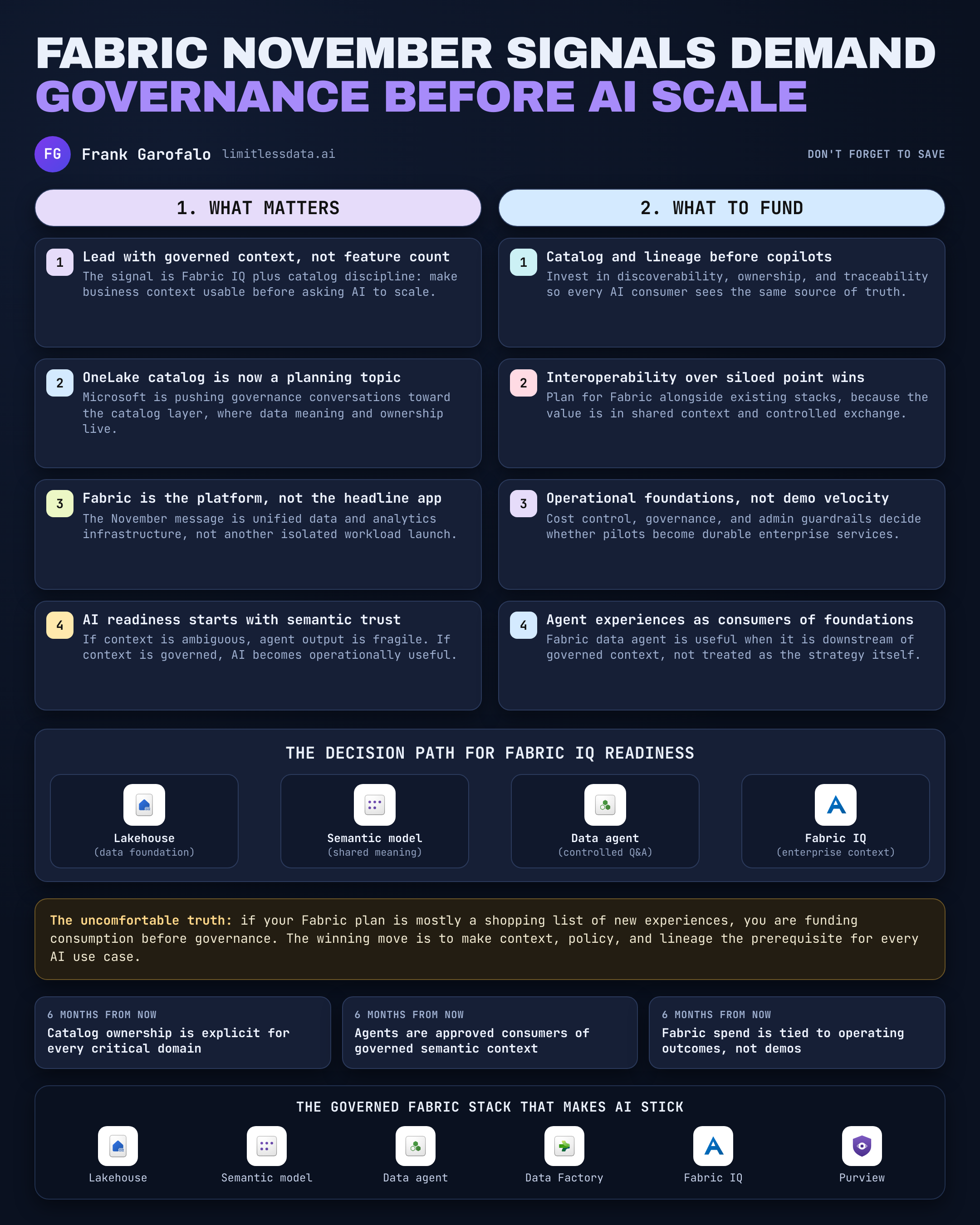
Microsoft Fabric Governance Strategy for Enterprise Scale
Microsoft Fabric at Scale: The Governance Patterns That Matter Before You Expand

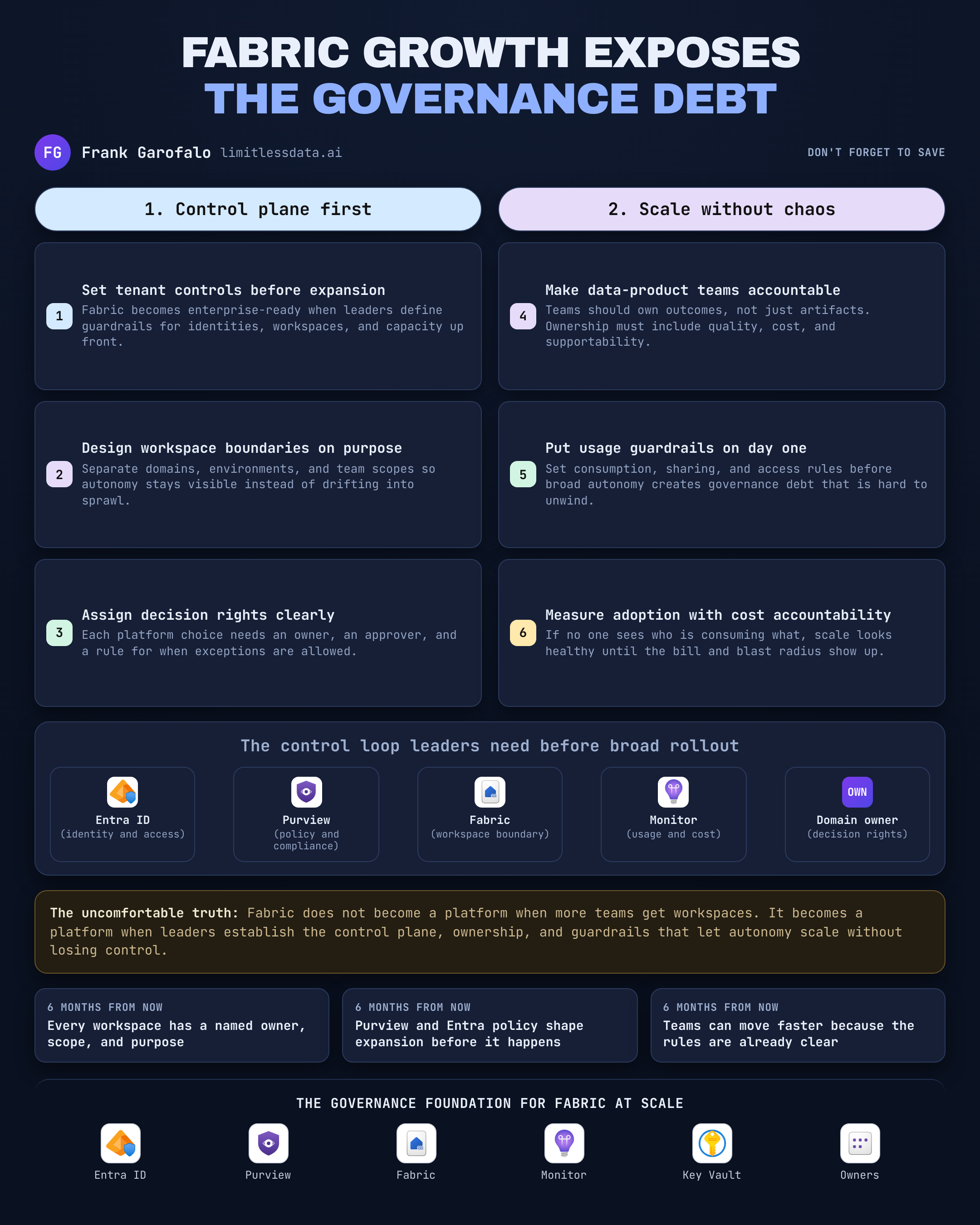
Microsoft Fabric scale is an operating-model decision, not a provisioning exercise. If your expansion plan is “give more teams workspaces and buy more capacity,” you are building governance debt on top of a very capable platform.
On this page
- Fabric scale is an operating-model test
- Choose the control plane before granting autonomy
- Design a workspace strategy that prevents accidental architecture
- Federate domains without federating accountability
- Make access governance and secure automation production criteria
- Put cost and usage guardrails beside platform freedom
- The pre-expansion checklist I’d make leadership sign off on
- Sources & References
Fabric is intentionally broad: a unified platform for data and analytics, spanning engineering, science, real-time workloads, and BI across OneLake-backed experiences, per the Microsoft Fabric overview and the lakehouse introduction. That breadth is exactly why sloppy governance gets expensive fast. Add embedded AI, Copilot-style workflows, and conversational access through Fabric data agents, which are in preview, and the blast radius of unclear ownership goes way up.
Here’s the standard I use with leadership teams before broad rollout:
- Who decides tenant-wide policy?
- Who can create and own a production workspace?
- Who is accountable for a shared metric?
- Who approves exceptions?
- Who pays when “just one more domain” turns into permanent shared-capacity contention?
If you cannot answer those five questions in writing, you are not ready to scale Fabric. You are ready to create tickets.
Fabric scale is an operating-model test
A lot of organizations treat Fabric expansion like a licensing and enablement problem. Train some teams. Stand up a few capacities. Let every domain self-serve. That sounds modern right up until finance has three definitions of gross margin, HR is publishing reports from a test workspace, and the central team is spending Friday night figuring out who gave 120 people broad viewer access to the wrong content.
I had one enterprise program in Q3 where 14 delivery squads spun up analytics assets across multiple business units in less than 8 weeks, and by week 10 nobody could answer which semantic model was the approved source for board reporting. The platform was working. The operating model wasn’t.
That distinction matters. Fabric gives you a lot in one place. One place also means one place to make bad decisions at scale.
The move executives need to make is simple: stop treating scale as “more adoption” and start treating it as “more delegated authority under clear guardrails.” That is a very different conversation.
A practical way to visualize it is this: domains should move fast inside a control plane they did not invent.
flowchart TD
    A[Business Domains] --> B[Fabric Capacity]
    B --> C[Workspaces]
    C --> D[Lakehouses / Warehouses / Notebooks]
    C --> E[Semantic Models / Reports]
    F[Central Governance Team] --> G[Policies]
    G --> C
    G --> D
    G --> E
    H[Purview / Catalog] --> D
    H --> E
    I[Monitoring & Cost Controls] --> B
    I --> C
What to notice: the center is not “a team that owns everything.” The center owns policy, guardrails, and visibility. Domains own delivery inside those boundaries.
Choose the control plane before granting autonomy
The tenant is your policy boundary. Act like it.
Identity and access should not be reinvented by every analytics team. Microsoft Entra ID is the foundation for managing identities and access to applications, data, and resources across the estate, per the Entra ID documentation. That means your tenant-level decisions need to be explicit before you open the floodgates:
- Group-based access patterns
- Environment separation expectations
- External sharing stance
- Service principal and automation rules
- Baseline monitoring and alerting
- Escalation authority for policy violations
This is where leaders usually get lazy. They say “we want federated ownership,” when what they really mean is “we don’t want to slow teams down.” Fine. Then define the non-negotiables and get out of the way.
My rule: the central platform team owns guardrails and enablement, not every workload forever. If the central team becomes the permanent operator for every domain’s content, you do not have federation. You have a bottleneck with nicer branding.
A simple example is workspace naming. I know people roll their eyes at naming standards until they’re trying to automate inventory, lifecycle, access review, or environment isolation across hundreds of assets. Then suddenly consistent names look like operational maturity instead of bureaucracy.
Here’s a lightweight validator pattern I use to make the point with teams.
# Create a naming standard validator for Fabric workspaces
param(
    [string[]]$WorkspaceNames = @("FIN-PRD-ANL", "HR-DEV-DS", "bad-name")
)

$pattern = '^[A-Z]{2,5}-(DEV|TST|PRD)-(ANL|BI|DS)What to do next: don’t obsess over my exact pattern. Define one that encodes domain, environment, and workload type consistently enough that your automation can reason over it.Design a workspace strategy that prevents accidental architectureWorkspace sprawl is not a tooling problem. It is a leadership decision deferred.A workspace should represent an accountability boundary. Not a person. Not a temporary enthusiasm spike. Not “we needed somewhere to publish this report.” If you cannot state the purpose, owner, audience, lifecycle, and access model for a workspace class, you are letting architecture emerge by accident.I push teams to define a small set of workspace classes up front, usually something like:Domain production analytics
Domain development/test
Shared enterprise semantic assets
Central platform operations
Sandboxes with expiration rules

That forces the right executive question: what organizational boundary should a workspace represent here? A business domain? A product line? A regulated data boundary? A platform-managed shared service?You also need promotion criteria. I do not care how elegant the notebook is or how polished the report looks. If the workspace metadata is incomplete, it should not move forward. Ownership has to be machine-readable, not trapped in somebody’s memory or a Teams thread.This is the kind of governance check worth automating early.# Enforce workspace metadata tags before promotion
required_tags = {"owner", "data_domain", "environment", "criticality"}

workspaces = [
    {"name": "FIN-PRD-ANL", "tags": {"owner": "finops", "data_domain": "finance", "environment": "prod", "criticality": "high"}},
    {"name": "HR-DEV-DS", "tags": {"owner": "hr-team", "environment": "dev"}}
]

for ws in workspaces:
    missing = sorted(required_tags - set(ws["tags"].keys()))
    if missing:
        print(f"BLOCKED {ws['name']}: missing tags {missing}")
    else:
        print(f"APPROVED {ws['name']}: governance metadata complete")
What to observe: this pattern blocks promotion when the basics are missing. That is exactly the point. “We’ll document it later” is how production estates become archaeology projects.If you want a deeper operating model for this, I laid out the broader pattern in my post on AI-native data engineering operating model with Fabric.Federate domains without federating accountabilityI’m pro-federation. I’m not pro-anarchy.Centralized models give you consistency, common controls, and easier oversight. Domain teams give you business context, speed, and better local decisions. The answer in a real enterprise is usually a federated model with hard platform guardrails and named domain accountability.That means a domain has the right to build, but it also has the obligation to:Document ownership
Manage access appropriately
Maintain operational visibility
Communicate changes
Stand behind the data product it publishes

If nobody is accountable for the product, it is not a reusable enterprise asset. It is a file with marketing.This is where duplicated semantic models usually show up. Teams blame the modeling layer. I blame unclear authority. When five workspaces each define “active customer” differently, that is not a technical failure first. That is a decision-rights failure. Someone needs authority over shared definitions, and someone else needs a formal exception path when local context genuinely requires a different metric.That does not mean universal centralization. Some domain-specific models should stay domain-specific. Sales pipeline logic and actuarial reserve logic do not need to be forced into one semantic religion. But shared executive metrics need an owner, a quality expectation, and a change communication path.No owner, no broad reuse. That rule saves a lot of pain.Make access governance and secure automation production criteriaFabric’s convenience is exactly why access governance has to be treated as a production gate.Microsoft Purview spans governance, security, and compliance capabilities across the data estate, per the Purview overview. Pair that with Entra-based access control and you have the right foundation. Ignore both, and Fabric becomes an unmanaged distribution channel for sensitive data.That risk gets bigger as organizations add AI-assisted access patterns. Fabric data agents make conversational Q&A over enterprise data much easier. Great capability. Also a great way to expose weak ownership and bad access hygiene at machine speed.I wrote more specifically about that in Fabric Data Agent Query Governance and Control, because this is where a lot of teams get caught flat-footed: they secure dashboards, then forget that natural-language interfaces are still interfaces to governed data.One control I like to show early is role-size thresholding. It’s not enough to know that access exists. You want to know when it has drifted into something no one intended.# Block oversized role assignments to preserve least privilege
$assignments = @(
    @{ Workspace = "FIN-PRD-ANL"; Role = "Admin"; Members = 3 },
    @{ Workspace = "MKT-PRD-BI"; Role = "Viewer"; Members = 120 },
    @{ Workspace = "HR-DEV-DS"; Role = "Contributor"; Members = 8 }
)

$thresholds = @{
    Admin = 5
    Contributor = 25
    Viewer = 100
}

foreach ($a in $assignments) {
    if ($a.Members -gt $thresholds[$a.Role]) {
        Write-Output "ALERT: $($a.Workspace) has too many $($a.Role) members ($($a.Members))"
    }
    else {
        Write-Output "OK: $($a.Workspace) role assignment within threshold"
    }
}
What to do next: set thresholds that fit your environment, then review every exception. A “Viewer” role with broad membership may be totally valid for a curated enterprise report workspace. It is not automatically valid everywhere.You also need environment isolation checks. Dev reaching into prod is one of those shortcuts that feels harmless until it becomes permanent.# Detect cross-environment data access that breaks isolation
connections = [
    {"source": "FIN-DEV-ANL", "target": "FIN-PRD-WH"},
    {"source": "HR-PRD-DS", "target": "HR-PRD-LH"},
    {"source": "MKT-TST-BI", "target": "MKT-DEV-LH"},
]

def env(name: str) -> str:
    return name.split("-")[1]

for c in connections:
    if env(c["source"]) != env(c["target"]):
        print(f"VIOLATION: {c['source']} -> {c['target']}")
    else:
        print(f"OK: {c['source']} -> {c['target']}")
What to observe: this is basic, but basic controls catch real failures. If you do not enforce environment boundaries, your non-prod estate will quietly become dependent on prod data paths.Put cost and usage guardrails beside platform freedomEvery platform team says it wants self-service. Very few mean self-service with accountable consumption.Fabric sits in the middle of shared compute, shared storage patterns, shared semantics, and increasingly shared AI-assisted usage. If leaders cannot see who owns what, who is using what, and which workloads are pushing shared resources, they are not running a platform. They are sponsoring a mystery bill.Telemetry needs to be part of the operating model from day one:Capacity health
Interactive delay
Workspace inventory
Artifact ownership
Access assignment drift
Stale asset detection
Domain consumption reviews

Here’s a simple pattern for flagging hot capacities before user pain and cost complaints stack up.# Flag runaway capacity usage before scale amplifies cost
capacity_metrics = [
    {"capacity": "F64-Prod", "cpu_pct": 72, "interactive_delay_s": 4.2},
    {"capacity": "F32-Dev", "cpu_pct": 91, "interactive_delay_s": 12.8},
    {"capacity": "F128-Shared", "cpu_pct": 66, "interactive_delay_s": 3.1},
]

for m in capacity_metrics:
    hot = m["cpu_pct"] > 85 or m["interactive_delay_s"] > 10
    status = "SCALE/REBALANCE" if hot else "HEALTHY"
    print(f"{m['capacity']}: CPU={m['cpu_pct']}% Delay={m['interactive_delay_s']}s => {status}")
What to do next: define what “hot” means in your environment and who has authority to rebalance, optimize, or approve growth. If nobody owns that call, every incident becomes a committee meeting.Lifecycle governance matters just as much. Unused dev and test workspaces accumulate cost, confusion, and stale access. Retire them aggressively.# Audit stale workspaces for lifecycle governance
$workspaces = @(
    @{ Name = "FIN-PRD-ANL"; LastActivityDays = 12; Environment = "PRD" },
    @{ Name = "OPS-TST-BI"; LastActivityDays = 97; Environment = "TST" },
    @{ Name = "LAB-DEV-DS"; LastActivityDays = 143; Environment = "DEV" }
)

foreach ($ws in $workspaces) {
    if ($ws.Environment -ne "PRD" -and $ws.LastActivityDays -gt 90) {
        Write-Output "RETIRE CANDIDATE: $($ws.Name)"
    }
    else {
        Write-Output "KEEP: $($ws.Name)"
    }
}
What to observe: non-production should expire unless someone can justify keeping it. Production should be reviewed too, but with a different standard and process.If you’re dealing with the broader cost side of AI-enabled usage, my Microsoft Copilot usage-based billing governance guide covers the same core principle: freedom without usage transparency is just deferred cleanup.The pre-expansion checklist I’d make leadership sign off onBefore you expand Fabric broadly, get these decisions out of PowerPoint and into operating reality.Tenant control plane
   - Tenant-wide identity and access rules are defined
   - Exception paths are explicit
   - Central platform team owns guardrails, not every workloadWorkspace strategy
   - Each workspace class has a purpose
   - Every production workspace has an accountable owner
   - Lifecycle expectations exist for dev, test, and sandbox assetsDomain federation
   - Domains can build within policy
   - Shared business definitions have named authority
   - Data products have accountable owners before enterprise reuseProduction readiness
   - Ownership is documented
   - Access is appropriate
   - Monitoring exists
   - Escalation paths are clearConsumption governance
   - Capacity telemetry is reviewed
   - Unused assets are retired
   - Cost accountability sits with a named leader or domain, not “the platform”If you want to automate the oversight layer, this is the pattern I’d aim for: telemetry and inventory feeding governance rules, which then drive alerts, dashboards, and selective auto-remediation.What to do next: start with visibility before auto-remediation. Bad automation over bad ownership just makes the mess faster.Responsible Fabric scale is not slower rollout. It is the discipline that keeps early wins from becoming enterprise-wide governance debt six months later.Rate your Fabric governance readiness from 1 to 5: are you scaling workspaces, or have you actually defined the control plane that makes autonomy safe?#MicrosoftFabric #Datagovernance #DataArchitecture
Sources & ReferencesMicrosoft Fabric documentation - Microsoft Fabric
Lakehouse end-to-end scenario: overview and architecture - Microsoft Fabric
Microsoft Entra ID documentation - Microsoft Entra ID
Microsoft Purview
Fabric data agent creation - Microsoft Fabric
What is Fabric IQ? - Microsoft Fabric

foreach ($name in $WorkspaceNames) {
    if ($name -match $pattern) {
        Write-Output "VALID: $name"
    }
    else {
        Write-Output "INVALID: $name"
    }
}
What to do next: don’t obsess over my exact pattern. Define one that encodes domain, environment, and workload type consistently enough that your automation can reason over it.
Design a workspace strategy that prevents accidental architecture
Workspace sprawl is not a tooling problem. It is a leadership decision deferred.
A workspace should represent an accountability boundary. Not a person. Not a temporary enthusiasm spike. Not “we needed somewhere to publish this report.” If you cannot state the purpose, owner, audience, lifecycle, and access model for a workspace class, you are letting architecture emerge by accident.
I push teams to define a small set of workspace classes up front, usually something like:
- Domain production analytics
- Domain development/test
- Shared enterprise semantic assets
- Central platform operations
- Sandboxes with expiration rules
That forces the right executive question: what organizational boundary should a workspace represent here? A business domain? A product line? A regulated data boundary? A platform-managed shared service?
You also need promotion criteria. I do not care how elegant the notebook is or how polished the report looks. If the workspace metadata is incomplete, it should not move forward. Ownership has to be machine-readable, not trapped in somebody’s memory or a Teams thread.
This is the kind of governance check worth automating early.
CB2
What to observe: this pattern blocks promotion when the basics are missing. That is exactly the point. “We’ll document it later” is how production estates become archaeology projects.
If you want a deeper operating model for this, I laid out the broader pattern in my post on AI-native data engineering operating model with Fabric.
Federate domains without federating accountability
I’m pro-federation. I’m not pro-anarchy.
Centralized models give you consistency, common controls, and easier oversight. Domain teams give you business context, speed, and better local decisions. The answer in a real enterprise is usually a federated model with hard platform guardrails and named domain accountability.
That means a domain has the right to build, but it also has the obligation to:
- Document ownership
- Manage access appropriately
- Maintain operational visibility
- Communicate changes
- Stand behind the data product it publishes
If nobody is accountable for the product, it is not a reusable enterprise asset. It is a file with marketing.
This is where duplicated semantic models usually show up. Teams blame the modeling layer. I blame unclear authority. When five workspaces each define “active customer” differently, that is not a technical failure first. That is a decision-rights failure. Someone needs authority over shared definitions, and someone else needs a formal exception path when local context genuinely requires a different metric.
That does not mean universal centralization. Some domain-specific models should stay domain-specific. Sales pipeline logic and actuarial reserve logic do not need to be forced into one semantic religion. But shared executive metrics need an owner, a quality expectation, and a change communication path.
No owner, no broad reuse. That rule saves a lot of pain.
Make access governance and secure automation production criteria
Fabric’s convenience is exactly why access governance has to be treated as a production gate.
Microsoft Purview spans governance, security, and compliance capabilities across the data estate, per the Purview overview. Pair that with Entra-based access control and you have the right foundation. Ignore both, and Fabric becomes an unmanaged distribution channel for sensitive data.
That risk gets bigger as organizations add AI-assisted access patterns. Fabric data agents make conversational Q&A over enterprise data much easier. Great capability. Also a great way to expose weak ownership and bad access hygiene at machine speed.
I wrote more specifically about that in Fabric Data Agent Query Governance and Control, because this is where a lot of teams get caught flat-footed: they secure dashboards, then forget that natural-language interfaces are still interfaces to governed data.
One control I like to show early is role-size thresholding. It’s not enough to know that access exists. You want to know when it has drifted into something no one intended.
CB3
What to do next: set thresholds that fit your environment, then review every exception. A “Viewer” role with broad membership may be totally valid for a curated enterprise report workspace. It is not automatically valid everywhere.
You also need environment isolation checks. Dev reaching into prod is one of those shortcuts that feels harmless until it becomes permanent.
CB4
What to observe: this is basic, but basic controls catch real failures. If you do not enforce environment boundaries, your non-prod estate will quietly become dependent on prod data paths.
Put cost and usage guardrails beside platform freedom
Every platform team says it wants self-service. Very few mean self-service with accountable consumption.
Fabric sits in the middle of shared compute, shared storage patterns, shared semantics, and increasingly shared AI-assisted usage. If leaders cannot see who owns what, who is using what, and which workloads are pushing shared resources, they are not running a platform. They are sponsoring a mystery bill.
Telemetry needs to be part of the operating model from day one:
- Capacity health
- Interactive delay
- Workspace inventory
- Artifact ownership
- Access assignment drift
- Stale asset detection
- Domain consumption reviews
Here’s a simple pattern for flagging hot capacities before user pain and cost complaints stack up.
CB5
What to do next: define what “hot” means in your environment and who has authority to rebalance, optimize, or approve growth. If nobody owns that call, every incident becomes a committee meeting.
Lifecycle governance matters just as much. Unused dev and test workspaces accumulate cost, confusion, and stale access. Retire them aggressively.
CB6
What to observe: non-production should expire unless someone can justify keeping it. Production should be reviewed too, but with a different standard and process.
If you’re dealing with the broader cost side of AI-enabled usage, my Microsoft Copilot usage-based billing governance guide covers the same core principle: freedom without usage transparency is just deferred cleanup.
The pre-expansion checklist I’d make leadership sign off on
Before you expand Fabric broadly, get these decisions out of PowerPoint and into operating reality.
- Tenant control plane
- Tenant-wide identity and access rules are defined - Exception paths are explicit - Central platform team owns guardrails, not every workload
- Workspace strategy
- Each workspace class has a purpose - Every production workspace has an accountable owner - Lifecycle expectations exist for dev, test, and sandbox assets
- Domain federation
- Domains can build within policy - Shared business definitions have named authority - Data products have accountable owners before enterprise reuse
- Production readiness
- Ownership is documented - Access is appropriate - Monitoring exists - Escalation paths are clear
- Consumption governance
- Capacity telemetry is reviewed - Unused assets are retired - Cost accountability sits with a named leader or domain, not “the platform”
If you want to automate the oversight layer, this is the pattern I’d aim for: telemetry and inventory feeding governance rules, which then drive alerts, dashboards, and selective auto-remediation.
CB7
What to do next: start with visibility before auto-remediation. Bad automation over bad ownership just makes the mess faster.
Responsible Fabric scale is not slower rollout. It is the discipline that keeps early wins from becoming enterprise-wide governance debt six months later.
Rate your Fabric governance readiness from 1 to 5: are you scaling workspaces, or have you actually defined the control plane that makes autonomy safe?
#MicrosoftFabric #Datagovernance #DataArchitecture
Sources & References
- Microsoft Fabric documentation - Microsoft Fabric
- Lakehouse end-to-end scenario: overview and architecture - Microsoft Fabric
- Microsoft Entra ID documentation - Microsoft Entra ID
- Microsoft Purview
- Fabric data agent creation - Microsoft Fabric
- What is Fabric IQ? - Microsoft Fabric
Try it yourself
Run this tutorial as a Jupyter notebook: Download runbook.ipynb (22 cells, 17 KB).