Microsoft Fabric Medallion Governance for Warehouses
Fabric Medallion Governance Is Maturing: What the New Warehouse Guidance Means for Data Leaders

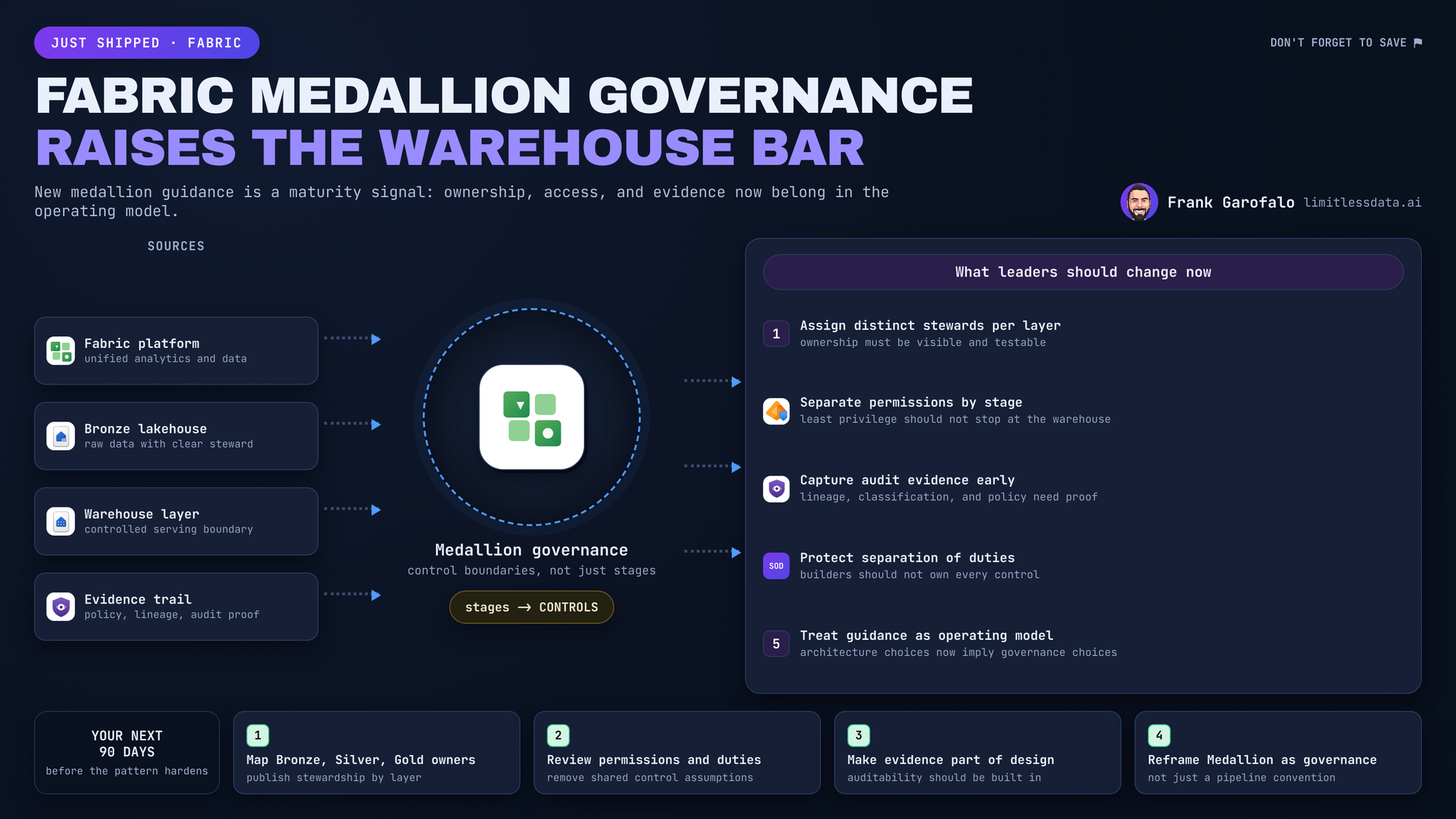
Fabric medallion governance just became a leadership issue.
On this page
- The quiet shift from architecture advice to operating-model pressure
- Medallion layers are control boundaries, not pipeline checkpoints
- Standardize four controls before standardizing more pipelines
- The organizational failures hidden by a shared lakehouse
- What warehouse guidance changes for platform standardization
- A practical mandate for the next planning cycle
- The bottom line
- Sources & References
If Bronze, Silver, and Gold are still just engineering labels in your Fabric estate, you have only implemented half the pattern.
Microsoft positions Fabric as a unified analytics platform for organizational data needs, and the medallion pattern is the recommended design approach in Fabric’s own guidance, not a side suggestion from the field (Fabric overview, medallion architecture guidance). Once the platform standardizes the pattern, leaders lose the excuse to leave ownership, access, and evidence as “team-level conventions.”
My take is simple: medallion architecture should be treated as a control-boundary model.
That means Bronze, Silver, and Gold need different stewards, permissions, duties, and audit evidence. If they don’t, you have a pipeline with colored folders, not a governed operating model.
The quiet shift from architecture advice to operating-model pressure
A lot of teams still talk about medallion architecture like it’s just a data engineering diagram: raw lands here, conformed goes there, curated ends up somewhere useful.
Fabric changes the pressure. The platform spans data movement, engineering, science, real-time analytics, and BI in one place, and Microsoft’s end-to-end scenarios explicitly center the medallion approach across that flow (Fabric lakehouse scenario). In a standardized Fabric estate, weak controls become visible fast.
Here’s the executive interpretation: the important change is not another medallion diagram. It’s that a unified platform exposes where accountability is missing.
In Q1, I worked with a 14-person retail analytics team that had three “gold” datasets feeding executive scorecards, and two still depended on direct joins back to a raw customer intake zone after a schema break in their POS feed. The architecture slide said medallion. The operating model said chaos.
That’s the issue. A medallion implementation without accountable control boundaries is partial adoption. The platform gives you the structure. Leadership has to define what each layer permits, who owns it, and what evidence proves it was handled correctly.
Medallion layers are control boundaries, not pipeline checkpoints
Let me make this practical.
Bronze is not just where data lands first. It is the preservation and intake boundary. Its job is source fidelity, traceable ingestion, and restricted handling of raw content, especially when raw means sensitive, incomplete, or ugly.
Silver is the transformation and conformance boundary. This is where quality remediation, standardization, deduplication, survivorship, and schema harmonization happen. If business meaning changes here without a named owner, you have built a silent policy engine.
Gold is the publication boundary. This is the layer people use to run the business. Gold should contain curated, business-facing data products with named owners, explicit intended use, service expectations, and controlled publishing. Gold is where “available” has to become “decision-ready.”
The pattern itself does not assign stewardship, authorize access, or prove compliance. Leaders have to turn the layers into enforceable boundaries.
A simple target-state picture helps when you explain this to platform and governance teams:
What to notice in that flow: Gold is not merely downstream from Silver. It is downstream from quality gates and governance controls. That is the design habit you want teams to internalize.
Standardize four controls before standardizing more pipelines
If I were walking into a Fabric standardization program this quarter, I would lock four controls before approving another wave of pipelines.
1) Layer-specific stewardship
Each layer needs an accountable steward with decision rights.
For Bronze, the steward approves intake rules and source fidelity exceptions. For Silver, the steward approves transformation logic that changes usability or meaning. For Gold, the steward approves publication, certification, SLA, and intended consumer class.
Not “the team.” Not “data engineering.” A named role.
One lightweight way to force the conversation is to validate naming and ownership conventions early. I use simple checks like this in workshops because they expose how fast standards fall apart when ownership is optional.
# Validate medallion layer naming and ownership conventions
warehouses = [
    {"name": "wh_gold_sales", "layer": "gold", "owner": "data-platform"},
    {"name": "wh_silver_ops", "layer": "silver", "owner": "data-eng"},
    {"name": "sales_curated", "layer": "gold", "owner": ""},
]

def validate(items):
    issues = []
    for w in items:
        expected_prefix = f"wh_{w['layer']}_"
        if not w["name"].startswith(expected_prefix):
            issues.append(f"{w['name']}: expected prefix {expected_prefix}")
        if not w["owner"]:
            issues.append(f"{w['name']}: missing owner")
    return issues

for issue in validate(warehouses):
    print(issue)
The point is not the script. The point is the failure mode: if your warehouse objects don’t even carry a clear layer signal and owner, your governance model is already leaking.
2) Least-privilege access
Access should follow operational need, not project familiarity.
Microsoft Entra ID exists to manage identities and control access to applications, data, and resources (Entra ID overview). Bronze access should be narrow. Silver access can be broader but still role-based. Gold access should align to consumer classes, not be inherited because someone once helped debug a pipeline.
I’m blunt on this one: if analysts can browse Bronze because “it’s easier,” your layer model is cosmetic.
3) Separation of duties
The same person or same small team should not ingest, transform, approve, publish, administer access, and attest that controls were followed.
That sounds obvious until you look at real estates. Shared lakehouses hide this constantly: one workspace, one team, one service principal, one release path. That is a monoculture with no meaningful control point.
Promotion rules are where you make separation real. Before something becomes Gold, require evidence that quality, ownership, and service expectations exist.
# Enforce a simple promotion rule from silver to gold warehouse
$datasets = @(
    @{ Name = "customer_360"; QualityScore = 92; HasOwner = $true; HasSLA = $true },
    @{ Name = "orders_daily"; QualityScore = 74; HasOwner = $true; HasSLA = $false }
)

foreach ($d in $datasets) {
    $approved = ($d.QualityScore -ge 85) -and $d.HasOwner -and $d.HasSLA
    if ($approved) {
        Write-Output "$($d.Name): promote to gold warehouse"
    }
    else {
        Write-Output "$($d.Name): hold in silver until controls are complete"
    }
}
What matters here: a Gold promotion decision should be conditional on controls being complete, not just on the data being useful enough for a dashboard.
4) Auditability
Every layer transition should leave evidence.
You need evidence for source intake, transformation ownership, permission changes, and Gold publication decisions. That’s where Microsoft Purview becomes relevant. Purview is a portfolio across governance, security, and compliance, which is exactly the conversation leaders need to have around evidence and policy coverage (Microsoft Purview).
But let’s keep this honest: no product writes your operating model for you. Purview and Entra help enforce and document. They do not decide your stewardship boundaries.
If you want a deeper operating-model treatment, I laid out the broader pattern in Microsoft Fabric Governance Strategy for Enterprise Scale and the workload side in AI-Native Data Engineering Operating Model With Fabric.
The organizational failures hidden by a shared lakehouse
This is where the architecture crowd usually gets uncomfortable, because the ugliest problems are management failures wearing technical clothes.
Bronze often becomes a convenience analytics zone. Someone needs a field that hasn’t been cleaned yet. Someone else wants to debug source drift. Then a notebook, a shortcut, or a quick report gets pointed at raw content, and suddenly the weakest layer becomes a semi-official consumption path.
Silver becomes a junk drawer even faster. Quality fixes, business rule changes, one-off joins, and experimental transformations pile up together. Now you have no clean line between conformance and invention. When Finance asks why “active customer” changed between quarters, nobody can answer without replaying notebooks and memory.
Gold fails more subtly. Teams treat it as a reporting convenience instead of a publication contract. The tables look curated, but ownership is fuzzy, intended use is undocumented, and nobody can say which datasets are actually safe for executive decisions.
A shared lakehouse can make all three failures look tidy on paper because the objects are organized by layer. That fools leaders. The folders are clean. The accountability is not.
One practical fix is to score assets for warehouse readiness using governance signals, not just technical shape. I like showing teams a simple scoring model because it reframes the discussion away from “can we query it?” to “should we publish it?”
# Score tables for warehouse readiness based on governance signals
tables = [
    {"table": "dim_customer", "pk": True, "tests": 12, "pii_tagged": True},
    {"table": "fact_sales", "pk": False, "tests": 8, "pii_tagged": True},
    {"table": "stg_orders", "pk": False, "tests": 2, "pii_tagged": False},
]

def readiness_score(t):
    score = 0
    score += 40 if t["pk"] else 0
    score += min(t["tests"] * 5, 40)
    score += 20 if t["pii_tagged"] else 0
    return score

for t in tables:
    score = readiness_score(t)
    tier = "warehouse-ready" if score >= 80 else "needs-hardening"
    print(f"{t['table']}: {score} -> {tier}")
The right next step after a score like this is not to debate the math. It’s to define your minimum bar for Gold and make it mandatory.
What warehouse guidance changes for platform standardization
Fabric training and architecture guidance push teams to evaluate when lakehouses, warehouses, and eventhouses are appropriate in OneLake-based analytics storage (Fabric training path). Good. That’s the right technical conversation.
But data leaders should read that as a governance prompt, not just a storage decision.
When do you want governed consumption to live in a warehouse? Where should source-adjacent handling remain tightly restricted? Which transformations belong in conformance layers versus publication layers? How will evidence travel if different domains choose different stores?
That’s the standardization question.
I’m not prescribing one topology for every enterprise. Some teams will use lakehouse-heavy patterns. Some will lean on warehouses for curated consumption. Some will have event-driven paths that never fit a neat batch story. Fine.
The non-negotiable principle is this: a storage choice is acceptable only when ownership, access, separation of duties, and evidence requirements are equally explicit.
This is why I’ve been arguing that Fabric Medallion Architecture for Warehouse Governance is really an operating-model discussion disguised as a data-modeling discussion.
And there’s another reason this matters now. Fabric IQ ontology preview is already framing business concepts like customers, products, assets, orders, and locations as shared machine-understandable representations (Fabric IQ ontology overview). Once your business concepts become more standardized and reusable, the cost of sloppy Gold publication goes up. Bad semantics scale just as efficiently as good ones.
A practical mandate for the next planning cycle
If you’re the CDO, CAO, or platform leader, here’s the move I’d make next.
1) Publish a layer-control charter
One page per layer. Define:
- purpose
- accountable owner
- allowed consumer class
- access posture
- promotion criteria
- required evidence
No poetry. No architecture wallpaper. Just the rules.
2) Bake the charter into workspace and data-product standards
Do not leave this to project-by-project interpretation.
If a team wants a Gold publication path, require owner, SLA, quality checks, and access model before approval. If a team wants broad Bronze access, force an exception process.
3) Measure exceptions, not intentions
Track:
- direct consumption from Bronze or Silver
- undocumented owners
- broad access grants
- Gold publications without certification evidence
- transformations with no accountable approver
Leadership teams love maturity models. I prefer exception counts because they reveal behavior.
A tiny KPI summary can make the point fast in steering meetings:
# Generate a simple governance KPI summary for leadership reporting
assets = [
    {"name": "gold_sales", "certified": True, "rls": True, "owner": True},
    {"name": "gold_finance", "certified": True, "rls": False, "owner": True},
    {"name": "silver_ops", "certified": False, "rls": False, "owner": False},
]

total = len(assets)
certified = sum(a["certified"] for a in assets)
secured = sum(a["rls"] for a in assets)
owned = sum(a["owner"] for a in assets)

print({"total_assets": total, "certified_pct": certified / total})
print({"secured_pct": secured / total, "owned_pct": owned / total})
What matters here is not the script output. It’s the discipline of reporting ownership, security, and certification as first-class platform metrics.
4) Treat Gold as a contract
If a dataset is Gold, it should have a contract: grain, owner, SLA, columns, and intended use. If it lacks those basics, it belongs back in Silver until it grows up.
# Build a lightweight data contract for curated warehouse tables
contract = {
    "table": "dim_customer",
    "grain": "one row per customer",
    "owner": "domain-sales",
    "sla_hours": 4,
    "columns": [
        {"name": "customer_id", "type": "string", "nullable": False},
        {"name": "customer_name", "type": "string", "nullable": False},
        {"name": "region", "type": "string", "nullable": True},
    ],
}

required = {"table", "grain", "owner", "sla_hours", "columns"}
missing = required - contract.keys()
print("contract_valid=", len(missing) == 0)
print("column_count=", len(contract["columns"]))
That one habit alone will save you from a lot of “why did this metric move?” theater six months from now.
The bottom line
Fabric maturity is not demonstrated by having Bronze, Silver, and Gold on a diagram.
It is demonstrated when each layer changes what people are allowed to do, what they are responsible for doing, and what they can prove they did.
That is the shift data leaders should care about. Not prettier medallion slides. Not endless debates about lakehouse versus warehouse as a matter of taste. The real upgrade is making ownership, access, and evidence visible at every layer.
Rate your team’s current state on this from 1 to 5: are your Bronze, Silver, and Gold layers actual control boundaries, or just pipeline checkpoints?
#MicrosoftFabric #Datagovernance #DataArchitecture
Sources & References
- Microsoft Fabric documentation - Microsoft Fabric
- Microsoft Purview
- Microsoft Entra ID documentation - Microsoft Entra ID
- Lakehouse end-to-end scenario: overview and architecture - Microsoft Fabric
- What Is Ontology (Preview)? - Microsoft Fabric
- Implement Medallion Lakehouse Architecture in Fabric - Microsoft Fabric
- Explore Analytics Data Stores in Microsoft Fabric - Training
Try it yourself
Run this tutorial as a Jupyter notebook: Download runbook.ipynb (21 cells, 17 KB).