GitHub Open Source Graph and Enterprise Engineering
What GitHub's Open Source Collaboration Graph Says About Enterprise Engineering Strategy

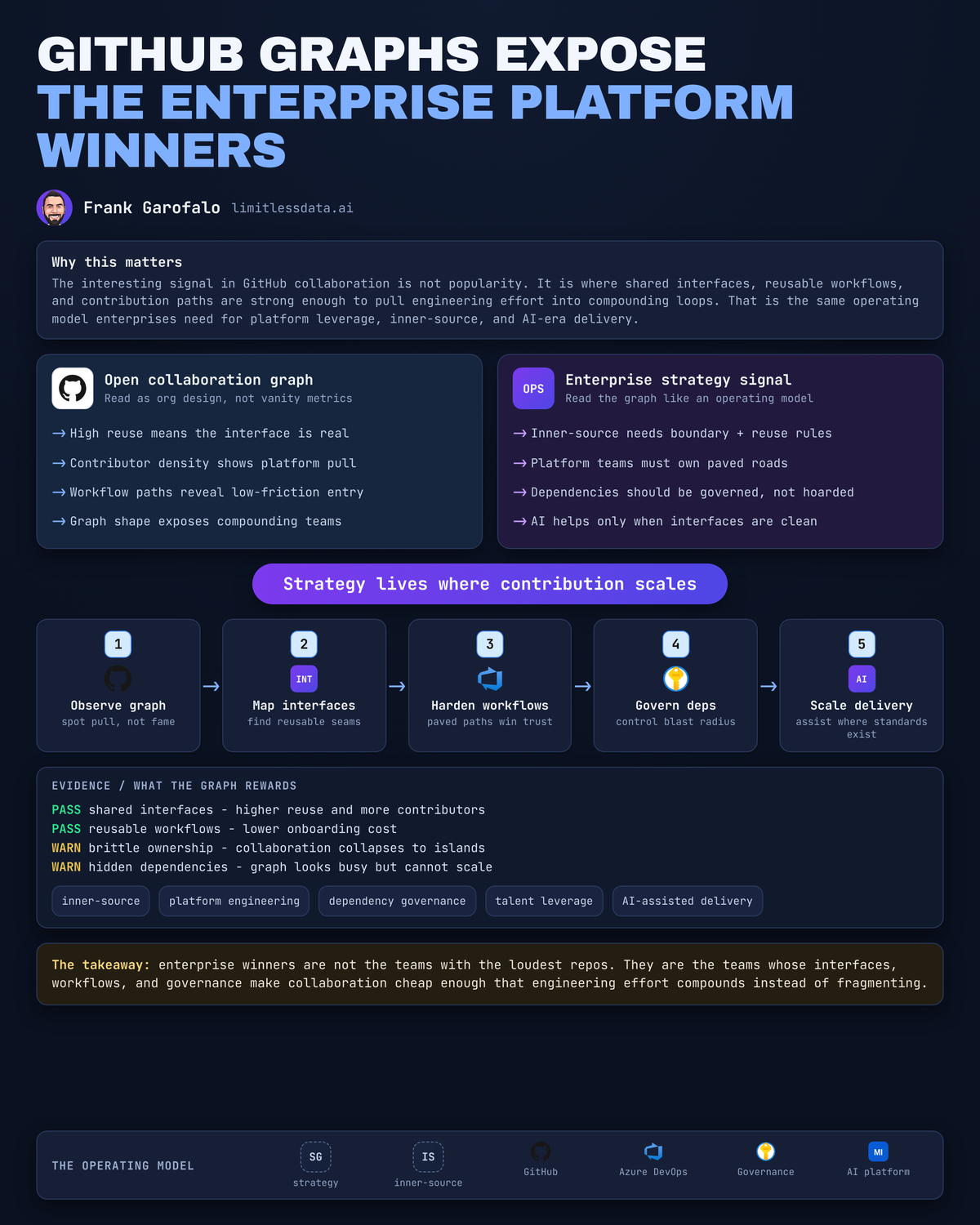
The org chart you need is hiding in the repo graph. The interesting signal in GitHub collaboration is not popularity. It is where shared interfaces, reusable workflows, and contribution paths are strong enough to pull engineering effort into compounding loops.
Enterprise leaders keep reading open source graphs like marketing dashboards. Stars, forks, trend lines, logo density. Wrong lens. The graph that matters shows where engineers keep coming back because the interface is stable, the workflow is obvious, and the contribution path doesn’t feel like a committee hearing.
That is the same operating model large enterprises need right now for inner-source, platform engineering, dependency governance, and AI-assisted delivery.
I’ll make this concrete.
Read the collaboration graph as an operating model signal
When I look at a collaboration graph, I’m not asking “what’s popular?” I’m asking four blunt questions:
- Where do multiple teams converge?
- Which repos create repeatable work instead of one-off heroics?
- Where are the interfaces strong enough that strangers can contribute safely?
- Which workflows reduce coordination cost every time they get reused?
That is why these graphs matter to enterprise strategy. They are a proxy for where engineering work compounds.
Microsoft’s own architecture guidance leans this way. The Azure Architecture Center is built around solution ideas, reference architectures, and decision guides because scale comes from standardizing choices and reducing reinvention, not from celebrating bespoke systems every quarter, per the Azure Architecture Center.
Here’s the simplest mental model I use with CIOs and platform leads:
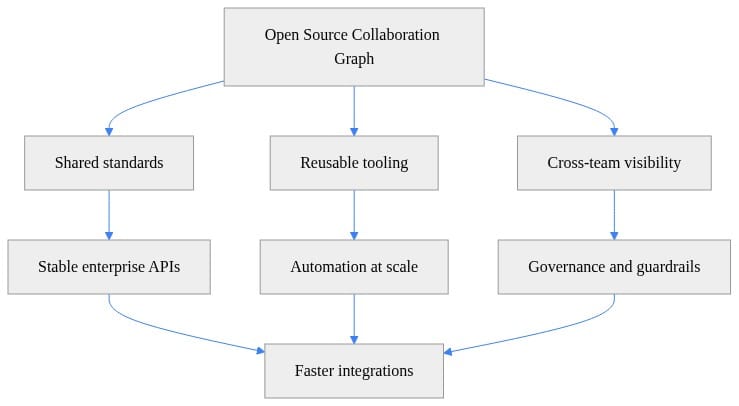
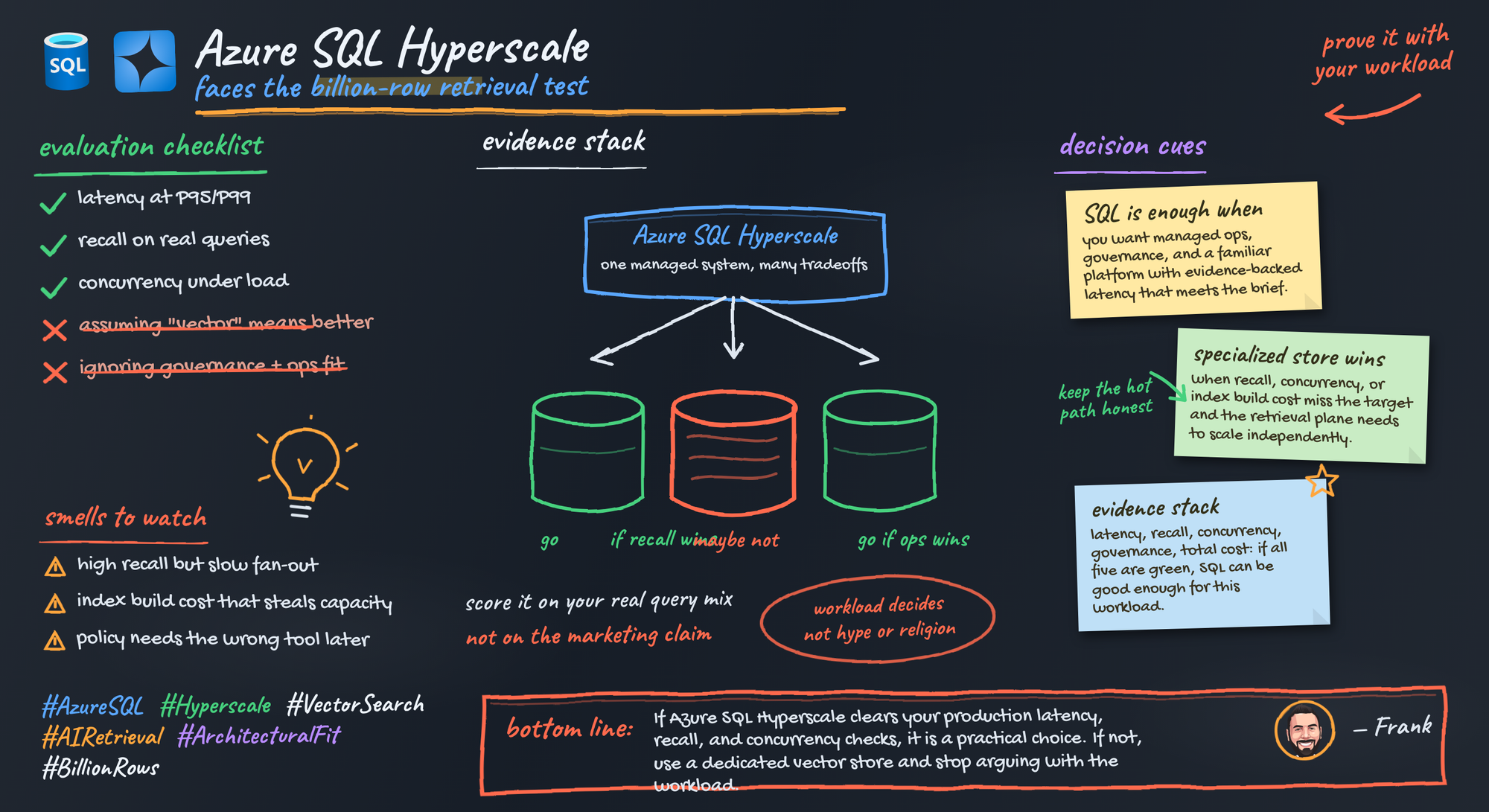
What to notice: the collaboration graph only becomes strategically useful when it resolves into stable standards, reusable tooling, and guardrails that speed integrations. If your internal graph is dense but every team still hand-rolls auth, CI, secrets, repo structure, and release policy, you don’t have compounding. You have synchronized chaos.
A specific field note: in Q3 of last year, a 40-person platform and app engineering group I worked with had 312 repositories, but just 11 of them accounted for almost every cross-team contribution that actually reduced delivery time. Those 11 had templates, clear owners, versioning discipline, and documented contribution rules. The rest were just code storage.
Why platform teams create contribution gravity
The best platform teams are not internal help desks with Terraform. They are product teams for engineering leverage.
Microsoft’s platform engineering guidance gets this right: platform teams should create personalized, optimized, and secure developer experiences using building blocks from Microsoft and other vendors, per the platform engineering guide. That sounds polite. In practice, it means your platform team owns the paved roads, the interfaces, the telemetry, and the friction budget.
Here’s the contrarian part: the best platform is rarely the one with the most features. It’s the one with the clearest default path and the lowest coordination tax.
I’ve seen home labs prove this faster than enterprises do. In my Proxmox/Azure setup, the services I reuse most are not the fanciest ones. They’re the ones with dead-simple deployment patterns, clean secrets handling, and boring upgrade paths. Same rule inside a Fortune 500. Engineers return to platforms that remove decisions.
The mechanics are straightforward:
- Strong interfaces
- Measurable onboarding friction
- Fast feedback loops
- Explicit ownership boundaries
- Ruthless prioritization
If you want to visualize whether your platform has contribution gravity, start tiny. Build a basic graph from contribution events and look for overlap across strategic repos:
# Build a tiny collaboration graph from repository contribution events
from collections import defaultdict

events = [
    ("payments-api", "alice"), ("payments-api", "bob"),
    ("identity-sdk", "alice"), ("identity-sdk", "carol"),
    ("platform-cli", "bob"), ("platform-cli", "carol"),
]

graph = defaultdict(set)
for repo, engineer in events:
    graph[repo].add(engineer)

for repo, engineers in graph.items():
    print(f"{repo}: {sorted(engineers)}")

shared = graph["payments-api"] & graph["platform-cli"]
print("Cross-project overlap:", sorted(shared))
What to notice: overlap matters more than volume. A repo with moderate activity but meaningful cross-project overlap often has more strategic value than a noisy app repo with lots of commits and zero reuse.
Then score for reuse, not vanity:
# Score repositories by cross-team reuse to approximate strategic platform value
repos = {
    "identity-sdk": {"appdev", "security", "platform"},
    "payments-api": {"appdev", "finance"},
    "platform-cli": {"platform", "security", "data"},
    "design-system": {"web", "mobile", "marketing"},
}

scores = {name: len(consumers) for name, consumers in repos.items()}
ranked = sorted(scores.items(), key=lambda item: item[1], reverse=True)

for name, score in ranked:
    print(f"{name}: reused by {score} teams")
What to notice: a repository reused by security, platform, and app teams is telling you something about enterprise leverage. That repo is probably closer to “platform asset” than “project artifact.”
This is exactly why I argued in Azure PostgreSQL from commit to cloud that standardization work belongs upstream in the developer path, not downstream in operations clean-up.
Inner-source is the enterprise version of open source compounding
A lot of companies still talk about inner-source like it’s a culture initiative. That framing kills it.
Inner-source is a throughput strategy.
If open source collaboration teaches enterprises anything, it’s this: contribution scales when people can discover the thing, understand the boundaries, and make a safe change without negotiating with six teams. Shared repos, starter templates, issue labels, CODEOWNERS, branch policies, release notes, versioning rules — this is the plumbing that turns engineering effort into a flywheel.
Git literacy is no longer niche. Microsoft’s AZ-400 path is explicitly advanced enterprise DevOps training covering Git across Azure DevOps and GitHub for DevOps, platform, and security roles, per the AZ-400 training path. That matters because it tells you where the market already is: Git-based collaboration is core operating muscle now, not a specialist hobby.
If you want inner-source to work, make the first contribution path painfully obvious:
- repo templates
- standard labels
- required reviews
- branch protection
- issue forms
- ownership metadata
- dependency policy
- release automation
Here’s a lightweight example of baseline repository governance through the GitHub API:
# Enforce baseline governance settings for a GitHub repository via REST API
$Token = $env:GITHUB_TOKEN
$Owner = "contoso"
$Repo  = "platform-cli"
$Headers = @{
    Authorization = "Bearer $Token"
    Accept        = "application/vnd.github+json"
}

$Body = @{
    has_issues            = $true
    has_projects          = $false
    delete_branch_on_merge = $true
    allow_squash_merge    = $true
    allow_merge_commit    = $false
} | ConvertTo-Json

Invoke-RestMethod -Method Patch `
    -Uri "https://api.github.com/repos/$Owner/$Repo" `
    -Headers $Headers `
    -Body $Body `
    -ContentType "application/json"
What to notice: this is not glamorous. That’s the point. Inner-source succeeds on repeatable defaults.
Then lock the default branch with guardrails that make quality and security the easy path:
# Apply repeatable branch protection guardrails to the default branch
$Token = $env:GITHUB_TOKEN
$Owner = "contoso"
$Repo  = "platform-cli"
$Branch = "main"
$Headers = @{
    Authorization = "Bearer $Token"
    Accept        = "application/vnd.github+json"
}

$Protection = @{
    required_status_checks = @{ strict = $true; contexts = @("build", "security-scan") }
    enforce_admins         = $true
    required_pull_request_reviews = @{ required_approving_review_count = 2 }
    restrictions           = $null
} | ConvertTo-Json -Depth 5

Invoke-RestMethod -Method Put `
    -Uri "https://api.github.com/repos/$Owner/$Repo/branches/$Branch/protection" `
    -Headers $Headers `
    -Body $Protection `
    -ContentType "application/json"
What to notice: one compliant repo is nice. A thousand repos with the same baseline is strategy.
Dependency strategy is now a board-level engineering concern
This is where a lot of leadership teams are still asleep.
Your dependency model is now a direct expression of risk, velocity, and maintainability. That includes open source packages, internal libraries, build actions, templates, SDKs, and Git-based integration points across platforms.
Microsoft Fabric’s Git integration documentation explicitly points teams to privacy statements, data protection information, and network security for CI/CD before enabling Git integration, per the Fabric Git integration overview. Good. That is how grown-up engineering works. Collaboration tooling is inseparable from governance.
I use Intune Enterprise Application Management as a useful analogy here. Microsoft maintains a large catalog of packaged applications because enterprises need standardized and governed software consumption at scale, per the Intune Enterprise Application Management docs. You need the exact same discipline for code dependencies and developer tooling.
That means leaders should ask:
- Which dependencies are strategic, tolerated, or banned?
- Who owns intake and exception review?
- Which libraries are approved paved roads?
- How fast can we patch or replace a compromised component?
- Which build and release workflows are standard across business units?
If nobody can answer those questions in one meeting, you don’t have dependency governance. You have dependency drift.
I made a similar point in Databricks to OneLake Just Rewrote Azure Platform Strategy: platform choices are portfolio decisions. The same is true for libraries, actions, and internal packages.
AI raises the value of good interfaces more than raw coding speed
This is the part people keep getting backwards.
AI coding assistance helps, sure. But the bigger multiplier is not keystroke reduction. It’s interface quality.
Microsoft’s GitHub Copilot Agent Mode training makes the dependency plain: autonomous task execution depends on prompting work clearly, using documentation for guidance, and understanding how the agent iteratively manages tasks, per the Copilot Agent Mode module. Translation: if your platform boundaries, docs, ownership, and workflows are a mess, agentic tooling will just fail faster and more creatively.
The organizations that benefit most from AI-assisted delivery will be the ones with:
- discoverable APIs
- structured documentation
- standard repo layouts
- clean ownership metadata
- governed access to data and services
That’s why Microsoft Graph matters in this conversation. It is the gateway to Microsoft 365 data and intelligence for building intelligent apps and deriving insights, per the Microsoft Graph docs. Standardized APIs are what make automation reusable instead of custom every time.
Here’s a tiny example that shows the principle:
# Query Microsoft Graph to show how standardized APIs enable reusable integrations
import os
import requests

token = os.getenv("MS_GRAPH_TOKEN", "replace-with-bearer-token")
url = "https://graph.microsoft.com/v1.0/users?$top=3&$select=id,displayName,mail"

response = requests.get(url, headers={"Authorization": f"Bearer {token}"}, timeout=20)
response.raise_for_status()

for user in response.json().get("value", []):
    print(f"{user.get('displayName')} <{user.get('mail')}>")
What to notice: standardized APIs are leverage. Once identity and directory data are accessible through one governed interface, you can automate repo policy, ownership mapping, onboarding, and audit workflows around it.
Now connect that to policy automation:
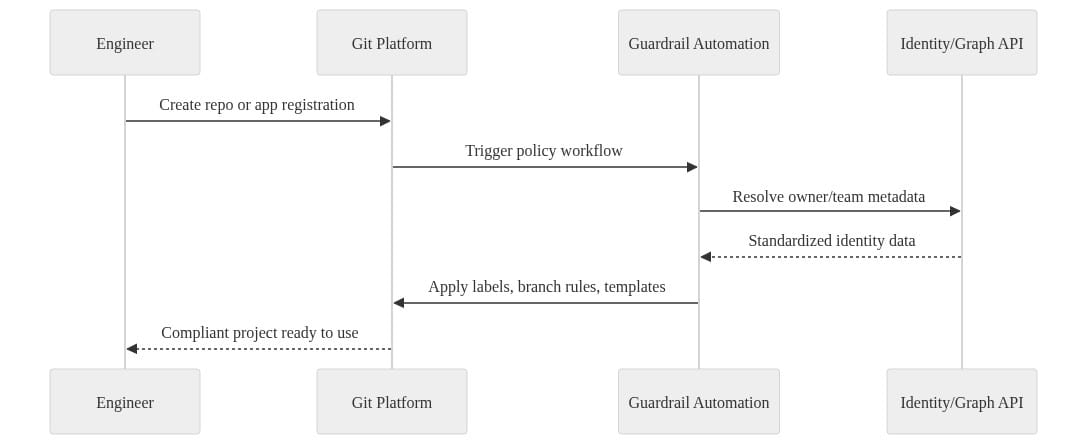
What to notice: this is the real enterprise AI story. Not “the model wrote a function.” The story is that clear interfaces plus guardrails plus identity context allow autonomous or semi-autonomous work to happen safely.
That is also why I wrote How Visual Studio Agent Skills can turn Copilot into a governed engineering assistant for enterprise teams. Good agents need good boundaries. Same as humans.
What senior leaders should change now
If you’re a CIO, CDO, VP Engineering, or platform lead, here’s the practical move set.
1. Fund platform product management, not just platform engineering headcount
A platform without product discipline turns into a backlog sponge. Someone must own the paved road, the adoption path, the deprecation story, and the feedback loop.
2. Measure compounding, not just output
Track:
- reuse across teams
- onboarding time to first compliant repo
- contribution cycle time
- dependency health
- percentage of services on standard templates
- exception rates to platform defaults
Ticket throughput is a weak metric. Reuse is stronger. Friction is stronger. Time-to-safe-contribution is stronger.
3. Standardize contribution policy across business units
Set explicit rules for:
- repo creation
- branch protection
- code owners
- dependency intake
- CI baselines
- release tagging
- secrets handling
- archival and deprecation
The rule should be simple: local autonomy is fine, but only after the shared controls are satisfied.
4. Use reference architectures and decision guides aggressively
This is how you reduce local reinvention without crushing teams. Give them approved patterns, not abstract principles. The architecture center model works because it narrows choices without blocking delivery.
5. Treat dependency governance like portfolio management
Every dependency has a cost curve:
- security exposure
- maintenance burden
- upgrade friction
- onboarding complexity
- AI usability
That portfolio needs active ownership.
The bottom line
GitHub’s collaboration graph is useful because it shows where engineering effort compounds. Not where people are loud. Not where branding is strong. Where interfaces are stable, workflows are reusable, and contribution paths are clear enough to attract sustained effort.
That is the blueprint for enterprise engineering over the next few years:
- inner-source as throughput
- platform engineering as leverage
- dependency governance as strategy
- AI delivery as an interface problem before it becomes a model problem
If your internal engineering system does not create contribution gravity, AI will not save it. It will just expose the mess faster.
Rate your organization from 1 to 5 on this specific question: how easy is it for an engineer from one team to make a safe, governed contribution to another team’s strategic repo in under a day?
#PlatformEngineering #Innersource #GitHub
Sources & References
- Azure Architecture Center - Azure Architecture Center
- AZ-400: Development for Enterprise DevOps - Training
- Microsoft Intune Enterprise Application Management - Microsoft Intune
- Microsoft Graph documentation
- Building Applications with GitHub Copilot Agent Mode - Training
- Platform engineering guide
- Overview of Fabric Git integration - Microsoft Fabric
Try it yourself
Run this tutorial as a Jupyter notebook: Download runbook.ipynb (21 cells, 15 KB).