Microsoft Fabric Local MCP as an Enterprise Agent Runtime
How Fabric Local MCP Could Turn Microsoft Fabric Into an Agent Runtime

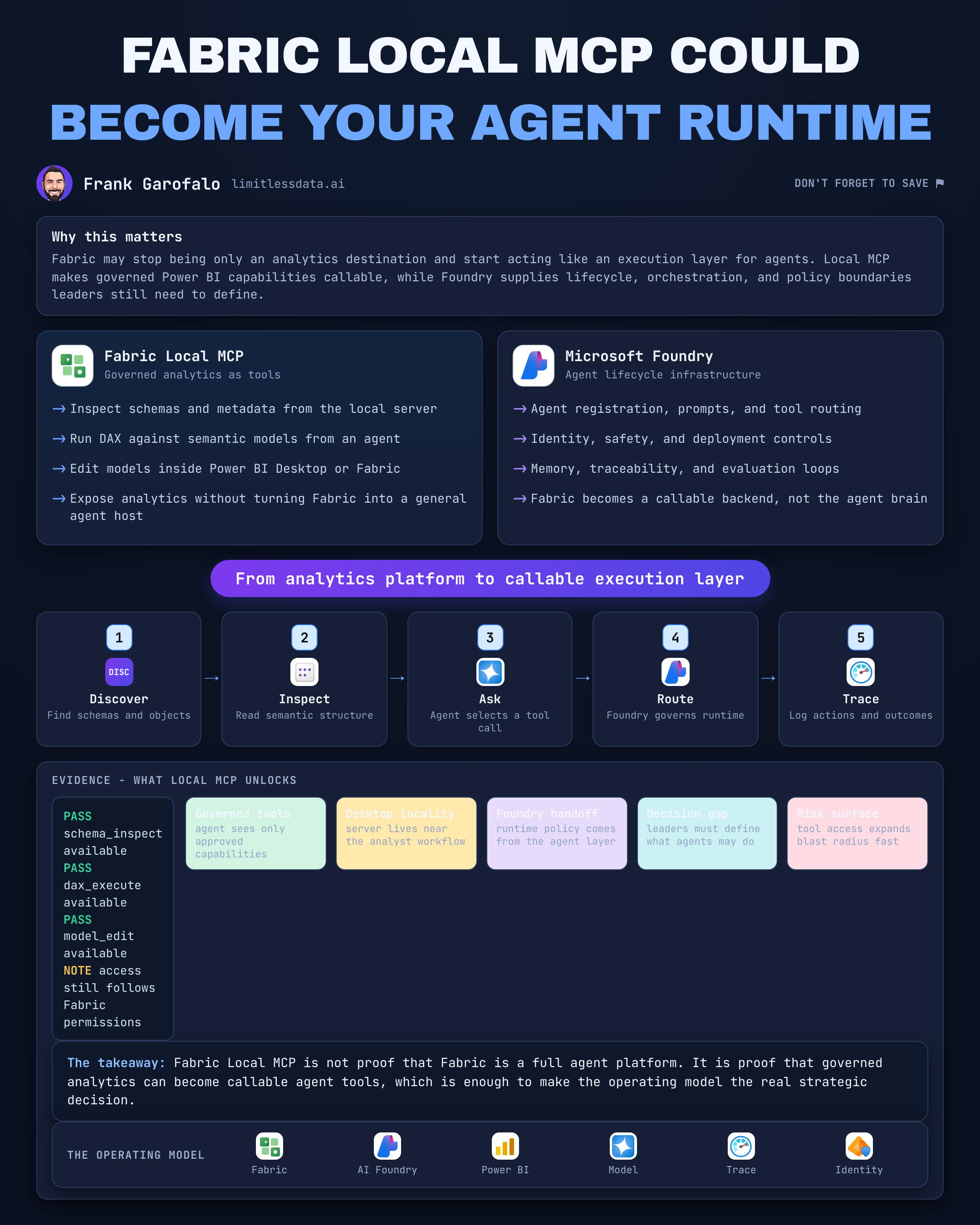
72 hours is enough to build a convincing Fabric agent demo. It is not enough to decide who owns the blast radius.
On this page
- The runtime argument is about tool access, not model hosting
- What Local MCP changes inside the Fabric estate
- The emerging Microsoft control plane
- Why local is both the accelerator and the constraint
- Governance has to follow the action surface
- A practical pilot that proves the architecture, not just the answer
- My opinionated takeaway for Fabric leaders
- Sources & References
That’s why Fabric Local MCP matters. The strategic value of Microsoft Fabric shifts the minute governed analytics capabilities become callable tools for agents, because now the semantic layer stops being a passive reporting asset and starts acting like an execution surface.
I’m bullish on this direction for one reason: Microsoft already has the pieces. Fabric is the unified analytics estate for organizational data and analytics workloads per the Microsoft Fabric docs. Power BI now exposes MCP options, including a local MCP server that lets an agent inspect schemas, run DAX, and edit semantic models in Power BI Desktop or Microsoft Fabric per the Power BI agentic overview. Foundry Agent Service gives you managed agent lifecycle and orchestration per the Foundry agents overview. Put those together and Fabric starts to look a lot less like “just the data platform” and a lot more like the governed execution layer behind analytics-aware agents.
The connector is not the runtime. The operating model is.
The runtime argument is about tool access, not model hosting
A lot of teams are asking the wrong question. They want to know whether Fabric is becoming “the” agent platform.
That’s not the useful frame.
For this discussion, an agent runtime is the governed environment where an agent gets context, decides which tool to call, executes an action, and returns an auditable result. You do not need Fabric to host the model to make Fabric strategically central. You need Fabric to expose governed capabilities an agent can actually use.
That distinction matters in the boardroom and in the lab.
In my home lab, I run this kind of split architecture constantly: reasoning layer in one place, execution surface in another, policy in the middle, logs everywhere. Same pattern on enterprise programs. Back in Q1, a 40-person BI and data engineering team I worked with had three copilots summarizing dashboards beautifully, but the first one that could actually run the right DAX against the semantic model made the others look like toys.
Here’s the architecture I’d put on the whiteboard for any CDO or platform lead evaluating this:
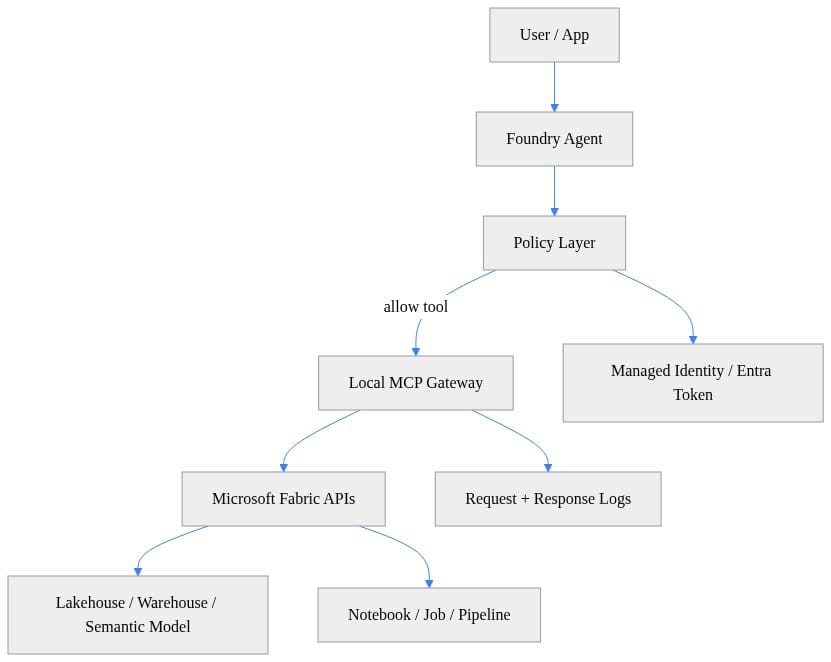
What to notice: the agent is not talking directly to Fabric with unlimited freedom. There’s a policy layer, an MCP boundary, identity, and logs. If you skip any one of those, you’re not building a runtime. You’re building a demo with a support ticket waiting to happen.
What Local MCP changes inside the Fabric estate
The important part of Local MCP is not “agents can query data.” We’ve had ways to query data forever.
The important part is where the tool surface sits.
The documented Power BI MCP capability set includes schema inspection, DAX execution, and semantic-model editing. That is a bigger deal than it sounds. Schema inspection tells the agent what exists. DAX execution lets it work through the business logic layer instead of bypassing it. Semantic-model editing crosses from retrieval into controlled change.
That last one is where executives need to stop smiling at the demo and start asking harder questions.
Read actions and write actions are not the same class of risk.
- Inspecting metadata is discovery.
- Running DAX is governed analytical execution.
- Editing a semantic model is change management.
If your architecture treats those as equivalent because they all arrive through “an MCP tool,” you’re going to create a governance mess fast.
I’ve written before about Fabric Local MCP for Governed Agentic Analytics, and this is the core point: the semantic model can become a tool surface for agents, not just a human-facing reporting artifact. That is strategically powerful because it preserves business meaning. It is also operationally dangerous if you let the agent mutate shared assets without approval boundaries.
The emerging Microsoft control plane
This is where the architecture starts to get interesting.
Fabric provides the analytics domain. Power BI MCP exposes selected analytics-aware tools. Foundry provides agent build, deployment, and scaling infrastructure. Microsoft IQ points toward a shared grounding layer across enterprise interactions per the Microsoft IQ docs.
That’s a real pattern, not marketing vapor.
Foundry documentation explicitly supports connecting agents to MCP server endpoints and even points to Fabric data agents added through the Fabric IQ tool as an MCP-tool example per the Foundry MCP tools guidance. That means the integration path is already visible: agent lifecycle in Foundry, governed analytics capabilities surfaced through MCP, organizational grounding expanding through IQ and Fabric-aware assets.
I would not describe this as one finished monolithic platform. Microsoft rarely wins that way anyway. It wins by making the seams usable enough that enterprises standardize around them.
That’s the real executive decision here: do you want the seam between agent orchestration and analytics execution to be explicit and governed, or hidden inside custom glue code that nobody can support in 18 months?
Why local is both the accelerator and the constraint
Local MCP is exactly the kind of thing that gets traction because it meets people where they work.
Analysts, BI developers, semantic model owners, and solution architects can experiment close to Power BI Desktop or Fabric workflows. That shortens the path from “interesting idea” to “working tool call.” Good. You want that.
But local also means local.
The Power BI MCP documentation distinguishes between a Fabric-hosted service and a locally hosted option, with different transport and authentication approaches including Entra ID and service principal patterns per the Power BI MCP servers overview. That one sentence should change how you evaluate every pilot.
Because “it worked on Sarah’s machine” is not an enterprise runtime.
Local raises six questions immediately:
- Which identity is actually being used?
- Which machine is part of the trusted boundary?
- What network path exists between the agent and the MCP endpoint?
- How do you reproduce the environment?
- Where do request and response logs live?
- Who supports it at 2:13 AM when the CFO’s refresh workflow breaks?
Here’s the simplest preflight pattern I’d use before letting any team call a Local MCP pilot “ready”:
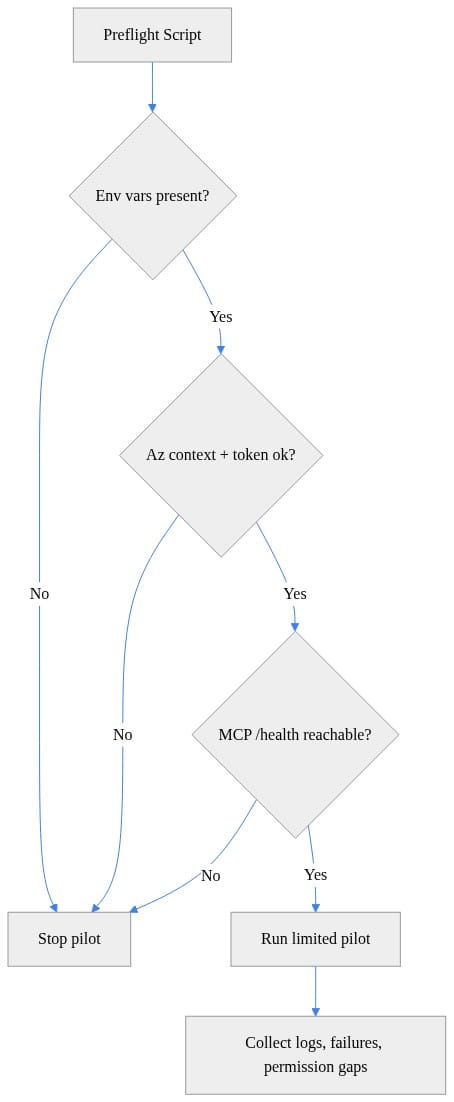
What to observe: this is boring on purpose. Environment variables, token acquisition, endpoint health, then a limited pilot. That’s how grown-up platforms get built. Not with a slick demo video and a prayer.
If you want a more detailed production checklist mindset, I covered that in my Microsoft Foundry Agent Governance Production Checklist. Same lesson: tool connectivity is the easy part. Ownership is the hard part.
Governance has to follow the action surface
This is the section leaders skip, and it’s the one that decides whether the whole thing survives contact with internal audit.
Governance should map to what the agent can actually do.
1. Metadata inspection
Low risk compared with write operations, but still not free. Metadata can reveal sensitive structures, business definitions, and model design choices. Scope it.
2. DAX execution
This is where the value starts. An agent can answer business questions using the same semantic logic your analysts trust. That’s exactly why it needs controls around workspace scope, allowed models, identity, and logging.
3. Semantic-model editing
This is a different approval class entirely. Once an agent can change measures, relationships, descriptions, or model structure, you are in change-control territory. Rollback, peer review, deployment path, and accountable ownership are mandatory.
A lightweight policy gate makes the point better than another paragraph:
# Minimal policy gate for MCP tool permissions before an agent can call Fabric actions
from typing import Iterable

ALLOWED_BY_ROLE = {
    "analyst": {"fabric.query_sql"},
    "operator": {"fabric.query_sql", "fabric.run_notebook", "fabric.refresh_model"},
}

def authorize(role: str, requested_actions: Iterable[str]) -> bool:
    granted = ALLOWED_BY_ROLE.get(role, set())
    return set(requested_actions).issubset(granted)

role = "operator"
requested = ["fabric.query_sql", "fabric.run_notebook"]

if authorize(role, requested):
    print("Authorized MCP tool actions:", requested)
else:
    raise PermissionError(f"Role '{role}' cannot use actions: {requested}")
What to notice: permissions are tied to actions, not vague role names alone. That’s the right design pattern. “Can use MCP” is not a permission model. “Can invoke fabric.query_sql but not fabric.refresh_model” is.
Foundry can manage agent deployment and scale. That does not magically solve Fabric-side authorization, semantic model stewardship, or change approval. If your platform team assumes the agent service owns all downstream governance, they’re outsourcing responsibility to a product boundary that doesn’t carry it.
I’d assign four named owners before production:
- Agent lifecycle owner
- Fabric asset owner
- Semantic model change owner
- Identity and app registration owner
No named owner, no production cutover.
A practical pilot that proves the architecture, not just the answer
If I were standing up a first implementation this month, I would not start with autonomous model editing. I’d start with a narrow workflow where success is measurable and the human already knows how to do the task manually.
A good first scenario:
- Agent inspects a semantic model schema
- Agent runs approved DAX against a known workspace
- Agent returns a user-safe summary
- Human approves any follow-on action
That lets you test the actual architecture:
- Is the tool scope correct?
- Is the identity path stable?
- Are logs usable?
- Are failures understandable?
- Does the answer respect the semantic layer rather than bypassing it?
Here’s a conceptual invocation pattern showing how I think about tool wiring, allowed actions, and response handling:
# Conceptual Foundry agent invocation with MCP tool wiring, permissions, logging, and response handling
from dataclasses import dataclass
from typing import Any, Dict

@dataclass
class MCPToolConfig:
    name: str
    endpoint: str
    allowed_actions: list[str]
    log_requests: bool = True

tool = MCPToolConfig(
    name="fabric-local-mcp",
    endpoint="http://localhost:8080/mcp",
    allowed_actions=["fabric.query_sql", "fabric.run_notebook"]
)

agent_request: Dict[str, Any] = {
    "agent": "fabric-ops-agent",
    "input": "Summarize yesterday's sales and refresh the semantic model.",
    "tools": [{"type": "mcp", "config": tool.__dict__}],
    "response_mode": "json"
}

print("Attach policy checks before invocation:", tool.allowed_actions)
print("Send request to Foundry agent runtime:", agent_request)
print("Log request/response IDs and redact secrets before persistence.")

# Then, handle response: separate raw tool output from the user-safe summary,
# treat retryable errors differently from escalation paths, and never expose
# operational details directly to the end user without filtering.
That separation matters more than people think. Tool output is operational truth. User summary is communication. Mixing them carelessly is how you end up with confident nonsense or accidental data leakage.
My opinionated takeaway for Fabric leaders
Fabric Local MCP could absolutely turn Microsoft Fabric into a practical execution layer for analytics-aware agents.
Not because Fabric suddenly becomes a general-purpose agent platform overnight.
Because agents can invoke governed analytics capabilities where the business meaning already lives, while Foundry handles agent construction and lifecycle. That is the right split. It preserves the value of the semantic layer instead of routing around it.
But here’s the line I’d hold in every steering committee:
Do not mistake an MCP-enabled connector for an enterprise runtime.
The opportunity is real. The architecture boundary is your decision. The governance boundary is your job.
If you get those right, Fabric becomes much more than a destination for reports and pipelines. It becomes the governed action surface for agents that need to reason with enterprise analytics instead of hallucinating around them.
If you get them wrong, you’ll have a pile of local prototypes, five different identity patterns, no audit trail, and one ugly incident the first time an agent edits a shared model without anyone knowing.
And yes, I think this direction gets even more interesting as Microsoft keeps building the intelligence layer around Fabric and shared organizational grounding. I touched on that in Microsoft Fabric IQ for Governed Semantic Analytics. The shape is there. The hard part now is operational discipline.
Rate your organization from 1 to 5 on this specific question: if an agent edits a semantic model through MCP tomorrow, do you already know who approves it, who logs it, and who rolls it back?
#MicrosoftFabric #AIAgents #Datagovernance
Sources & References
- Microsoft Fabric documentation - Microsoft Fabric
- Microsoft Foundry documentation
- Power BI Agentic Overview - Power BI
- What are the Power BI MCP servers? - Power BI
- Introduction to end-to-end analytics using Microsoft Fabric - Training
- What is Microsoft Foundry Agent Service? - Microsoft Foundry
- Course DP-600T00-A: Implement analytics solutions using Microsoft Fabric - Training
- Connect agents to MCP server endpoints - Microsoft Foundry
- Study guide for Exam AB-620: Designing and Building Integrated AI Solutions in Copilot Studio
- Microsoft IQ documentation
Try it yourself
Run this tutorial as a Jupyter notebook: Download runbook.ipynb (29 cells, 23 KB).