Azure Agent Resilience Testing for Production Readiness
If you want agents that survive the real world, start testing them in hostile environments


“A CIO asked me last week: if the agent aces the benchmark, why are you still blocking production?” Because Echoverse (a popular AI agent simulator) should be a warning, not a novelty: an agent can look brilliant in a clean harness and still fold the minute tools, identity, context, or infrastructure get weird.
On this page
- Benchmarks are admission tests, not production proof
- Convenient agent creation has widened the production-proof gap
- The hostile environment is the real test surface
- A small hostile harness beats a giant slide deck
- Turn resilience into release gates
- Demand platform evidence, not agent assurances
- Build an operating model that makes unsafe autonomy expensive
- The standard to set before the next rollout
- Sources & References
That gap is where enterprise incidents live.
If you want agents that survive the real world, start testing them in hostile environments. Benchmark scores are admission tests. They are not production evidence. Before an agent gets meaningful autonomy, I want proof that it can fail safely, preserve auditability, and recover when the enterprise around it degrades.
Benchmarks are admission tests, not production proof
A benchmark answers one narrow question: can the agent complete a task under known conditions?
Production asks nastier questions:
- What happens when the tool times out on the third hop?
- What happens when Entra permissions narrow mid-session?
- What happens when the grounding context is stale by 20 minutes?
- What happens when the output schema drifts and the agent keeps retrying?
- What happens when the right answer is “stop, escalate, and leave evidence”?
That last one is the one everybody skips.
I’ve watched teams celebrate a 90%+ task-completion run and then discover they had no answer for bounded retries, no rollback path, and no useful trace once the agent hit a permission edge. One platform team I worked with had an internal procurement agent pass a controlled eval and then dead-loop on a downstream 403 because the fallback path treated authorization denial like a transient network fault.
Capability testing tells you whether the agent can do the job.
Resilience testing tells you what it does when it can’t.
Those are different disciplines. Treating them as the same thing is how you end up with polished demos and ugly postmortems.
Convenient agent creation has widened the production-proof gap
This is why the current tooling wave is both useful and dangerous.
Agent Builder in Microsoft 365 Copilot is explicitly positioned as an immediate, interactive way to build quick declarative agents for straightforward projects, per the Agent Builder docs. Copilot Studio is also designed so organizations can quickly create agents for employee and customer scenarios, as described in the Microsoft training module.
That speed is a feature.
I’m not arguing against it. I’m arguing against confusing ease of creation with readiness for autonomy.
The easier it gets to create an agent, the more disciplined the release gates must become. Otherwise every business unit can spin up something that looks helpful in a workshop and nobody can answer the real operating questions:
- Which tools can it call?
- What identities does it rely on?
- What happens on denial, timeout, or malformed output?
- Can we reconstruct every action after the fact?
- Can we disable it in minutes, not meetings?
Microsoft’s own hosted-agent guidance spells out the operational reality: containerization, web server setup, security, memory persistence, scaling, instrumentation, and version rollbacks are all part of the job, per the Microsoft Foundry hosted agents guidance. That list is the point. Shipping an agent is not just prompt design with a prettier UI.
If you want the longer platform view, I wrote about this directly in Foundry Hosted Agents as a deployment model for enterprise platform teams.
The hostile environment is the real test surface
Here’s the test surface I care about before autonomy expands:
- Unavailable tools
- Authorization denial or narrowed scope
- Latency spikes and budget overruns
- Malformed or schema-drifted outputs
- Missing, stale, or partial context
- Adversarial multi-turn prompt chains
- Dependency degradation in the data plane
Why these? Because each one changes behavior in ways that benchmarks hide.
A timeout can become a retry storm.
A 403 can become an unsafe fallback if the agent decides to “try another route.”
Malformed tool output can get interpreted as empty success.
Missing context can produce fake confidence, which is worse than a clean failure.
And grounding is not static magic dust you sprinkle on the architecture diagram. Microsoft describes Work IQ as an intelligence layer grounding Copilot and agents in real-time shared organizational context, per the tooling and servers overview. Good. That means context freshness and availability are operational dependencies. Test them like dependencies, not like marketing claims.
Here’s the mental model I use with teams: inject one hostile condition per path first, then combine them.
Start simple:
- timeout only
- auth denied only
- malformed payload only
Then stack them:
- latency spike followed by malformed payload
- stale context plus narrowed authorization
- successful read followed by failed write authorization
This flow is what I want every team to visualize before they ask for autonomy:
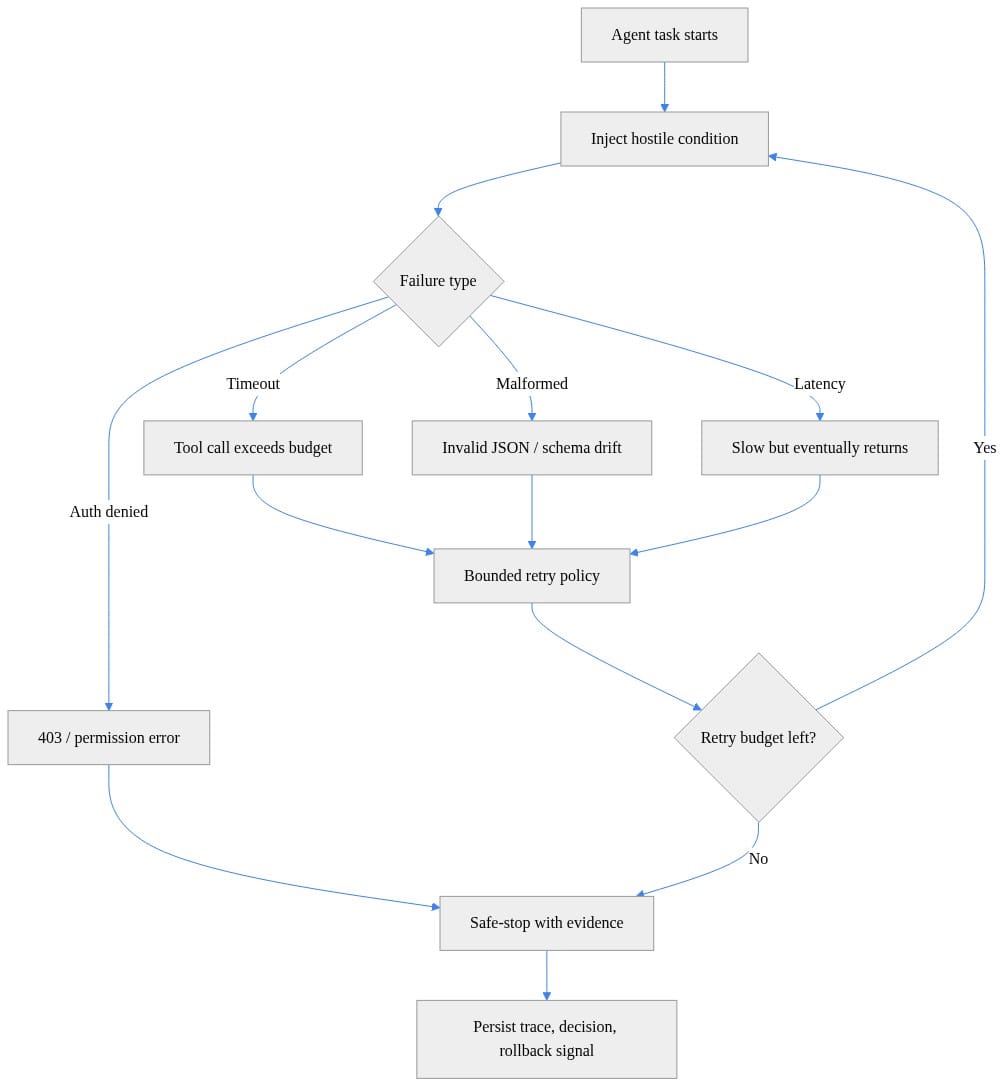
What to observe: every failure path ends in bounded behavior and persisted evidence. If your path diagram ends with “agent keeps trying” or “agent decides another tool,” you have work to do.
A small hostile harness beats a giant slide deck
You do not need a moonshot framework to start. You need a harness that can inject ugliness on purpose.
In my home lab, I do this constantly on a Proxmox cluster with a few disposable services behind an API gateway because clean environments lie. In enterprise, the same principle applies: make failure modes cheap to simulate before they become expensive to explain.
Here’s a tiny Python simulator that gives you four useful failure classes: timeout, auth denial, malformed output, and latency.
# Compact hostile-environment tool simulator for timeout, auth denial, malformed output, and latency.
import json, random, time

def hostile_tool(mode: str) -> str:
    if mode == "timeout":
        time.sleep(0.2)
        raise TimeoutError("tool exceeded deadline")
    if mode == "auth":
        raise PermissionError("403 forbidden")
    if mode == "malformed":
        return "{bad-json"
    if mode == "latency":
        time.sleep(0.15)
        return json.dumps({"status": "ok", "delay_ms": 150})
    return json.dumps({"status": "ok", "delay_ms": 5})

for mode in ["ok", "timeout", "auth", "malformed", "latency"]:
    try:
        print(mode, "=>", hostile_tool(mode))
    except Exception as e:
        print(mode, "=>", type(e).__name__, str(e))
What to observe: the tool surface is unstable by design. That is the point. Your agent runtime should treat those outcomes differently, not flatten them into generic “error handling.”
Next, wrap it with a bounded-retry runner that records evidence and safe-stop reasons.
# Bounded-retry runner that captures evidence and safe-stop decisions under hostile conditions.
import json, time

def run_with_guard(tool, mode: str, max_retries: int = 2) -> dict:
    evidence = {"mode": mode, "attempts": [], "safe_stop": False}
    for attempt in range(1, max_retries + 2):
        started = time.time()
        try:
            raw = tool(mode)
            parsed = json.loads(raw)
            evidence["attempts"].append({"n": attempt, "result": "success", "ms": int((time.time()-started)*1000)})
            evidence["output"] = parsed
            return evidence
        except (TimeoutError, json.JSONDecodeError) as e:
            evidence["attempts"].append({"n": attempt, "result": type(e).__name__})
            if attempt > max_retries:
                evidence["safe_stop"] = True
                evidence["reason"] = "retry_budget_exhausted"
                return evidence
        except PermissionError as e:
            evidence["attempts"].append({"n": attempt, "result": "PermissionError"})
            evidence["safe_stop"] = True
            evidence["reason"] = "authorization_denied"
            return evidence
    return evidence
What to observe: timeout and malformed output can retry within a budget; authorization denial should stop immediately; every branch leaves evidence. That separation matters. Too many teams retry permission failures like they’re packet loss.
Turn resilience into release gates
This is where opinion becomes operating model.
Resilience is not a nice-to-have test category. It is a release gate.
My minimum gate set for any autonomous action path looks like this:
- Bounded retry behavior with explicit max attempts
- Distinct handling for timeout, malformed response, and authorization denial
- Human confirmation rules for high-impact actions
- Trace completeness for prompt, tool call, identity, decision, and result
- Kill switch or disable path
- Rollback condition that is observable, not theoretical
A scenario that cannot be observed, attributed, and reversed is not ready for autonomous execution. Full stop.
You can make this concrete with a tiny release-state document and promotion logic. First, stamp the version and initialize the resilience state:
# Record a deployment version and initialize a resilience status document for release control.
param(
    [string]$AppName = "agent-service",
    [string]$Version = "2026.08.04.1",
    [string]$StatePath = ".\release-state.json"
)

$state = [ordered]@{
    app = $AppName
    version = $Version
    deployedAtUtc = (Get-Date).ToUniversalTime().ToString("o")
    approvalGate = "Pending"
    resiliencePassed = $false
    action = "None"
}

$state | ConvertTo-Json -Depth 4 | Set-Content -Path $StatePath -Encoding utf8
Get-Content $StatePath
Then evaluate resilience results and choose the action: promote, rollback, or disable.
# Resilience criteria evaluation that triggers a predefined rollback or disable action on failure.
param(
    [int]$TimeoutFailures = 2,
    [int]$AuthFailures = 1,
    [int]$MalformedFailures = 1,
    [string]$StatePath = ".\release-state.json"
)

$state = Get-Content $StatePath -Raw | ConvertFrom-Json
$resiliencePassed = ($TimeoutFailures -le 1) -and ($AuthFailures -eq 0) -and ($MalformedFailures -eq 0)

$state | Add-Member -NotePropertyName resiliencePassed -NotePropertyValue $resiliencePassed -Force
if (-not $resiliencePassed) {
    $state.action = if ($AuthFailures -gt 0) { "Disable" } else { "Rollback" }
} elseif ($state.approvalGate -like "Approved*") {
    $state.action = "Promote"
}

$state | ConvertTo-Json -Depth 4 | Set-Content -Path $StatePath -Encoding utf8
$state
And if you want the operational follow-through, wire the chosen action to your deployment target. This stub shows the pattern for rollback or disable in an Azure-oriented flow:
# Azure-oriented rollback/disable stub using CLI commands selected from the recorded release state.
param(
    [string]$ResourceGroup = "rg-demo",
    [string]$ContainerApp = "agent-api",
    [string]$StatePath = ".\release-state.json"
)

$state = Get-Content $StatePath -Raw | ConvertFrom-Json
switch ($state.action) {
    "Rollback" {
        Write-Host "az containerapp revision list -g $ResourceGroup -n $ContainerApp"
        Write-Host "az containerapp ingress traffic set -g $ResourceGroup -n $ContainerApp --revision-weight stable=100 latest=0"
    }
    "Disable" {
        Write-Host "az containerapp update -g $ResourceGroup -n $ContainerApp --set-env-vars AGENT_ENABLED=false"
    }
    default {
        Write-Host "No remediation required for version $($state.version)"
    }
}
What matters here is simple: failed resilience should trigger a predefined action, not a committee discussion. If your rollback story starts with “we’d have to figure that out,” you don’t have a rollback story.
I covered the governance side of this in Microsoft Foundry Agent Governance Production Checklist and the operational control plane angle in Azure API Management AI Gateway for Enterprise Governance.
Demand platform evidence, not agent assurances
This is the part platform leaders need to own.
Do not ask the app team, “Do you feel good about the agent?”
Ask for the evidence package:
- version and deployment identity
- tool dependency list
- identity and permission scope
- hostile test results by failure class
- trace samples
- escalation path
- rollback record
- data dependency health assumptions
That last one matters more than people admit. Microsoft Fabric is positioned as a unified platform for enterprise data and analytics, per the Fabric overview. If your agent depends on that shared data plane, then freshness, lineage, and dependency health are part of production validation. An agent grounded on stale enterprise data can be perfectly “capable” and still operationally wrong.
Security has to be handled the same way. Microsoft’s security stack is built around Zero Trust principles, including workload and AI protection with Defender for Cloud, per the Microsoft Security documentation. Good. Apply that mindset to agents: narrowly scoped access, continuously evaluated, no durable broad credentials, no mystery service identities wandering across systems.
An agent should earn every permission it gets.
Build an operating model that makes unsafe autonomy expensive
Here’s the division of labor that actually works:
Product teams
- own behavior
- own scenario coverage
- own action semantics
- own customer impact
Platform engineering
- owns the hostile harness
- owns observability
- owns release controls
- owns rollback and disable mechanisms
Security and governance
- own identity policy
- own exception review
- own audit requirements
- own blast-radius thresholds
Then use progressive autonomy.
Start with recommendation-only.
Move to human-confirmed actions.
Expand to bounded autonomous actions only after the hostile gates pass repeatedly under changing conditions.
That progression matters because environment drift is constant. Tool contracts change. Permissions tighten. Data products get delayed. APIs return a different shape on Tuesday than they did on Friday. Those are not excuses after an incident. Those are release-relevant events.
What you need is a repeatable decision record showing why this specific agent was allowed to take this specific class of action under these specific controls.
That’s what stands up in front of an audit team. That’s what survives a bad day.
The standard to set before the next rollout
The next time somebody shows you a benchmark chart and asks for broader autonomy, ask the harder question:
How does this agent behave when the enterprise around it becomes unreliable?
Not in theory. In a harness. With evidence.
That is the standard.
Fund hostile-environment validation the same way you fund identity, observability, and rollback. Treat it as production infrastructure. Because it is. Microsoft’s own architecture guidance for agentic business solutions includes requirements analysis, strategy design, and cost evaluation in the delivery motion, per the architecture learning path. Add hostile validation to that stack and make it non-negotiable.
Echoverse is interesting for about five minutes.
What matters in enterprise is whether the agent remains governable when tools fail, context drifts, permissions narrow, and dependencies wobble.
That’s the bar I’d set on every Azure team shipping agents with real authority.
Rate your team’s current hostile-environment validation from 1 to 5: are you still proving capability, or are you actually proving safe failure and recovery?
#AzureAI #EnterpriseAI #DataArchitecture
Sources & References
- Microsoft 365 Copilot hub
- Agent Builder in Microsoft 365 Copilot
- Get started with Microsoft Copilot Studio - Training
- Microsoft Fabric documentation - Microsoft Fabric
- Architect AI Solutions For Business Productivity - Training
- Security hub - Security
- Hosted agents in Foundry Agent Service - Microsoft Foundry
- Copilot Studio Agent Academy
- Transform Your Everyday Business Processes with Agents MS-4019 - Training
- Work IQ MCP overview (preview)
Try it yourself
Run this tutorial as a Jupyter notebook: Download runbook.ipynb (32 cells, 25 KB).